
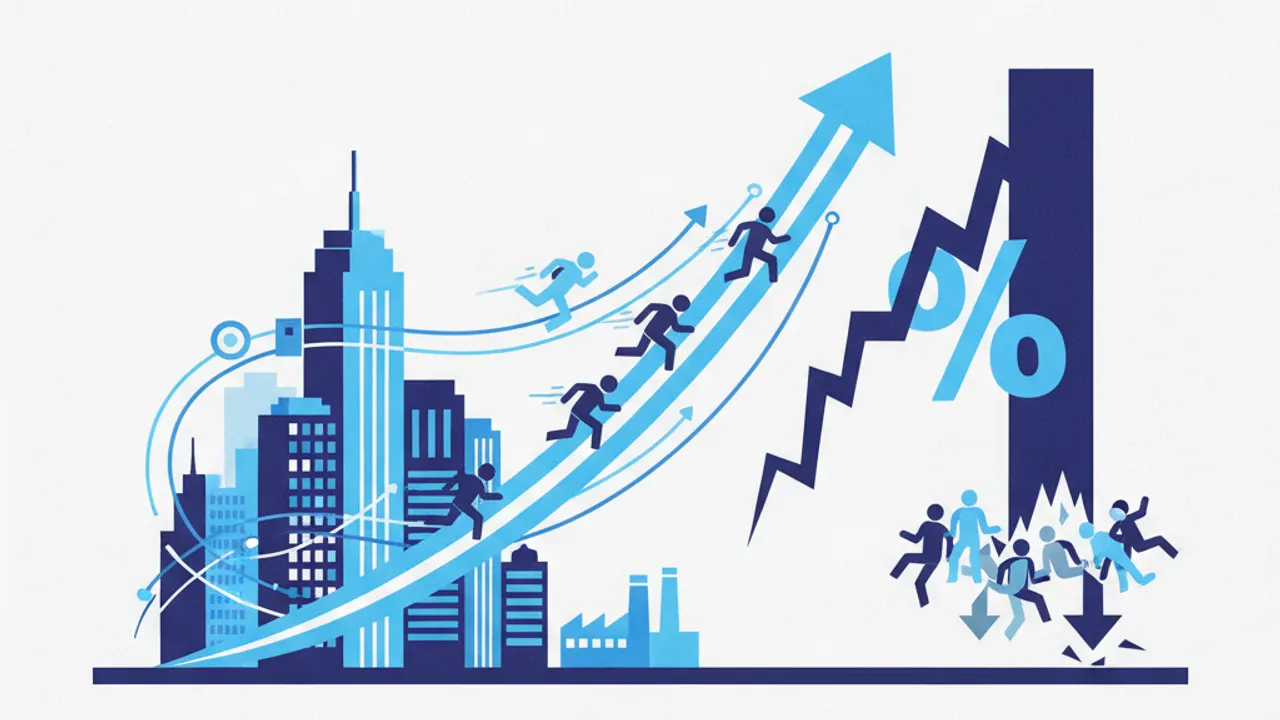
On September 22, 2026, the Department of Economic Affairs of the Canton of Zurich and the Zurich University of Applied Sciences (ZHAW) released a joint study examining the economic impact of generative artificial intelligence. Drawing on comprehensive data from the cantonal Office for Economy and Office for Labor, the analysis provides fresh empirical insights into a leading European financial and service center. The findings reveal a stark divergence: while generative tools promise a historic acceleration in regional economic output, the regional white-collar labor market is already experiencing severe structural strains.
At the core of the macroeconomic modeling lies an unprecedented gain in corporate efficiency. According to the ZHAW researchers, the broad deployment of generative AI carries the potential to add 1.1 percent in annual productivity growth over the next ten years. For the knowledge-intensive hub of Zurich, this projection represents an exact doubling of its historical productivity trend. Automated document processing, generative software coding assistants, and streamlined back-office operations serve as the primary drivers behind this anticipated acceleration.
However, this macroeconomic promise is offset by an alarming divergence across regional employment registries. Between October 2022 and June 2026, the number of registered job seekers across occupations heavily exposed to AI surged by 118 percent. This sharp rise concentrated primarily in software engineering, advertising and marketing, as well as clerical office work. By comparison, occupations with low AI exposure saw job seekers rise by merely 13 percent over the same period, highlighting an acute labor market asymmetry.
Crucially, the cantonal study distinguishes between routine task execution and complementary oversight functions. While standard cognitive execution tasks face heavy displacement pressure, total employment in complementary professions continued to expand. Executive leadership positions, engineering disciplines, and architectural specialists recorded sustained employment gains across the canton. The authors conclude that businesses leverage automated tools to eliminate operational bottlenecks, thereby shifting capital toward strategic planning, complex engineering, and operational control.
The empirical results from Zurich provide concrete evidence of how technological restructuring unfolds across advanced knowledge economies. Public employment agencies, educational institutions, and corporate leaders face urgent pressure to realign training programs with changing organizational demands. The investigation confirms that generative AI is not causing broad-based mass layoffs, but is rather triggering a targeted polarization that leaves mid-level administrative and creative roles under intense structural pressure.