
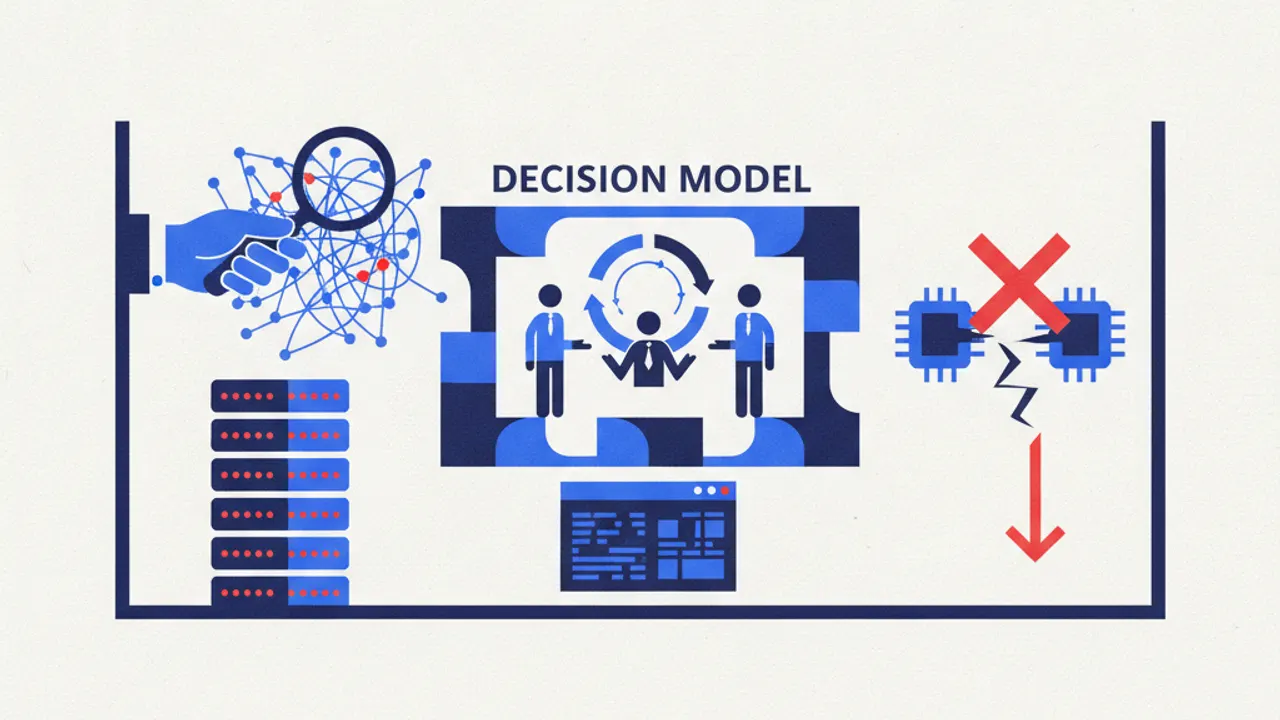
The gap between benchmark scores and the messy reality of production software engineering is becoming impossible to ignore. In the inaugural episode of the High Taste Testers roundtable hosted by Latent Space, engineers including Swyx, Alex Volkov, and Dex Horthy examined the operational bottlenecks that plague autonomous systems. Rather than celebrating theoretical capabilities, the panel focused on the failure modes that emerge when teams attempt to run software agents at scale. Their consensus highlights that agentic utility is currently constrained not by raw intelligence, but by verification limits and brittle architectures.
A primary focus of the discussion centered on what the panelists termed the verification crisis in autonomous coding. When development teams deploy agents in unbounded coding loops overnight, the failure point is rarely the model's ability to generate syntactically correct code. Instead, teams arrive the next morning only to drown in hundreds of automatically generated pull requests that require human inspection. Because engineers cannot realistically review such enormous volumes of code, the promised productivity gains quickly dissolve into human operational paralysis. Without robust automated validation layers, unconstrained agent loops create more organizational drag than value.
Beyond review bottlenecks, the panel pinpointed memory drift as a critical vulnerability in persistent agentic assistants. In real-world enterprise deployments, agents frequently suffer from context loss across distributed client sessions. This subtle degradation of state and history leads to inconsistent decisions, hallucinated constraints, and hard-to-diagnose regressions in production environments. For engineering organizations seeking deterministic behavior, the inability of modern agents to maintain stable session context remains a major roadblock to autonomous workflows.
To keep operational costs under control, engineering teams are responding with a fundamental shift in architecture. Rather than relying on expensive frontier reasoning models for every stage of a task, developers are adopting specialized decision models. These compact classifiers and routing models are engineered specifically to evaluate conditional branches and execute decision trees. By isolating simple routing logic from complex synthesis, systems can drastically reduce latency while preserving the reasoning capacity of larger models for tasks that genuinely require it.
The panelists highlighted concrete examples of this emerging category, including Liquid d1-ultra, Perplexity pplx-decider, and TypeSafe's Jev. These specialized routing components achieve a 10-fold to 20-fold reduction in token costs compared to full-scale frontier models. Deploying such targeted classifiers enables teams to design multi-agent workflows without driving inference budgets to unsustainable levels. This architectural evolution signals a decisive move away from monolithic model calls toward modular networks composed of lean, purpose-built engines.
The insights from the roundtable demonstrate that building reliable agentic software requires pragmatic engineering rather than benchmark optimism. The viability of autonomous agents will not be decided by incremental gains on public leaderboards, but by the rigor of review pipelines, verification tooling, and cost-effective routing. For technical leaders, this requires shifting focus from prompt engineering toward building robust middleware and verification infrastructure. Until evaluation and testing mechanisms can match the raw velocity of automated generation, agent deployments will remain strictly bounded by human review capacity.