
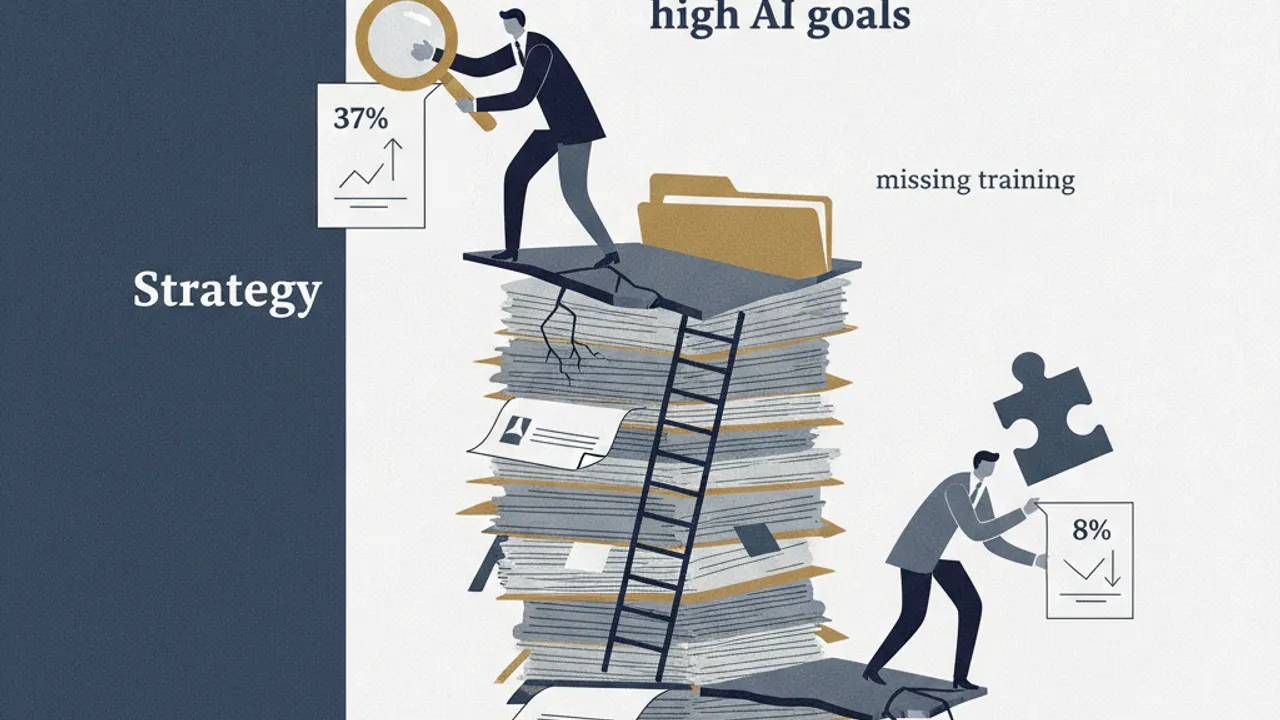
The disparity between strategic ambition and operational reality defines the current corporate adoption of artificial intelligence. According to the global study Voice of Our Clients 2026 released on September 2, 2026, by IT services provider CGI, 37 percent of surveyed enterprises have formulated an organization-wide AI strategy. However, actual operational adoption remains low, with only eight percent of companies successfully deploying these initiatives across their entire organizational ecosystem. CGI gathered these findings through interviews with more than 1,800 business and technology leaders worldwide, predominantly from the C-suite, including a dedicated focus on the DACH region. The data paints a clear picture of enterprises that design high-level roadmaps yet struggle to transition them into everyday business operations.
A principal cause for stagnation following initial experimentation lies buried within existing corporate IT environments. A striking 52 percent of the executives polled by CGI cited legacy IT and data infrastructures as the single greatest barrier preventing AI from scaling beyond isolated pilot projects. Decades of fragmented software architectures significantly complicate the seamless integration of modern foundational models. At the same time, systematic financial governance remains weak across the private sector. Only 55 percent of participating organizations consistently measure and quantify the outcomes and return on investment of their AI implementations.
Findings from the 2026 State of AI for Business Report published in late August 2026 by SmarterX confirm that operational friction extends far beyond legacy code. Surveying more than 2,100 professionals and leaders across multiple industries, the study identified organizational deficits as primary roadblocks to progress. Specifically, 38 percent of respondents pointed to an acute lack of systematic education and training programs within their companies. Furthermore, 35 percent reported a lack of basic technological understanding among their teams, while 30 percent cited severe time constraints that prevent staff from familiarizing themselves with new tools.
This widespread lack of workforce enablement stands in stark contrast to the urgent strategic importance assigned to AI by executive suites. In the SmarterX survey, 74 percent of participants categorized AI as very important or mission-critical for business success over the coming 12 months, a figure that climbed to 89 percent among chief executives and founders. Meanwhile, employees express a notable contradiction between macroeconomic concerns and individual confidence. While 71 percent believe artificial intelligence will eliminate far more jobs than it creates on a macro scale, only 20 percent fear for their personal employment. In contrast, merely 13 percent of respondents anticipate a net increase in total jobs.
To bridge this acute internal execution gap, enterprises are increasingly turning toward external partners. According to CGI, 29 percent of C-level leaders plan to expand their reliance on managed services models over the next three years to offset internal integration deficits. The convergence of rigid legacy infrastructure and untrained workforces forces leadership teams to purchase technical execution capacity from specialized vendors. Unless companies systematically modernize their core data architectures and invest in foundational team upskilling, ambitious corporate AI agendas risk remaining trapped in expensive dependencies without generating sustainable internal value.