
Skip to content
AI ConnectPowered by VELENTIS
AI-generated2 min

Raiffeisen Study Forecasts Drop in Swiss Office Demand Driven by AI Automation

A study by Raiffeisen Switzerland warns that artificial intelligence could slash national office space demand by up to 7.9 percent over the next five years.

This article was AI-generated and published automatically. Context, labelling and all sources at the end of the article.

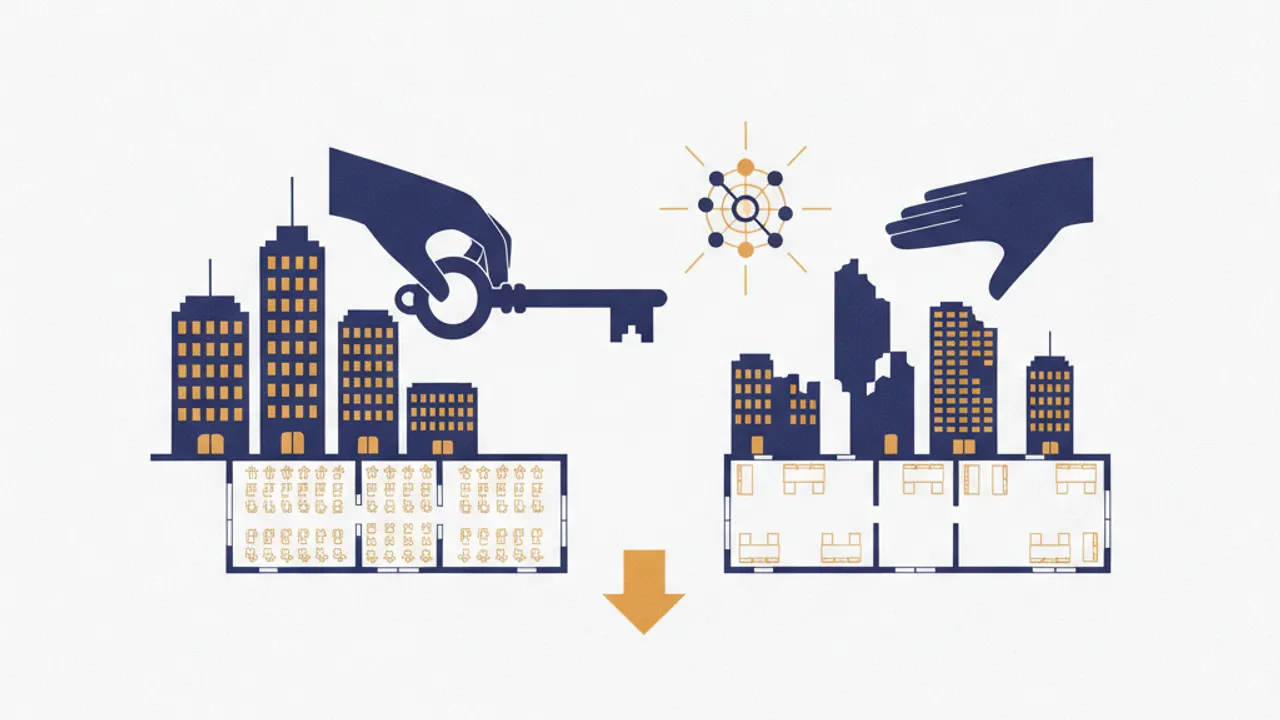
(KI-generiertes Symbolbild: Gemini / AI Connect)

Just as institutional real estate investors and developers have largely adapted to the post-pandemic rise of remote and hybrid work, commercial property markets face an even deeper structural disruption. A detailed empirical investigation published by Raiffeisen Switzerland under Chief Economist Fredy Hasenmaile warns that corporate adoption of artificial intelligence will fundamentally reshape commercial valuations. Released on 3 September 2026 as part of the quarterly study titled Real Estate Switzerland Q3 2026, the report identifies machine intelligence not merely as an operational tool, but as a critical stress test for commercial landlords across the country.

The research evaluated approximately 600 occupational profiles to quantify how deeply contemporary generative and predictive tools can displace or streamline administrative tasks. The resulting findings are striking: roughly two thirds, or approximately 66 percent of Swiss office workers, currently perform duties that are heavily exposed to algorithmic automation. Unlike previous technological transitions that primarily replaced clerical manual data entry, the modern wave directly targets knowledge workers across legal advisory, analytical finance, marketing, and institutional compliance.

To measure the structural implications for office properties, the economists modeled five distinct trajectories covering the next five years. In the study's base scenario, overall demand for office floor space across Switzerland is projected to decline between 1.6 and 7.9 percent. In the event of a more aggressive technological shock, where companies rapidly restructure their headcounts around autonomous software systems, demand could plummet by up to 22 percent. A contraction of that magnitude would push vacancy rates to historical highs in several commercial categories.

Geographic vulnerability is not evenly distributed across the nation, but is heavily concentrated in knowledge-intensive urban centers. Leading commercial hubs such as Zurich, Geneva, and Zug host high proportions of white-collar professionals whose core job descriptions align with AI capabilities. Because these metropolitan areas also command the highest commercial rents per square meter, even modest corporate downsizing or desk-sharing consolidations could trigger significant drops in rental cash flows and overall portfolio valuations.

In response to these findings, the study urges institutional property managers, pension funds, and asset holders to update their underwriting guidelines and long-term asset strategies. Fredy Hasenmaile advises real estate owners to immediately incorporate adaptive reuse strategies and modular leasing frameworks into capitalized earnings appraisals and loan-to-value calculations. Landlords must evaluate whether aging commercial spaces can be converted into residential units, educational centers, or flexible shared workspaces before structural vacancies erode the capital value of their assets.

What this means for you

For commercial investors and corporate tenants, the findings shift artificial intelligence from a futuristic concept into a balance-sheet liability. Underwriters and asset managers must recalibrate occupancy assumptions, factoring structural space reductions and mandatory conversion budgets directly into upcoming refinancing cycles.

Perspectives

Coverage: 3× Other

One story, several angles: how each source frames the topic, each with a verbatim quote.

  • raiffeisen.chOther

    Raiffeisen highlights the current stability of the office property market while warning that artificial intelligence is likely to become the next stress test with falling demand.

    Original quote

    Als realistisches Szenario erscheint uns eine Reduktion der Büroflächennachfrage zwischen 1,6 und 7,9 Prozent innerhalb der nächsten fünf Jahre.

    raiffeisen.ch
  • investrends.chOther

    Investrends focuses on the recovered office property market facing its next hurdle and a noticeable drop in demand due to artificial intelligence.

    Original quote

    Die Raiffeisen-Ökonomen rechnen deswegen mit einem spürbaren Nachfragerückgang in den nächsten fünf Jahren.

    investrends.ch
  • finews.chOther

    Finews questions the risk of an impending major AI shock and highlights the range of potential future scenarios as well as the importance of property quality.

    Original quote

    Als nächste Herausforderung und möglichen disruptiven Faktor schätzen die Experten von Raiffeisen den vermehrten Einsatz von KI ein.

    finews.ch

Source classification is maintained editorially (political spectrum only where consensus is broad; vendor communication is PR, not journalism). Unlabelled sources are unclassified: we do not guess.

Evidence

Well sourced
73/100
  • Around two thirds (approximately 66 percent) of Swiss office workers across 600 analyzed professions are heavily exposed to AI automation according to Raiffeisen.

    single source
  • Raiffeisen's quarterly study forecasts a decline in Swiss office space demand between 1.6 and 7.9 percent over the next five years in its baseline scenario.

    verified
  • In an acute automation shock scenario, the economists estimate office space demand could drop by up to 22 percent.

    verified
  • Fredy Hasenmaile and his research team identify major business hubs including Zurich, Geneva, and Zug as the most vulnerable locations.

    single source

The evidence score is computed, not hand-set: from confidence, the number of sources and the share of verified statements.

Source & transparency

As of: September 03, 2026

AI-generatedAI-generated: produced automatically from vetted sources with technical quality checks (source, quote and figure verification); no human sign-off of each item before publication

Sources
3
Verified statements
2 / 4
Evidence score
73Well sourced

Want to put this into practice?

We connect you with suitable AI providers from the DACH region, free of charge and without obligation.

What's next?