
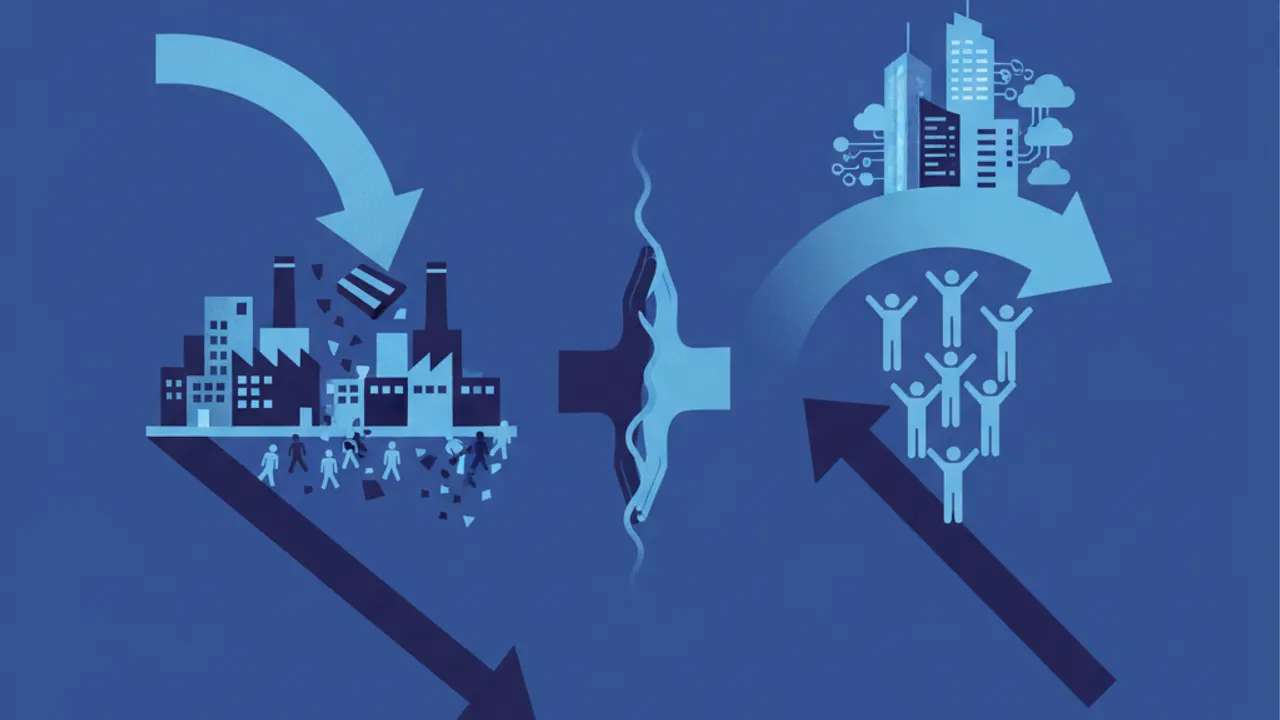
On November 10, 2026, Andrea Nahles, head of the Federal Employment Agency, presented a comprehensive 15-year projection for the German labor market in the Handelsblatt newspaper. According to the analysis, the expansion of artificial intelligence will fundamentally reshape Germany's employment landscape. By around 2041, roughly 800,000 existing positions are projected to be eliminated. At the same time, an equivalent number of about 800,000 new jobs is expected to emerge across the economy.
The scientific foundation of the forecast rests on the QuBe project, a collaborative scenario study conducted by three major research bodies. The Institute for Employment Research, the Federal Institute for Vocational Education and Training, and the Institute of Economic Structures Research combined their models to trace technological shifts. Their findings demonstrate that AI will not cause an aggregate shortage of work, but rather trigger a substantial reallocation across specific sectors and skill profiles.
Knowledge-intensive and analytical occupations face the most pronounced disruption under this structural transformation. Positions across the banking and insurance sectors are particularly exposed as algorithms increasingly automate complex data evaluation and risk assessments. Knowledge-based corporate service providers are encountering similar pressures, with routine research and document analysis being delegated to automated tools. Workers in these office-based environments will need to prepare for fundamentally altered job descriptions over the coming decade.
By contrast, traditional manual trades stand out as remarkably resilient to direct technological displacement. According to the projection, skilled crafts and manual trades remain largely robust against the integration of AI models. Physical problem-solving on site, manual craftsmanship, and customized local services cannot be easily replicated by software algorithms. Consequently, craft trades may experience relatively stable employment conditions compared to administrative and analytical professions.
Nahles placed these projections into the broader context of Germany's demographic contraction, which significantly alters the impact of automation. Germany currently loses a net total of approximately 500,000 workers every year as the baby boomer generation enters retirement. As a result, the elimination of 800,000 roles over fifteen years is unlikely to generate mass unemployment, but will instead coincide with an acute shortage of labor across multiple industries. AI automation may thus soften some demographic bottlenecks, yet it cannot completely bridge the deficit on its own.
To navigate this dual challenge of demographic decline and digital restructuring, Nahles proposed a concrete institutional response. She called for the establishment of a centralized state agency named the Work-and-Stay-Agentur to coordinate targeted recruitment and integration of qualified foreign talent. Alongside targeted immigration policies, extensive upskilling initiatives will be required to guide domestic professionals from declining analytical roles into newly created digital sectors.