
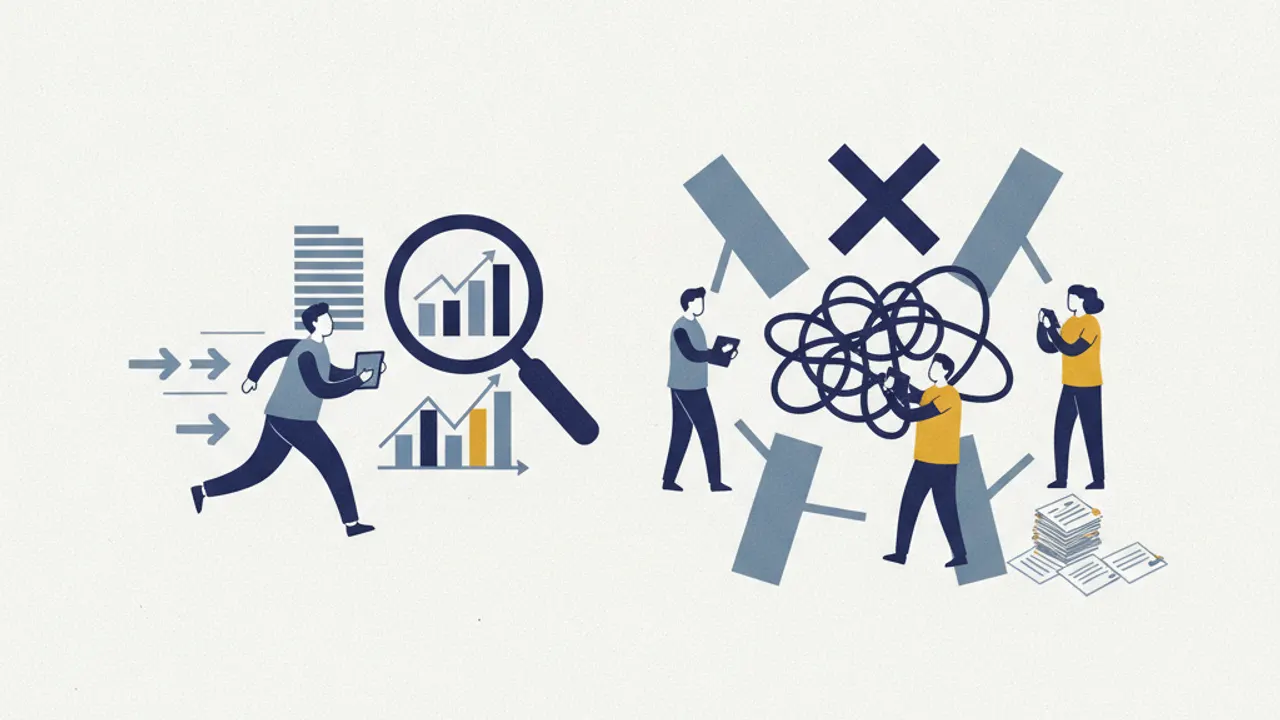
For its global report The State of Intelligent Collaboration 2026, workspace software provider Miro surveyed more than 9,500 executives and knowledge workers across North America, Latin America, Europe, and APAC in September and October 2026. The findings highlight a pronounced structural rift in modern office environments. While generative tools clearly expedite personal task execution, the anticipated performance gains largely evaporate once individual work intersects with team workflows.
At the personal task level, generative assistants appear remarkably effective. An overwhelming 83 percent of respondents report that artificial intelligence has increased their personal productivity, and 73 percent confirm that they deliver work output faster. Yet this acceleration exposes a clear qualitative shortcoming. Only 56 percent of participants state that the actual quality of their output improved, suggesting that sheer speed often masks substantive deficiencies.
Collective performance dynamics reveal even deeper operational friction. A substantial 60 percent of surveyed professionals see zero improvement in team collaboration resulting from the deployment of AI tools. Furthermore, 52 percent report no enhancement in organizational decision-making. Roughly ten percent of respondents even note that decisions have worsened, attributing this decline to uncritical reliance on automated suggestions that bypass human evaluation.
The primary structural bottleneck behind this stagnation is the persistence of private usage patterns. According to the research, 69 percent of employees interact with AI solely in isolated, single-player sessions without sharing prompts or contextual parameters with colleagues. These private data silos prevent teams from accumulating shared institutional knowledge. Individual micro-efficiencies remain disconnected from broader operational objectives, limiting the broader value of software deployments.
Simultaneously, uncoordinated AI usage introduces an active operational tax across corporate departments. Approximately 55 percent of knowledge workers observe an influx of mediocre, machine-generated content circulating across internal channels. This deluge of low-grade material triggers exhaustive manual correction loops and cognitive fatigue, shifting the labor burden from initial content creation to tedious downstream verification.
The findings demonstrate that software deployment alone does not resolve organizational collaboration barriers. When isolated task speed merely overwhelms colleagues with unvetted drafts, the administrative burden shifts rather than disappears. To realize tangible business returns, leadership teams must move beyond isolated experimentation and institute transparent, team-wide review standards and prompt-sharing protocols.