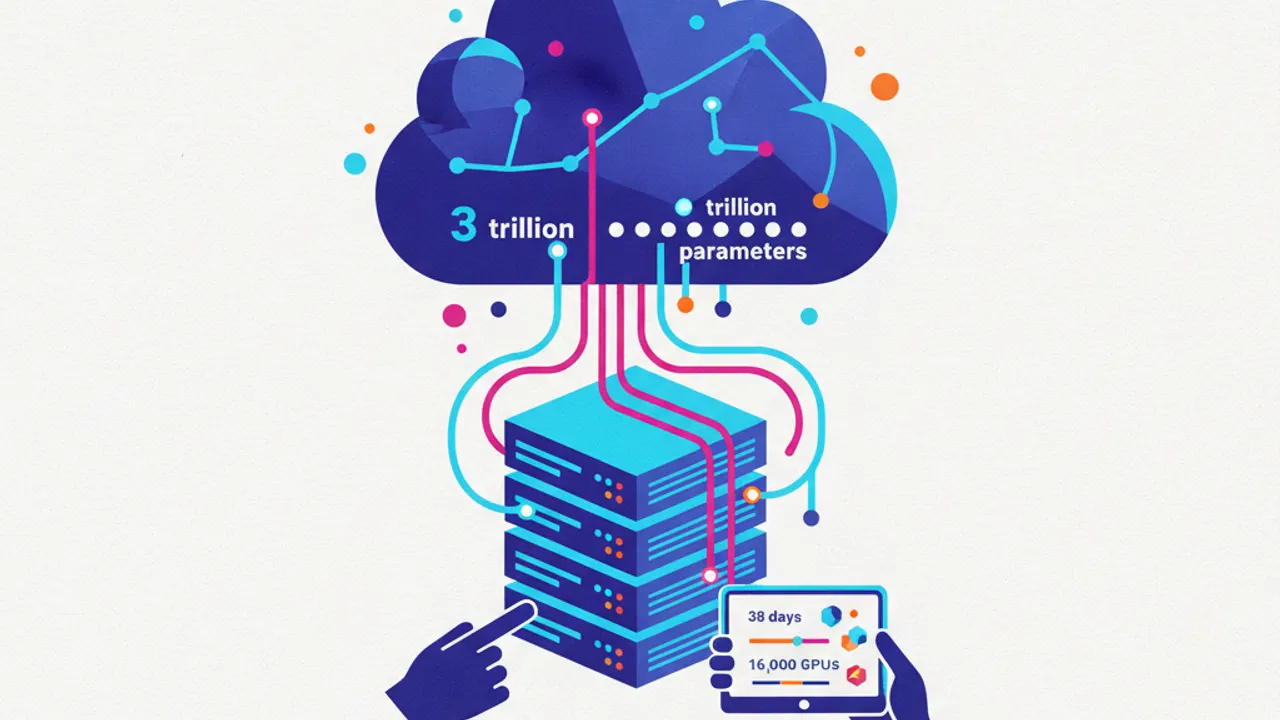
Microsoft AI, led by Mustafa Suleyman, has released technical insights into the pre-training run of its largest internal base model to date, designated MAI-Base-2. The mixture-of-experts architecture represents a decisive strategic step by the technology giant to establish an autonomous frontier model family alongside its existing commercial partnerships. With an overall parameter count ranging between 2.8 and 3 trillion, MAI-Base-2 enters the arena of colossal frontier networks. In doing so, the company offers rare visibility into the physical and computational realities of hyper-scale AI training.
Despite its massive total volume of nearly three trillion parameters, the model design relies heavily on architectural sparsity. For any single processed token, only approximately 80 billion parameters are active, keeping inference demands and training expenses within practical bounds compared to dense alternatives. Key structural elements include sliding-window attention mechanisms and specialised gradient clipping routines. For mathematical optimization, the engineering team utilised the Muon optimizer, designed to maintain numerical stability during extreme scaling runs.
The completed run demonstrates the immense compute clusters that hyperscalers are now assembling. Microsoft trained MAI-Base-2 across a unified cluster of 16,000 Nvidia GB200 NVL72 accelerators. The entire pre-training phase was finished in just 38 days. This rapid completion rate highlights both the raw throughput of Nvidia's Blackwell hardware generation and substantial operational refinements in cluster networking and fault tolerance.
In internal benchmarks, Microsoft highlighted considerable compute efficiency improvements over competing architectures. The company claims that the model achieved up to twelve times higher FLOP efficiency on programming evaluations when contrasted with DeepSeek-V4-Pro-Base. This metric indicates that the combination of MoE token routing, algorithmic optimization, and data curation reduced the aggregate raw compute required to build complex coding and reasoning capabilities. Such performance ratios remain critical for any cost-effective downstream deployment.
Commercial rollout plans for the model are closely linked to Microsoft's cloud infrastructure. Selected post-training checkpoints of MAI-Base-2 are scheduled for availability on the Azure AI Foundry platform for enterprise customers. For Microsoft, this milestone secures greater technological independence from external suppliers such as OpenAI. The tech corporation can now exert end-to-end control across its AI stack, stretching from custom data center hardware up to developer API endpoints.
The disclosure also underscores the ongoing arms race surrounding multi-trillion-parameter systems among major technology platforms. Even as compact edge engines and specialized deterministic classifiers gain traction for routine workflows, massive foundation models remain the primary pillar for open-ended problem solving and autonomous agentic behavior. At the same time, training clusters of this magnitude place unprecedented strain on energy grids, intensifying industry discussions over long-term power generation and datacenter expansion.