
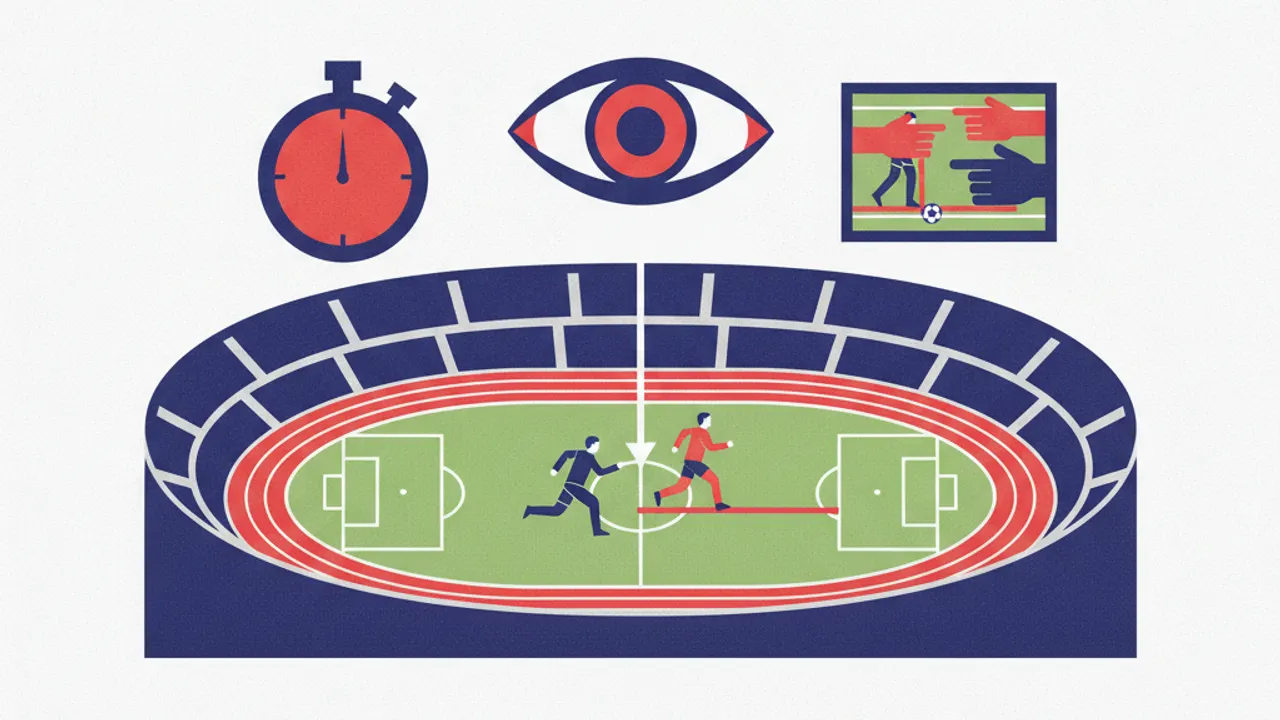
The referee organization PGMOL has released a detailed evaluation examining the interaction between human match officials and semi-automated offside technology. The inquiry was presented by PGMOL chief Howard Webb following recent controversial match decisions in top-flight football. At the center of the review was the semi-automated offside technology, known as SAOT, which is designed to enhance the accuracy of officiating teams on the pitch. The findings reveal that introducing advanced artificial intelligence introduces novel sources of error into sports governance. Rather than entirely eliminating incorrect rulings, the challenge shifted directly to the interface between human operators and automated machines.
From a purely technical measurement standpoint, the deployed system operated without error. The installed AI tracking cameras continuously monitored the match action and calculated the geometric offside position of a player within fractions of a second. This automated reconstruction delivered a mathematically accurate representation of the spatial positions of players on the pitch. In his analysis, Howard Webb emphasized that no doubts existed regarding the underlying calculations and optical capture performed by the tracking cameras. The algorithm fulfilled its primary objective of establishing the exact position of the player at the moment of the pass without any technical failure.
The complications began only when match officials processed the incoming data. The evaluation exposed a serious interface issue, as the video assistant referee placed excessive reliance on the purely visual confirmation provided by the technology. This uncritical dependence on the computer-generated graphic induced a severe tunnel vision in the responsible video official. The immediate visual clarity offered by the technology led the official to prematurely abandon the standard review procedures required for game management. The human operator at the monitor unconsciously deferred the interpretive responsibility for the rules to the automated assistance system.
This technical tunnel vision caused critical consequences for the application of the laws of the game. While the AI determined the spatial position flawlessly, the mandatory assessment of the full playing situation required by football regulations was omitted. Specifically, the video assistant neglected the subsequent evaluation of whether potential goalkeeper obstruction occurred or whether other players were passively involved in the move. Because the technology only captures geometry and cannot interpret passive participation or distraction, an essential regulatory question remained unaddressed. Match officials thereby overlooked the fact that a geometric offside position alone does not automatically constitute an infraction.
As a direct consequence of the incident, the refereeing body is implementing methodological and structural adjustments for match officiating. PGMOL is introducing revised training guidelines for referees and video assistant officials to overhaul how computer-generated offside models are interpreted. The updated directives aim to clearly decouple the human evaluative process from the visual AI confirmation. Match officials will receive targeted training to treat computer-generated models strictly as geometric aids while consistently upholding their obligation to assess obstruction and passive involvement. The incident highlights that even the most precise AI tools remain flawed if the operational interface with human decision-makers is improperly managed.