
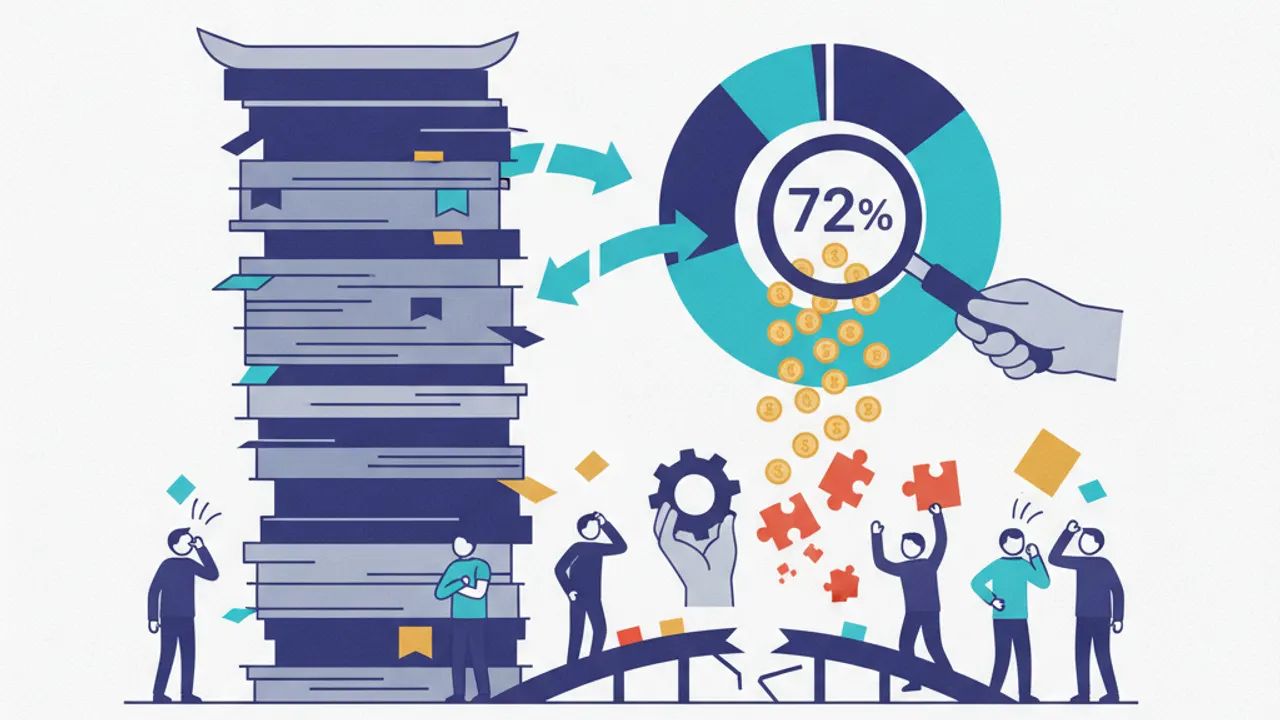
Major enterprises are currently funneling substantial budgets into artificial intelligence, yet practical execution often encounters expensive setbacks. According to an empirical report titled 'The AI Process Gap', published by process automation vendor Camunda in partnership with Sapio Research, 72 percent of corporate AI initiatives fail due to defective operational workflows. Outdated, faulty, or poorly documented business processes systematically prevent modern algorithmic systems from delivering their intended value.
The financial repercussions of these organizational oversights are considerable. Survey data shows that affected organizations suffer average financial losses of 1.55 million US dollars, equivalent to approximately 1.33 million euros, for each troubled rollout. Many companies attempt to deploy complex automation tools directly onto legacy process environments without first auditing data paths or workflow resilience. This leads to operational friction, delayed timelines, and ultimately costly implementation failures.
Anticipated future expenses are causing additional alarm among executive leadership. Exactly 72 percent of surveyed decision-makers warn that their enterprise AI costs will explode uncontrollably unless they undertake fundamental process reengineering. Instead of generating meaningful productivity gains, failed deployments consume critical technical resources and operational funds, pushing the expected return on investment out of reach.
The comprehensive empirical framework of the research highlights the structural nature of this dilemma across major Western economies. Sapio Research surveyed 1,000 process decision-makers across IT, operations, and enterprise transformation, alongside 5,000 employees at companies with at least 1,000 staff members. The data encompasses organizations across four core international markets: the United States, the United Kingdom, Germany, and France.
A critical factor contributing to these failures is a pronounced divide between management teams and operational staff. Frontline workers report being rarely consulted during rollout planning, leaving their day-to-day requirements unaddressed. Employees are frequently mandated to adopt generic toolsets that actively conflict with the real workflows required to execute their daily tasks, triggering frustration across business units.
The findings send an unequivocal signal regarding corporate digital transformation strategies. Enthusiasm for advanced software models collapses quickly when forced to operate on top of fragmented, undocumented workflows. For business leaders, true transformation requires disciplined preparation: only when core processes are transparently mapped and standardized can automated tools reliably generate tangible efficiency.