
European football leagues are actively preparing for the widespread rollout of semi-automated offside technology across their competitions. Ahead of this implementation, new evaluations and technical limitations have been publicly examined by experts from Northumbria University, Sports Technology Analysis, and Global Market Insights. The resulting assessments provide detailed insights into both the measurable speed gains of the technology and the operational conditions where automated systems still rely on human intervention.
The operational framework of Semi-Automated Offside Technology, known as SAOT, relies on a sophisticated hardware foundation distributed throughout the venue. Approximately 12 specialized high-speed cameras installed around the stadium continuously track the movement of players and the ball. At the same time, an integrated sensor inside the match ball transmits 500 data points per second directly to the analysis software. This high-frequency transmission ensures that the exact moment of ball contact is precisely aligned with player positioning across the pitch.
Using this visual and spatial data, the computer vision engine reconstructs a continuous three-dimensional model of the match action. The system maps up to 29 individual anatomical limb points per player to generate an accurate 3D skeletal mesh in real time. By continuously tracking these specific physical markers, the software determines the precise positioning of all body parts relevant to offside calls. This dynamic modeling provides far greater spatial precision than standard two-dimensional broadcast camera angles.
The verified performance metrics show a tangible acceleration of on-pitch decision-making. Benchmark evaluations demonstrate that the average duration of offside reviews dropped by 31 seconds compared to traditional manual line-drawing by video assistant referees. Eliminating the tedious manual calibration of lines on broadcast footage noticeably reduces the downtime that often disrupts match momentum. This reduction in delay directly addresses long-standing complaints from players and spectators regarding extended video reviews.
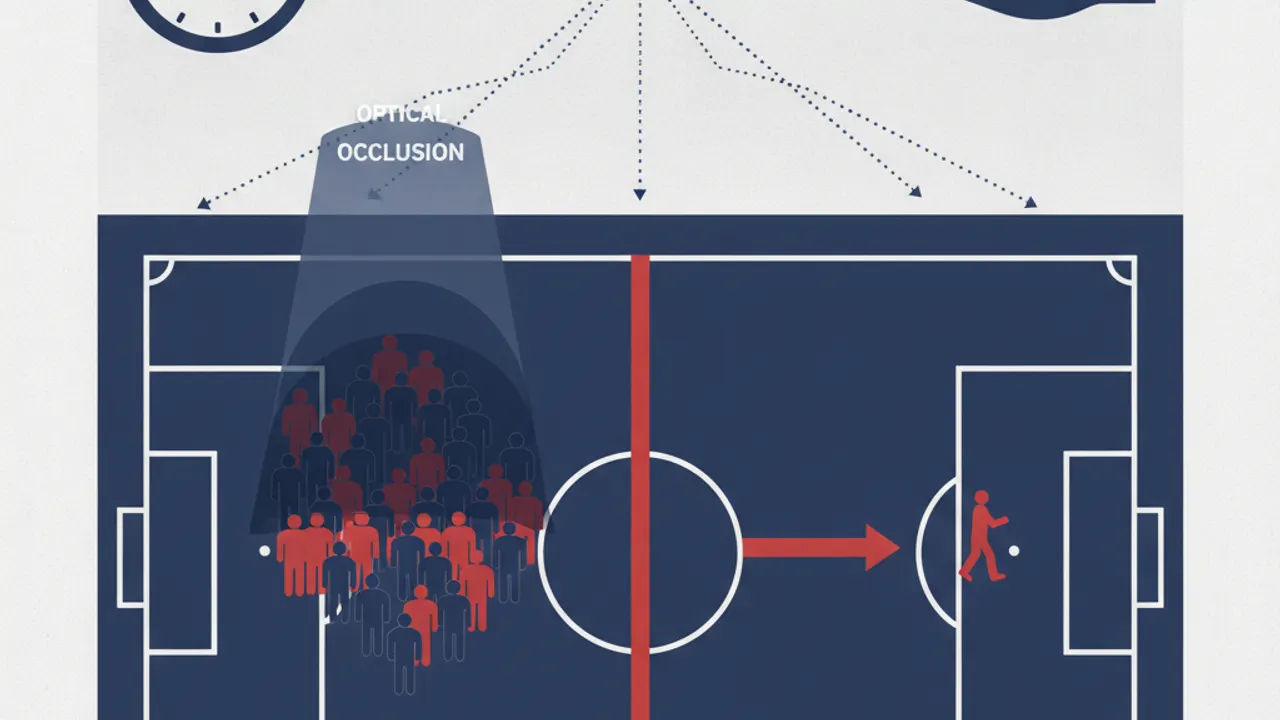
Despite the clear efficiency gains, the technical assessments highlight specific vulnerabilities within the automated process. Widespread discussion focuses on so-called black spots, which arise during scenarios of severe optical occlusion. When dense clusters of players converge during set pieces or scuffles inside the penalty area, camera sightlines can become completely obstructed. Under these conditions, the computer vision models cannot reliably calculate the complete skeletal structures of obscured players.
When these visual obstructions prevent automatic tracking, the system forces officials to revert to manual video frames. To handle these edge cases without undermining match officiating, league governing bodies are instituting supplementary redundancy protocols for video assistant referees. These structured fail-safe procedures define exactly when and how human officials must intervene with conventional tools, ensuring that regulatory integrity and accuracy are maintained even when automated vision systems reach their limits.