Despite dramatic advances in generative video models such as Veo, Sora, or Gen-3, producing long narrative motion pictures has remained a stubborn technological challenge. While modern diffusion engines render stunning isolated clips lasting a few seconds, longer storytelling attempts regularly collapse due to semantic drift, where character clothing or set details mutate across cuts, and cascading errors, where an artifact in an early shot corrupts the rest of the sequence. Google Research has now presented a modular framework that treats filmmaking not as raw pixel synthesis, but as an orchestration and memory challenge.
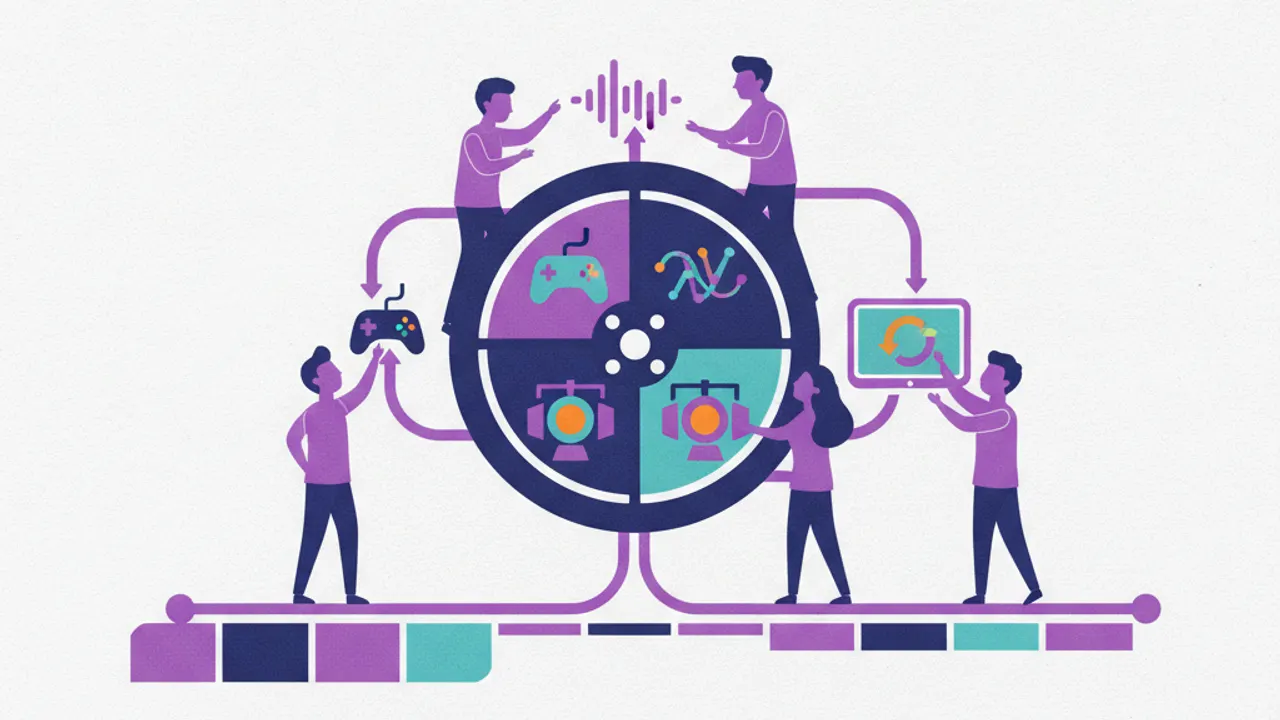
The system, introduced as the AI Video Co-Director on September 24, connects Google's multimodal model Gemini with its video generation engine Veo. The framework is split into four specialized components that divide the creative labor. The process begins with Co-Director, a planning module presented at COLM 2026. It applies multi-armed bandit optimization to translate a natural language creative brief into cohesive narrative strategies, visual aesthetics, and structured storyboards.
To tackle the chronic problem of visual drift, the pipeline relies on CANVAS, a component presented at EMNLP 2026. CANVAS functions as a persistent visual memory buffer that tracks and anchors character identities, props, and three-dimensional spatial layouts across scene transitions. Rather than forcing the generator to reinvent the frame at every cut, this explicit memory layer maintains continuity analogous to the role of a traditional script supervisor.
Actual video synthesis is driven by Agentic Autoregressive Diffusion (A²RD). This component generates sequences segment by segment in an autoregressive fashion, keeping long visual chains stable. To showcase the capabilities of the architecture, Google Research demonstrated a coherent ten-minute film featuring characters and environments that remained consistent without noticeable degradation. This represents a significant departure from the fragmented montages typical of current AI video tools.
The workflow is finalized by VQQA, a visual quality assurance feedback module. Functioning like an automated continuity editor, VQQA inspects generated frames for cut mismatches, physical inconsistencies, and logical flaws, triggering targeted feedback loops to correct artifacts before rendering finishes. Google also embeds its proprietary SynthID digital watermarking into all generated outputs to ensure origin tracking and tamper detection.
The release of the AI Video Co-Director reflects a clear shift in research priorities from simply scaling foundation models toward designing structured agentic control layers. By decomposing the filmmaking pipeline into ideation, persistent memory, autoregressive synthesis, and iterative quality control, Google shows how multi-agent architectures can turn standalone diffusion models into coherent tools for professional visual entertainment.