
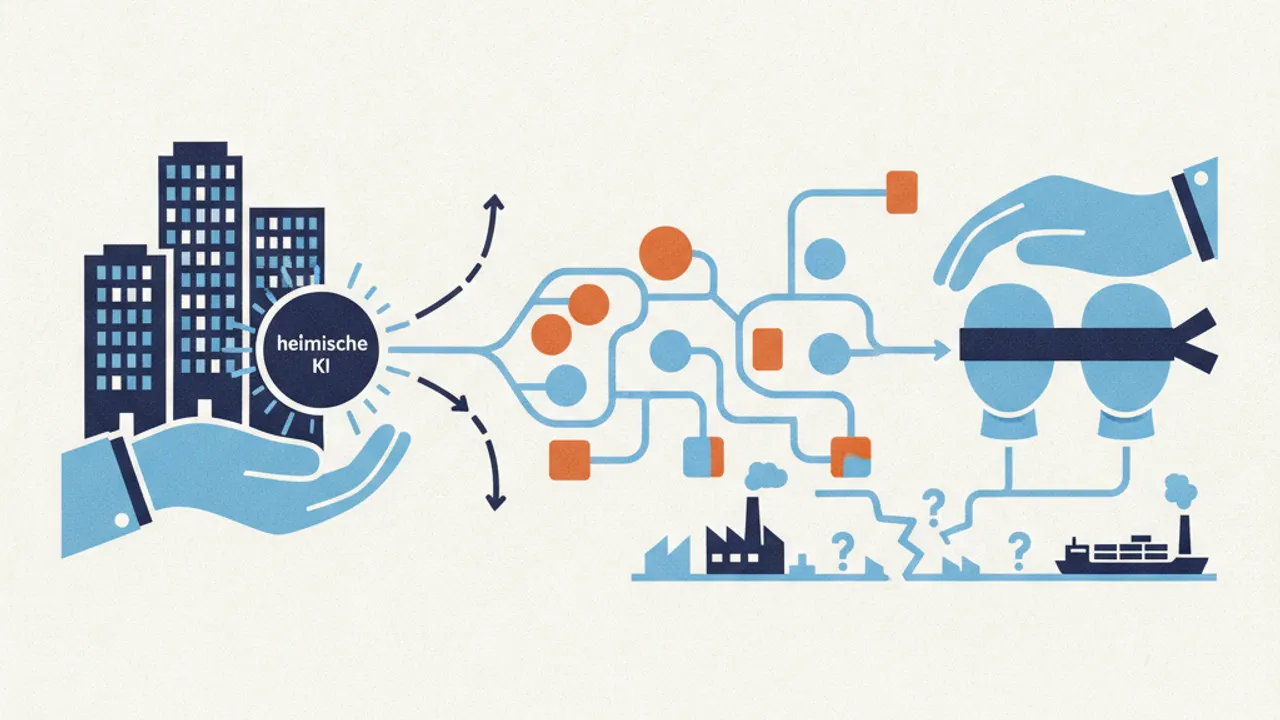
A representative survey of 603 companies with 20 or more employees, published on November 2, 2026, by digital association Bitkom, reveals clear technological ambitions across the German Mittelstand. Almost the entire domestic economy strives for digital sovereignty in artificial intelligence to reduce dependencies on foreign cloud ecosystems. A striking 96 percent of surveyed businesses state that they prefer to deploy AI models and applications from domestic vendors. The appetite for reliable European alternatives to dominant global platforms is expanding across both industrial manufacturing and enterprise service sectors.
However, a substantial sovereignty gap separates this aspiration for independence from day to day operational realities. Nearly two thirds of respondents, specifically 64 percent, are completely unwilling to accept compromises regarding pricing, computational performance, or feature completeness simply to adopt European software. Domestic and European software providers must therefore withstand direct competition against established US hyperscalers without relying on patriotic sentiment. For German executives, measurable competitiveness, operational uptime, and system reliability matter far more than regional origin.
Vendor preferences nevertheless reveal shifting purchasing attitudes within enterprise IT procurement. Suppliers from the United States have noticeably lost ground, favored by only 41 percent of German companies compared to 51 percent in the previous year. Concurrently, French software providers climbed to 46 percent, up from 38 percent, while providers from the wider European Union reached 43 percent, and Chinese platforms dropped to 12 percent. This shift coincides with immense political pressure on Berlin, with 97 percent of surveyed businesses demanding massive public investments into sovereign computing infrastructure and key technologies.
Meanwhile, a separate investigation by the German Economic Institute confirms that artificial intelligence has firmly transitioned from experimental pilots into daily operations. According to research presented by Senior Economist Barbara Engels at IW Cologne, 61 percent of German enterprises currently utilize AI in at least one business department. The technology is no longer confined to isolated trial projects, having established itself across routine workplace workflows. Yet the IW analysis identifies a troubling divergence between this widespread operational uptake and actual organizational management.
Despite the high adoption rate of 61 percent, many companies manage their AI initiatives in what researchers describe as programmatic blind flight. Only roughly one third of active AI users, approximately 33 to 35 percent, have established binding and measurable objectives for algorithmic deployment. Furthermore, nearly two thirds lack dedicated AI budgets and standardized metrics to quantify productivity enhancements or return on investment. Without such governance mechanisms, executive leadership cannot reliably evaluate whether newly integrated tools yield genuine efficiency gains or merely accumulate licensing expenses.
Taken together, the findings from Bitkom and IW Cologne underscore a critical dual tension facing the German economy. On one hand, corporate leaders insist on top tier performance and expect billions in state funded sovereign computing capabilities. On the other hand, many enterprises neglect internal management foundations, failing to implement basic performance controls and financial tracking. The long term success of enterprise AI will therefore depend less on geopolitical origins and far more on rigorous organizational governance.