
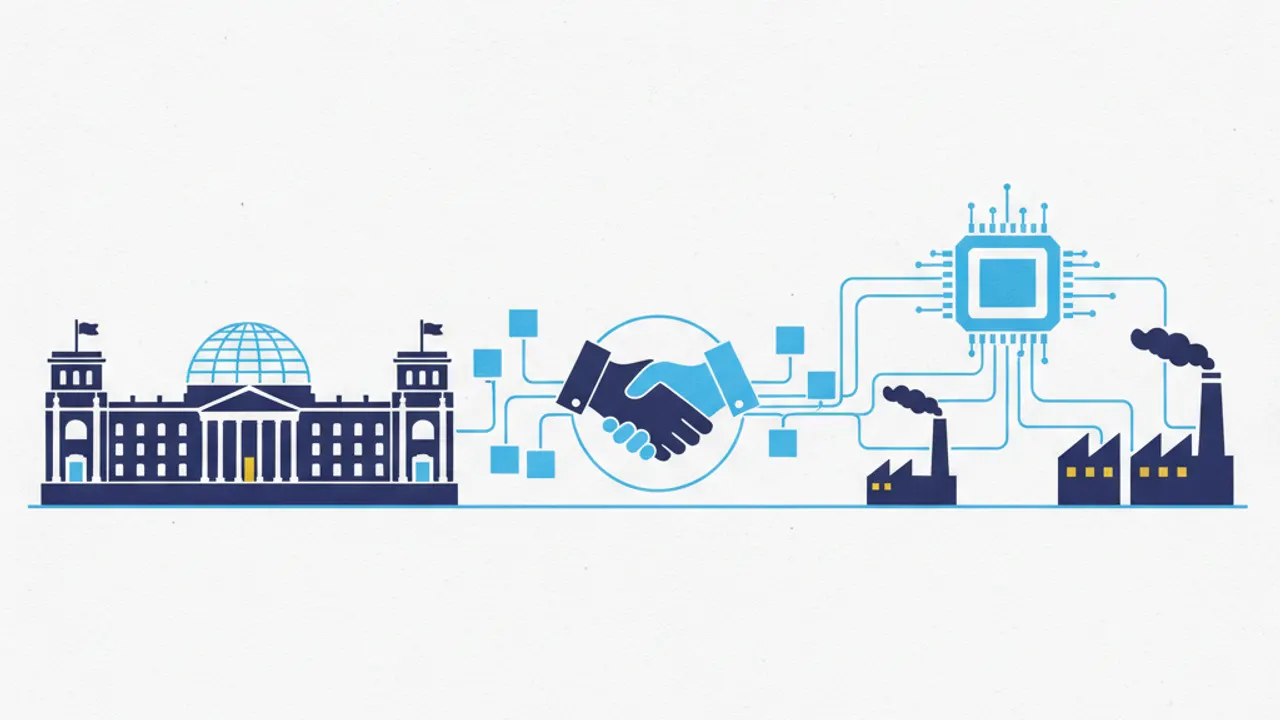
At the two-day Invest in Germany Summit in Berlin, German Chancellor Friedrich Merz and Nvidia CEO Jensen Huang opened a new chapter in industrial digitalization. The German government signed an official memorandum of understanding with the chipmaker to specifically develop and scale foundation models tailored to industrial manufacturing. The core objective of the alliance is to rapidly accelerate the transition of pilot projects into operational factory automation.
Federal Research Minister Dorothee Bär and Digital Minister Karsten Wildberger highlighted the strategic value of Germany's industrial data assets during the forum. While consumer-facing frontier models have relied largely on public web text and imagery, Germany's distinct advantage lies in the proprietary process and machine data held by mid-sized industrial manufacturers. The initiative seeks to systematically leverage these datasets to train models capable of handling intricate production workflows.
A primary bottleneck for mid-sized suppliers has long been gaining practical access to dedicated compute infrastructure and specialized technical expertise. Through the partnership, hardware resources and algorithmic optimizations are intended to become far more accessible to medium-sized industrial players. Both political and industry representatives emphasized that scaling industrial AI will heavily influence the future global competitiveness of core domestic sectors.
The technological alliance is mirrored by a structural renewal of public support programs. The Federal Ministry for Economic Affairs and Energy has finalized the funding decisions for its grant period starting in 2027. Under this plan, six transregional and eleven sector-specific Mittelstand-Digital centers will be established nationwide. State Secretary Johannes Steiniger cautioned that without vendor-neutral implementation support for generative and agentic systems, mid-sized companies risk losing their footing in global supply chains.
Practical developments on the ground reflect this strategic pivot, as demonstrated at the 7th annual conference of the Chamber of Commerce and Industry for Munich and Upper Bavaria. Industry participants reported that general-purpose text chatbots are increasingly being replaced by dedicated workflow and shopfloor agents. These specialized tools can interpret technical engineering drawings, correlate live machine telemetry and automatically audit complex contract files.
Contrary to recurring fears regarding widespread job cuts, early assessments from manufacturing firms reveal a different reality. Productivity gains are primarily driven by democratizing technical expertise and legacy engineering archives amid persistent skilled-labor shortages. By uniting public digital support centers with practical agentic tooling, the initiative aims to safeguard vital operational domain knowledge directly on the factory floor.