
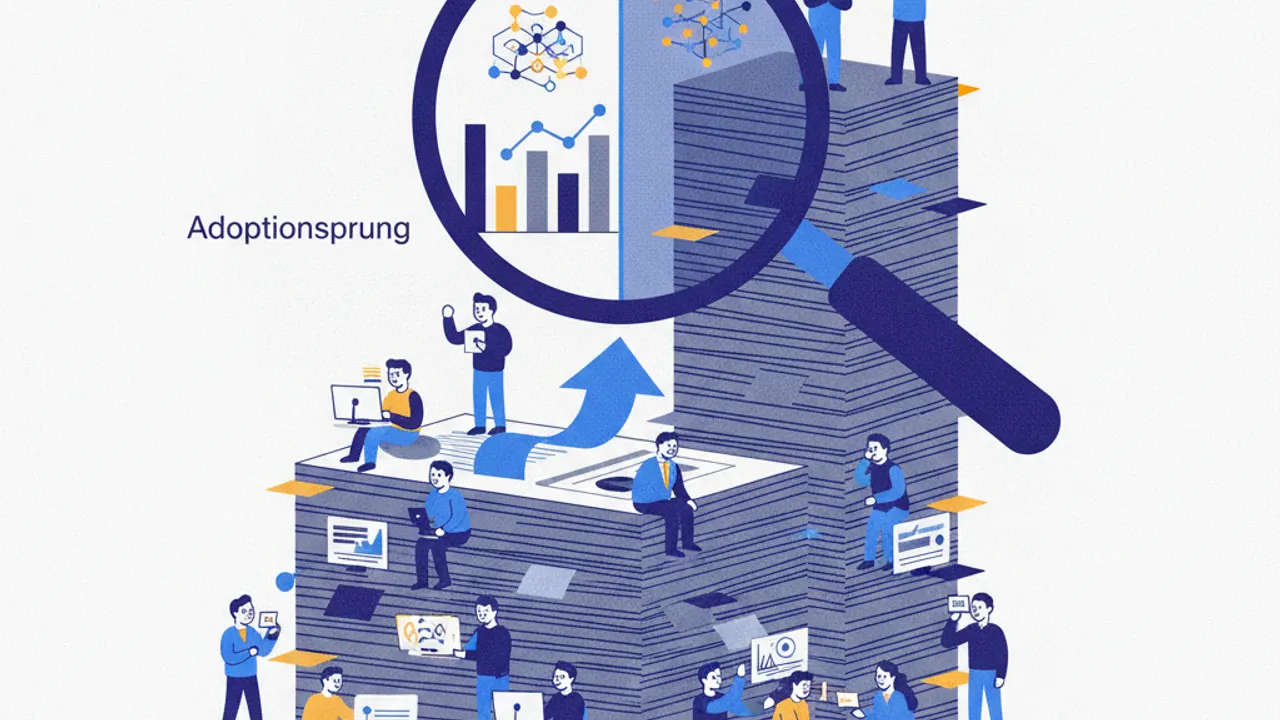
Artificial intelligence has reached a critical adoption milestone across the German economy. According to a representative survey of 603 companies with 20 or more employees conducted by the digital association Bitkom in September 2026, an absolute majority of 57 percent now actively deploys AI. This represents a substantial rise from 36 percent in the previous year and 20 percent two years ago. An additional 38 percent are currently planning or discussing implementation, leaving only four percent for whom AI remains irrelevant.
Despite this widespread deployment, a severe maturity gap persists. Companies are barely tapping into the deeper capabilities of the technology in their everyday workflows. Not a single business surveyed stated that it was utilizing the full potential of AI. Only three percent claimed strong utilization, while 28 percent reported low exploitation and 59 percent acknowledged practically no operational utilization of AI capabilities at all.
Strategic awareness, however, has climbed to record highs. Ninety-one percent of executives now view AI as the most critical technology for the future, up from 73 percent in 2024. Just eight percent still dismiss the development as mere hype. The findings demonstrate that leadership teams widely recognize how permanently artificial intelligence is altering traditional business models and industrial processes.
This recognition brings acute competitive pressure. Sixty-one percent of respondents are convinced that enterprises without AI cannot survive in the long term, compared to 51 percent in 2025. Furthermore, 34 percent of companies now view artificial intelligence as a direct threat to their own existence, a notable jump from 23 percent recorded in the prior year.
Respondents cited mounting operational friction, complex internal processes and compliance burdens, such as obligations under the European AI Act, as primary obstacles to deeper integration. Consequently, many organizations remain stalled after initial pilot phases rather than integrating end-to-end automated pipelines into their core IT infrastructures.