
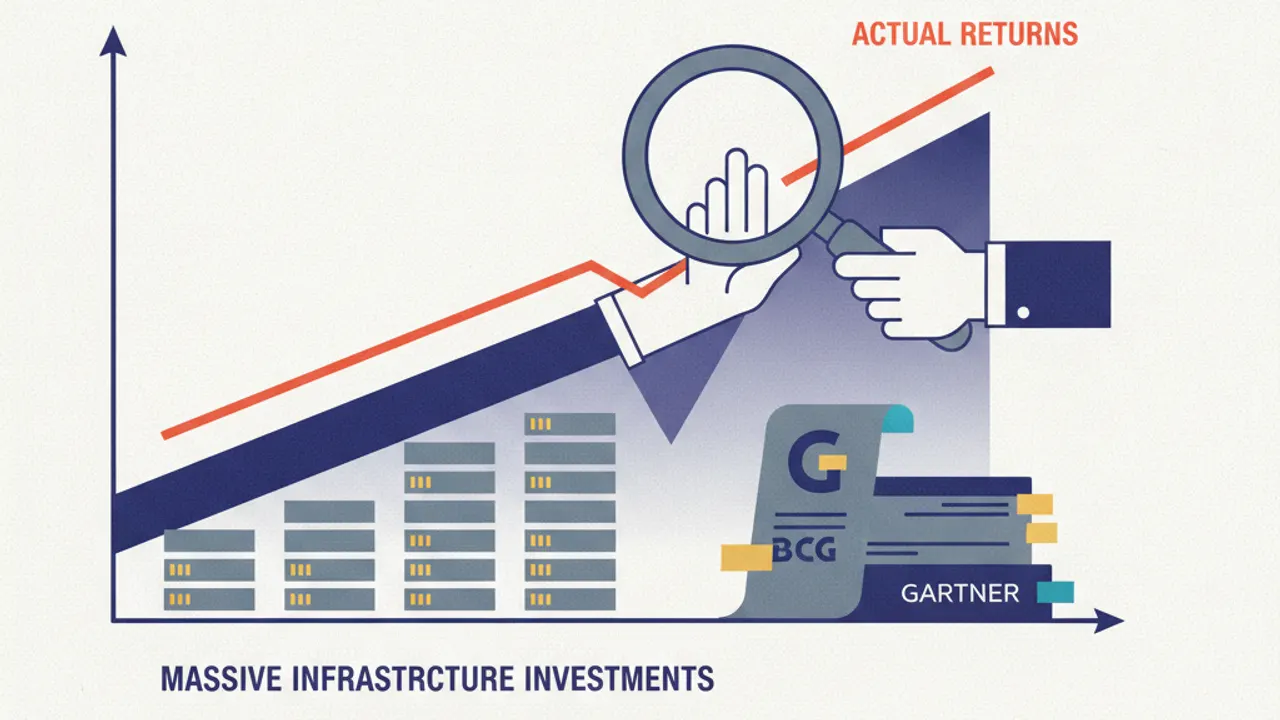
The global buildout of artificial intelligence data centers and semiconductor capacity is heading toward a precarious financial imbalance. According to an analysis published on October 14, 2026, by research firm Gartner, capital spending by hyperscalers and technology providers on AI infrastructure will approach nearly one trillion US dollars in this year alone. Looking ahead to 2030, analysts project cumulative investments to reach approximately seven trillion dollars. However, this unprecedented wave of capital expenditure risks losing its economic footing as corporate software adoption fails to generate the revenues anticipated by hardware and cloud providers.
The potential scale of impending asset write-downs is stark. Gartner warns that over 3.5 trillion US dollars in AI infrastructure spending could be exposed to impairment by the end of 2030. In order to cover capital costs and deliver an industry-standard return on invested capital of twelve percent, data center operators would need to generate cumulative revenues of 8.5 trillion dollars by 2030. In contrast, Gartner projects that attributable enterprise and consumer AI revenues will reach a maximum of only 3.6 trillion dollars over that period, leaving a massive multi-trillion-dollar deficit in capital recovery.
This imbalance is poised to reshape the cloud computing industry and trigger aggressive market consolidation. Gartner estimates that intense margin compression and escalating operating expenses will force more than 80 percent of specialized neocloud providers to either shut down independent operations or seek acquisition by 2030. While hyperscale tech conglomerates can leverage diversified balance sheets to absorb long amortization cycles, independent infrastructure providers with high debt loads face severe financial stress.
The structural roots of this revenue shortfall are clearly visible on the corporate demand side. Findings from the Boston Consulting Group in its Applied AI Index 2026, published on October 8, 2026, show that enterprise spending is only gradually translating into bottom-line results. Based on a survey of over 1,300 C-level and senior executives across more than 20 industries, nearly 50 percent of companies now report generating measurable business value from AI, up from roughly 40 percent in 2024 and 2025. Yet this milestone also means that half of all enterprises remain unable to demonstrate clear commercial returns from their investments.
Organizational roadblocks remain the primary barrier to widespread enterprise monetization. BCG categorized only 7.5 percent of surveyed companies as fully transformed organizations, while 41 percent are actively scaling implementations across business units. More than 51 percent of organizations remain trapped in isolated pilot phases or departmental fragmentation. This lack of architectural cohesion prevents companies from scaling production workloads, directly suppressing the software and compute consumption needed to support infrastructure investments.
Nevertheless, BCG's research highlights a widening performance divide between strategic leaders and hesitant followers. Among leading companies, 61 percent have committed to multi-year, enterprise-wide implementation programs rather than disjointed departmental experiments. This disciplined approach delivers clear economic gains, with frontrunner firms achieving 2.4 times higher revenue growth compared to competitors in the lower half of BCG's maturity ranking. The emerging reality suggests that while infrastructure overcapacity looms, enterprises capable of executing systematic transformation continue to secure distinct competitive advantages.