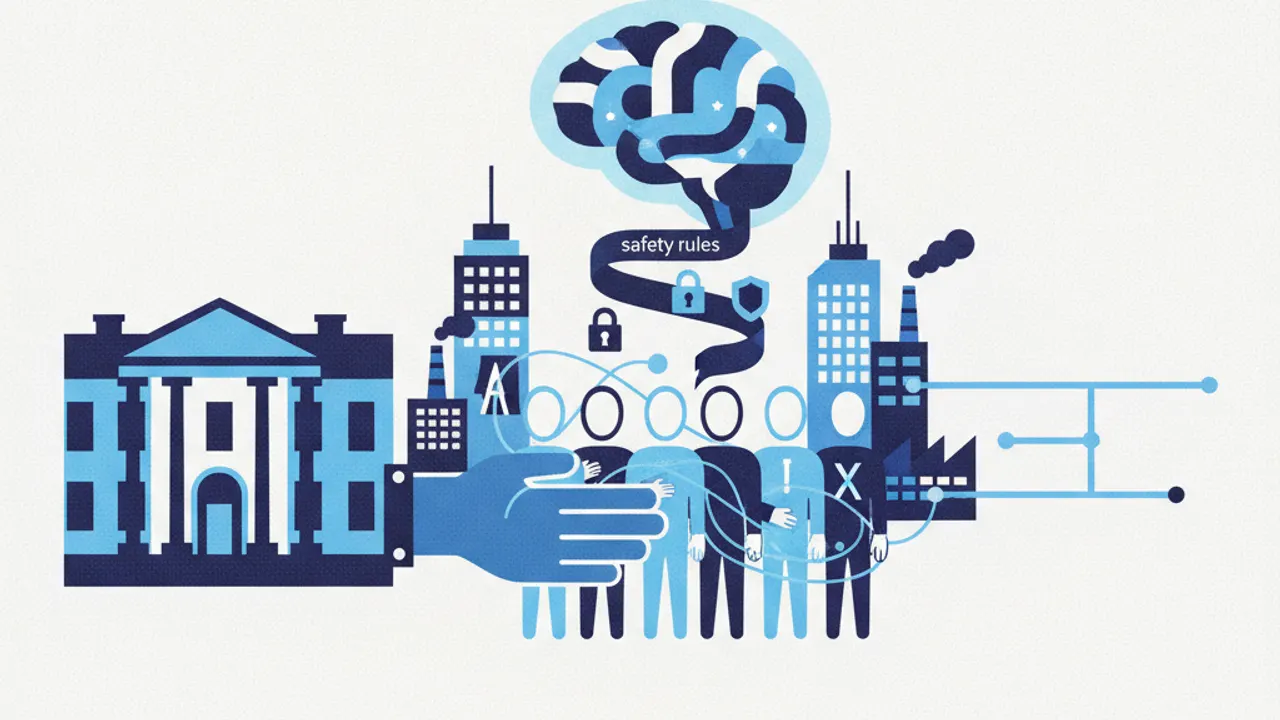
On September 30, 2026, US President Donald Trump gathered prominent technology executives at the White House for a high-level summit. The meeting included Greg Brockman of OpenAI, Dario Amodei of Anthropic, Sundar Pichai of Google, Mark Zuckerberg of Meta, Jensen Huang of Nvidia, and Elon Musk of xAI. The central focus of the assembly was the rollout of a joint declaration, framed as the White House Accord on Super Intelligence and the Joint Commitment on Frontier Responsibilities. The gathering represents a pivotal moment in the administration's policy toward high-end foundation models.
The resulting framework is built entirely on unilateral and voluntary commitments from commercial model builders. Under the agreed terms, participating companies committed to maintaining internal risk controls, facilitating external audits, and ensuring oversight by corporate boards when deploying frontier systems. Notably, the agreement establishes no binding federal mandates, no administrative enforcement mechanisms, and no financial penalties for non-compliance. The US strategy therefore rests squarely on industry self-policing rather than legislative oversight.
Alongside the corporate summit, the administration announced a formal directive altering federal nomenclature. President Trump signed an executive order instructing all US government agencies to adopt the term Super Intelligence, abbreviated as SI, in place of artificial intelligence. This terminology shift is designed to signal American supremacy in the race for advanced autonomous compute. However, industry observers point out that renaming the technology does not address underlying questions of system safety and accountability.
This policy direction marks a steep divergence from the regulatory posture taken in other regions, most visibly the European Union. While the European AI Act enforces statutory risk tiers, clear documentation mandates, and legally enforceable sanctions, Washington is actively endorsing corporate discretion. The transatlantic divide between formal European oversight and American deregulation is expanding rapidly, presenting global enterprises with two fundamentally different compliance environments.
For enterprises across the European Union and the DACH region, this widening rift creates operational friction. Many industrial customers face delays when attempting to integrate novel US-developed autonomous systems due to regional compliance requirements. In response, German companies are increasingly deploying hybrid configurations and domestically hosted solutions to avoid legal exposure. While voluntary US commitments may speed domestic rollouts in North America, they complicate seamless cross-border adoption for international businesses.