
Skip to content
AI ConnectPowered by VELENTIS
AI-generated2 min

Shift in AI Training: Engineers Earn up to $300 an Hour for Verification Data

The market for AI training data is fundamentally changing as frontier labs hire high-paid senior software engineers to build reinforcement learning environments instead of relying on clickworkers.

This article was AI-generated and published automatically. Context, labelling and all sources at the end of the article.

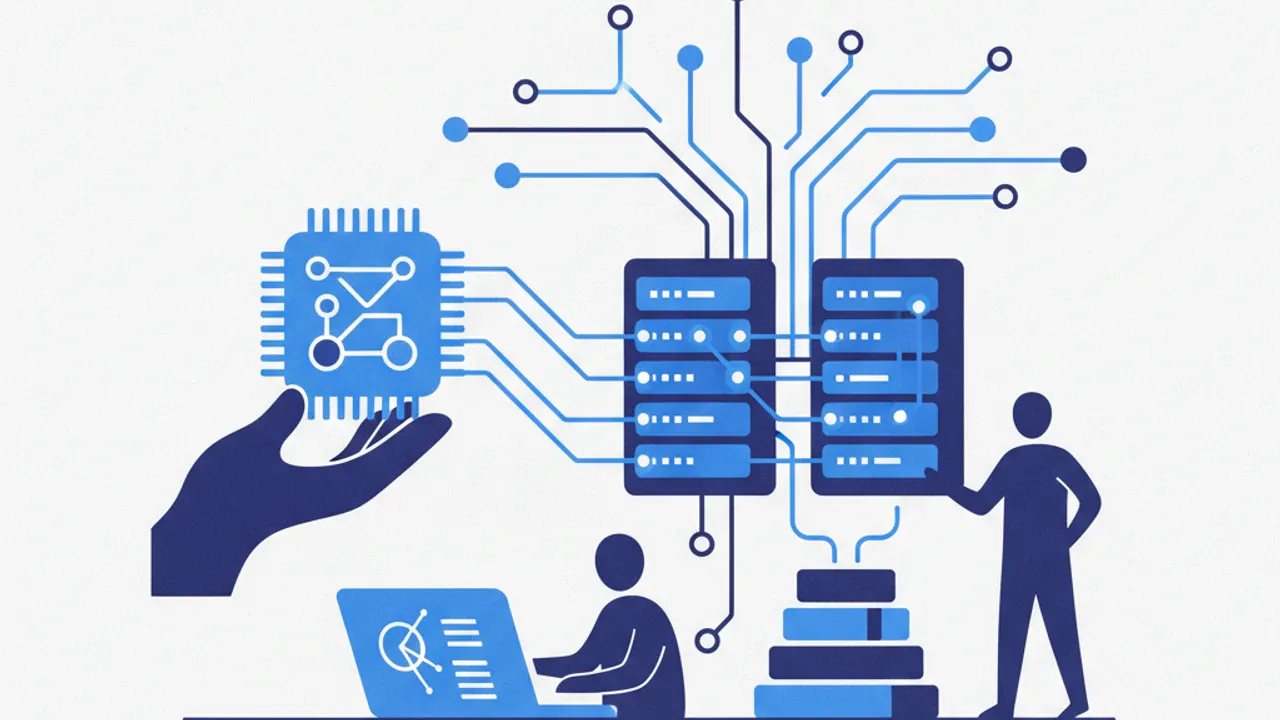
(KI-generiertes Symbolbild: Gemini / AI Connect)

The training of top-tier artificial intelligence models is undergoing a profound economic and architectural shift. For years, the industry relied on armies of low-cost data labelers to categorize text snippets and tag images by hand. Today, however, the frontier has moved entirely toward rigorous reinforcement learning, creating an unprecedented appetite for senior and staff software engineers. Because pre-training datasets harvested from the public web are largely exhausted, model progress on complex reasoning and coding benchmarks now hinges on custom-built verification systems and automated test harnesses.

This transformation is fueling remarkable revenue growth for specialized talent platforms. Speaking on the Latent Space podcast hosted by Swyx, G2i chief executive Gabe Greenberg detailed how his company scaled its annual revenue from $15 million in 2025 to approximately $100 million in 2026 without taking on venture capital. The broader global market for high-grade human reinforcement learning data is now valued between $10 billion and $15 billion. Frontier labs are competing aggressively for technical capacity, turning specialized data generation into one of the fastest-growing niches in enterprise computing.

The engineering requirements in this segment diverge sharply from traditional data labeling. Instead of reviewing code outputs for style or grammar, contracted engineers design deterministic execution sandboxes, unit tests, and runtime environments that allow models to safely execute generated software and verify results autonomously. Top labs are paying rates ranging from $250 to $300 per hour for this high-level architectural work. Consequently, experienced systems engineers are increasingly migrating to these roles, drawn by lucrative compensation and the opportunity to define how next-generation reasoning engines validate computation.

Major research organizations, including OpenAI, Anthropic, and Google, are reallocating significant portions of their capital to accommodate this demand. These labs now commit an estimated 4 to 6 percent of their overall operating budgets to bespoke interactive environments and post-training data pipelines, compared to just 2 to 3 percent in the preceding year. The race for technological differentiation has also sparked intense bidding wars over data licensing agreements. Labs frequently pay substantial premiums to secure exclusive rights to verification suites, or conversely accept marked-down rates when sharing pools of standardized benchmark problems across the industry.

This strategic pivot underscores the limitations of raw compute scaling driven purely by uncurated text corpora. Synthetic data generation alone cannot resolve edge cases without grounded ground truth, making formal verification the central pillar of post-training research. For the broader software development community, the rise of RL verifiers proves that manual testing and rigorous validation remain critical engineering disciplines. As reasoning models expand deeper into production systems, the ability to build bulletproof verification harnesses will remain a primary driver of technical value.

What this means for you

For experienced engineers, the post-training data boom presents highly lucrative opportunities outside traditional enterprise product roles. Developing deterministic testing infrastructure and sandboxed verifiers has become a primary bottleneck and revenue driver for the frontier AI industry.

Perspectives

Coverage: 2× Other

One story, several angles: how each source frames the topic, each with a verbatim quote.

  • latent.spaceOther

    Latent Space highlights the rapidly growing market for coding training data, emphasizing that young startups are securing hundred-million-dollar contracts with frontier labs while engineers create tasks and verifiers to evaluate model outputs.

    Original quote

    „how engineers design the task, choose the starting data, and build a verifier that can grade the result.“

    latent.space
  • daily.devOther

    daily.dev frames the development as an informative market briefing for developers, focusing on how startups generate large contract revenues by having engineers build datasets and verifiers for frontier labs.

    Original quote

    „Engineers design the task, choose the starting data, and build a verifier that can grade the result.“

    daily.dev
  • latent.spaceOther

    The podcast episode focuses on the transition from basic human labeling to expert engineering, detailing how senior engineers construct challenging tasks and verifiers for frontier AI models.

    Original quote

    „senior engineers design the task, choose the starting data, and build a verifier that can score the result.“

    latent.space

Source classification is maintained editorially (political spectrum only where consensus is broad; vendor communication is PR, not journalism). Unlabelled sources are unclassified: we do not guess.

Evidence

Solidly sourced
62/100
  • G2i increased its annual revenue from $15 million in 2025 to roughly $100 million in 2026 without venture capital.

    single source
  • The global market for high-quality human RL data is estimated at $10 billion to $15 billion.

    single source
  • Frontier labs like OpenAI, Anthropic, and Google now allocate 4 to 6 percent of their budgets to interactive environments and verifiers.

    single source

The evidence score is computed, not hand-set: from confidence, the number of sources and the share of verified statements.

Source & transparency

As of: November 28, 2026

AI-generatedAI-generated: produced automatically from vetted sources with technical quality checks (source, quote and figure verification); no human sign-off of each item before publication

Sources
3
Verified statements
0 / 3
Evidence score
62Solidly sourced

Want to put this into practice?

We connect you with suitable AI providers from the DACH region, free of charge and without obligation.

What's next?