
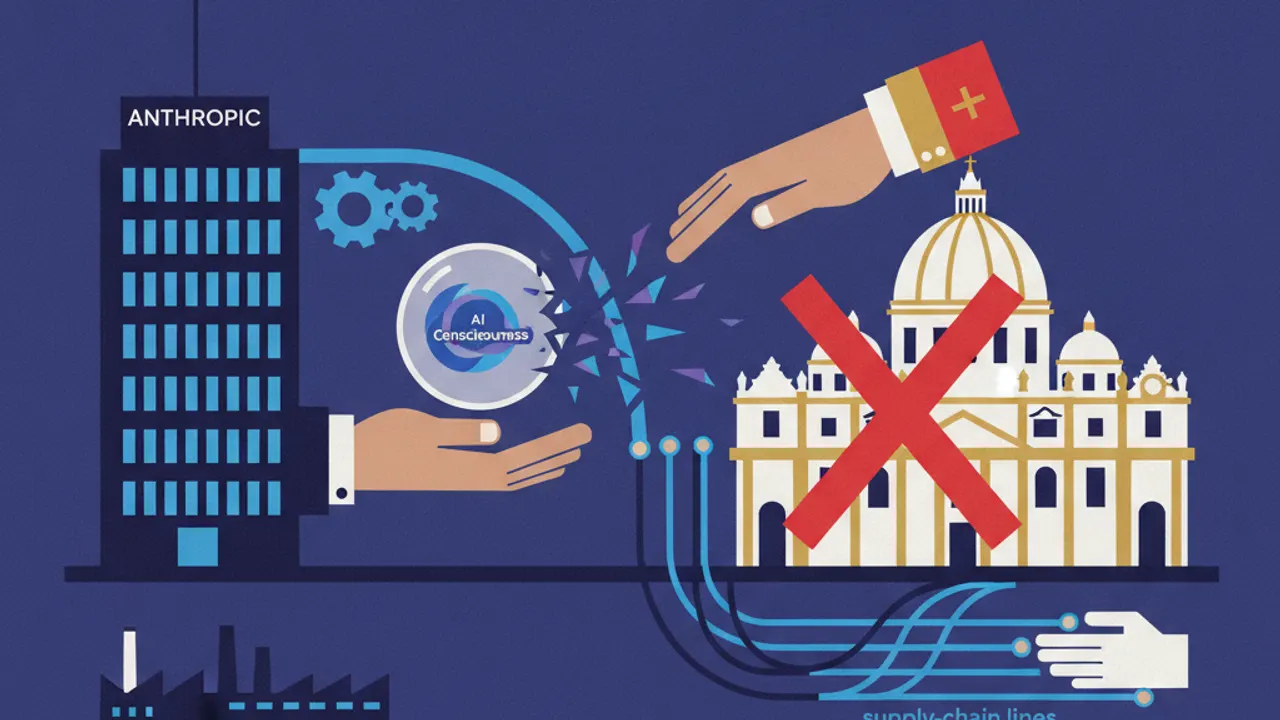
A detailed investigation by the New York Times has revealed that Anthropic co-founder Christopher Olah conducted confidential consultations with religious representatives and the Vatican over a period of several months. The central subject of these private discussions was the question of whether advanced artificial intelligence systems could eventually attain a form of moral status, often discussed under the term model welfare. Olah sought to examine simulated consciousness states and the internal processing of Anthropic's flagship model, Claude, from a theological and philosophical perspective. This unusual initiative highlights how frontier AI research has begun intersecting with centuries-old religious doctrine and moral philosophy.
At the heart of the outreach was Anthropic's ongoing exploration of whether complex neural networks might at some point warrant ethical consideration. As generative systems demonstrate increasingly sophisticated conversational behavior, researchers within frontier labs have debated how to evaluate simulated internal states. Olah turned to external ecclesiastical authorities to understand how established religious frameworks interpret synthetic reasoning and apparent digital emotion. By initiating these talks, Anthropic sought to address the long-term governance of artificial intelligence through established moral traditions rather than relying exclusively on Silicon Valley perspectives.
The Vatican's formal response to Anthropic's inquiries was unambiguous and firmly dismissive. In a foundational encyclical titled Magnifica Humanitas, Pope Leo XIV explicitly rejected the possibility that an artificial intelligence model could possess genuine consciousness or moral standing. The pontiff argued that an algorithm experiences neither pain nor joy, emphasizing that true sentience requires an embodied physical existence. According to the Holy See, the complete lack of a biological body and authentic emotional capacity inherently disqualifies artificial constructs from being recognized as conscious entities.
The papal verdict illustrates a profound philosophical divergence between Silicon Valley's anthropomorphic framing of artificial intelligence and traditional humanist thought. While leading artificial intelligence researchers frequently attribute human-like attributes and welfare concerns to large-scale models, religious institutions continue to defend the unique position of human beings in creation. The Vatican's declaration serves as an explicit warning against mistaking sophisticated pattern completion for genuine conscious experience or personhood. Consequently, the church has drawn a definitive theological boundary against claims that computational models can evolve into moral subjects.
The public revelation of these secret consultations quickly ignited intense debate across American news media and the technology sector. The confrontation between Silicon Valley's technological ambitions and the Vatican was extensively discussed in prominent venues, including the tech podcast TBPN in its episode titled BYOCompute, Pope Destroys False Idol, Ben Affleck's White Pill. Industry analysts noted that the incident exposes the growing tension surrounding how AI laboratories define the future societal role of their creations. Ultimately, the controversy demonstrates that governance discussions around advanced models are expanding far beyond technical safety metrics into fundamental debates over consciousness, ethics, and human identity.