
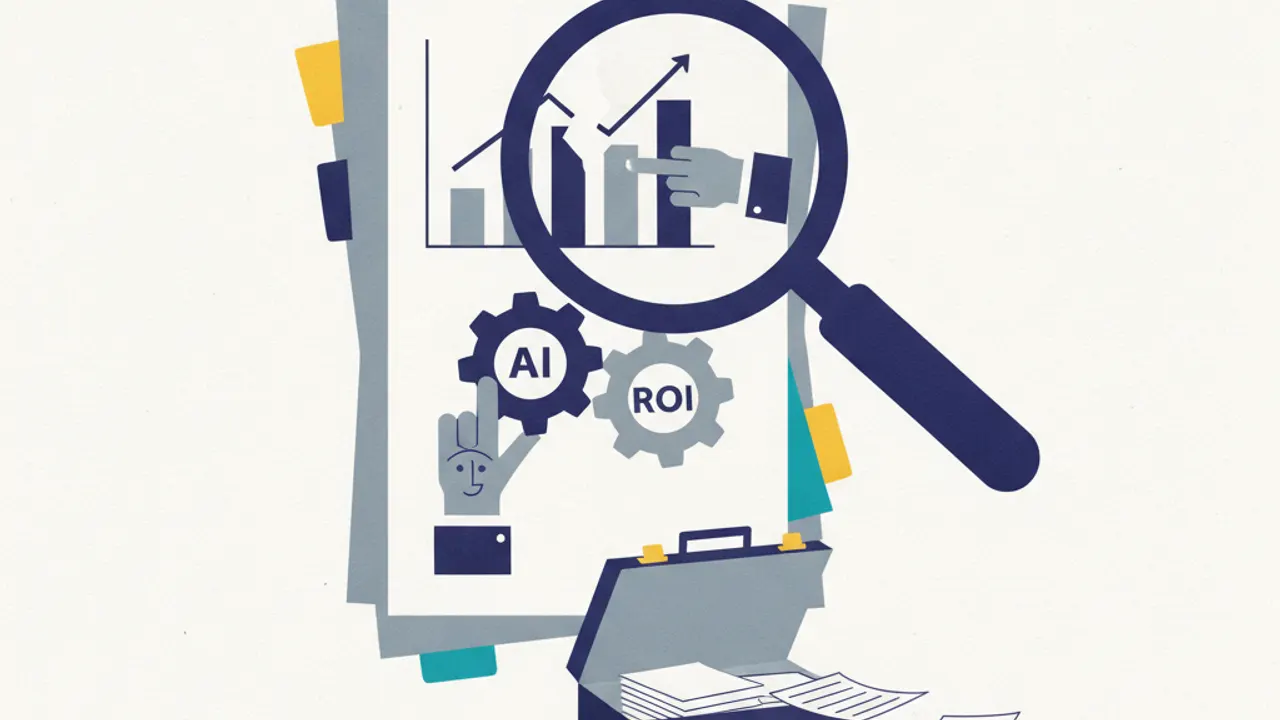
Artificial intelligence in the enterprise has transitioned from an exploratory gimmick to an established component of everyday work. However, a series of new empirical studies from prominent research institutions and advisory firms paints a sobering picture of corporate reality. While employees routinely operate AI tools, a significant chasm has opened between day-to-day adoption and net commercial returns. Simultaneously, an increasing number of organizations are delegating operational decisions to autonomous software agents without establishing robust oversight or liability mechanisms.
Recent figures from the U.S. Census Bureau Business Trends and Outlook Survey underline how deeply AI has penetrated commercial operations. The formal adoption rate among US firms reached 24.6 percent in October 2026, marking a substantial increase from just 3.7 percent when data collection began in September 2023. Furthermore, 29 percent of surveyed businesses state that they plan to integrate AI into their operational processes over the coming six months. The expansion is led by the information and technology sector at 46 percent adoption, while retail lags far behind at approximately 14 percent.
This rapid adoption is not translating into unreserved executive confidence. The fourth annual study published by Wharton Human-AI Research at the University of Pennsylvania alongside GBK Collective demonstrates clear signs of managerial disillusionment. Knowledge workers using generative AI on a daily basis surged to 62 percent, up 16 percentage points compared to 2025. Conversely, the proportion of executives reporting that they feel enthusiastic about AI within their organizations dropped by eight percentage points year over year. Only 28 percent of managers report a strongly positive return on investment, and merely seven percent meet all three criteria for mature transformation.
Similar findings emerge from the global report issued by the Deloitte AI Institute, which surveyed 3,500 director- and C-suite executives across 25 countries. While 81 percent of respondents affirm that AI accelerates decision-making cycles, only 25 percent have fundamentally transformed their organizational workflows. Financial visibility also presents major inconsistencies: although 28 percent of companies now report measurable top-line revenue gains from AI, accounting controls remain incomplete. While 71 percent monitor aggregated API and token expenditures, only 44 percent track unit economics per individual inference unit.
Deloitte's findings regarding operational autonomy are particularly striking. Forty percent of surveyed enterprises already permit AI systems to execute operational actions or make decisions without prior human review or approval. Yet corporate governance has failed to keep pace: 23 percent of organizations have no clear internal policy determining who is legally or operationally accountable when an autonomous system produces erroneous or harmful outcomes. A parallel study by the UK Department for Science, Innovation and Technology and the Department for Business and Trade similarly identified internal auditing limitations and compliance barriers as the primary obstacles to scaling.
Academic researchers from KLU Hamburg, TU Eindhoven, and Emory University issue an explicit warning against uncontrolled full automation. In a joint paper, they argue that entirely removing human judgment from operational processes disrupts the vital feedback loop required to keep underlying models aligned with dynamic market shifts. Without human oversight, algorithmic performance deteriorates gradually. Instead of unconstrained autonomy, the researchers advocate a targeted automation model where manual oversight is deliberately preserved at mission-critical checkpoints to safeguard operational stability.