
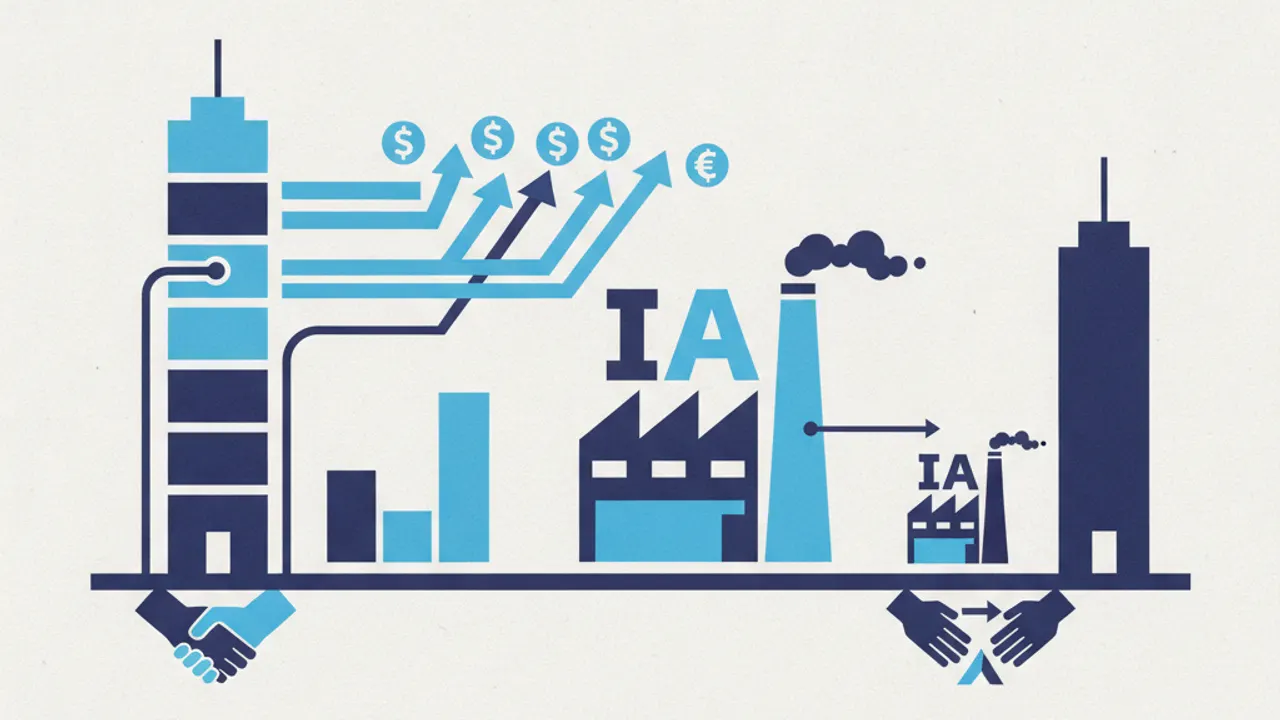
As the global debate over generative AI and enterprise automation accelerates, a significant investment divide has opened between American corporations and Central European industry. According to a study published on September 7, 2026, by management consultancy Horváth, industrial enterprises in the United States invest an average of 2.9 percent of their revenue into artificial intelligence. In contrast, German industrial firms commit only 0.6 percent of their revenues to the same category. US competitors are effectively dedicating nearly five times the financial resources toward advancing their computational capabilities.
This gap does not stem from an outright reluctance to invest. Horváth's survey found that roughly 90 percent of surveyed German companies plan to increase their budgets for big data and artificial intelligence over upcoming cycles. The consultancy emphasizes that the core bottleneck is neither a refusal to allocate capital nor the burden of hardware costs. Instead, deep structural deficits within organizational data architectures are holding initiatives back across the manufacturing sector.
Many established firms are constrained by heterogeneous data silos and legacy enterprise resource planning software that prevent the continuous, structured flow of operational information. Compounding these structural weaknesses is a persistent shortage of in-house personnel qualified to scale and oversee advanced algorithmic deployments. Without standardized interfaces and clean data pipelines, organizations struggle to move systems out of controlled proof-of-concept setups into day-to-day operations.
The ground-level impact of these bottlenecks was underscored on September 10, 2026, during the IFS Connect DACH conference in Munich. In an IFS survey of 91 executives from industrial and mid-market enterprises across Germany, Austria, and Switzerland, 43 percent reported that their organizations remain trapped in isolated pilot phases. An additional 27 percent deploy tools productively only within specific individual departments. Only four percent have achieved a comprehensive, company-wide operational rollout.
Among early adopters, measurable operational gains are surfacing primarily within supply chain management and logistics networks. Yet scaling beyond these initial areas remains difficult for the majority of organizations. The survey indicates that 55 percent of leaders identify poor data quality and missing interfaces as their primary operational obstacle. Furthermore, 38 percent cite complex integration with legacy infrastructure, while 37 percent point to an inability to demonstrate a clear return on investment.
Taken together, the findings from Horváth and IFS present a sober assessment of industrial digitization across the DACH region. While corporate leadership recognizes strategic necessity and assigns growing budgets, executions stall at the infrastructure level. Without focused remediation of legacy software stacks and fragmented datasets, regional manufacturers risk trailing further behind international peers that are already embedding automation across their core operations.