
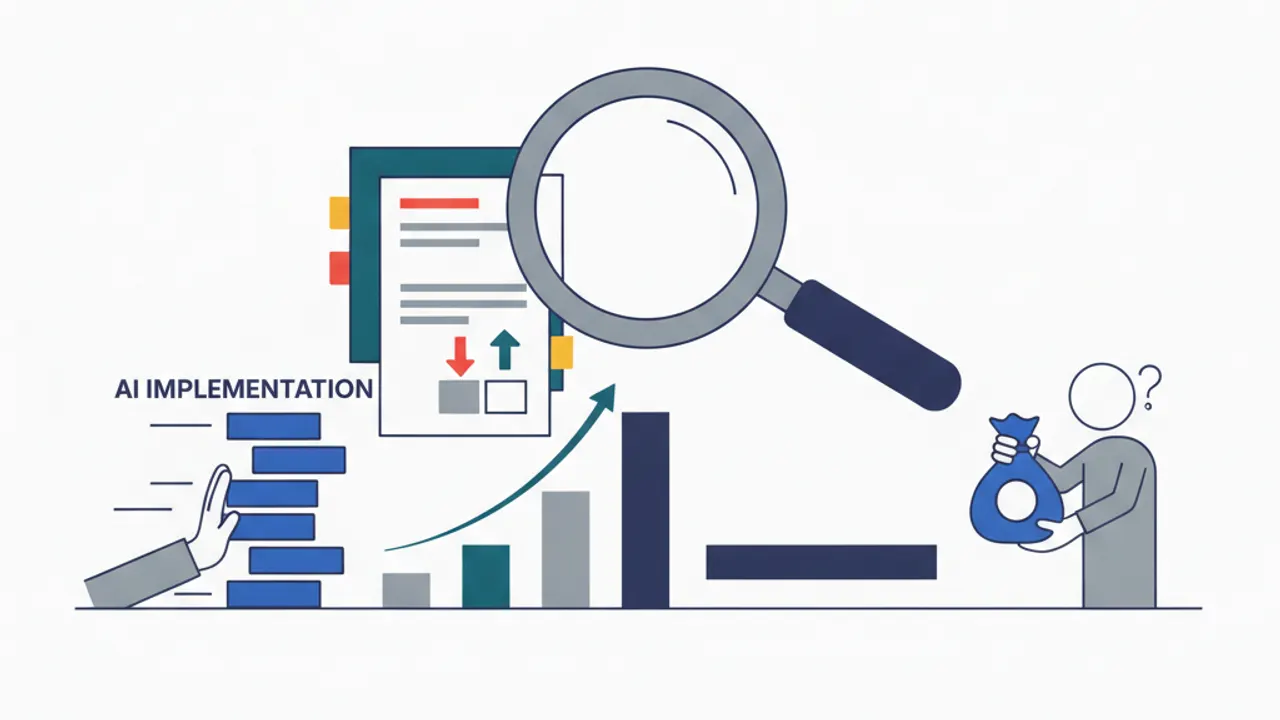
A series of empirical market surveys published in August 2026 presents a nuanced perspective on corporate AI deployment. While artificial intelligence is entering enterprise environments at record speed, a significant disconnect has emerged between individual employee productivity gains and measurable financial returns on the balance sheet. Research conducted by advisory firms, economic institutes, and polling organizations highlights that companies face substantial operational hurdles.
The extent of operational integration is highlighted in the Middle Market AI Survey 2026 by RSM US LLP. According to the report, 90 percent of surveyed mid-sized technology and service firms have integrated AI fully or in specific workflows. Furthermore, 89 percent of decision makers plan to increase their AI budgets in the coming fiscal year. Spending is focused primarily on specialized AI software (68 percent) and data platform modernization (52 percent), while talent shortages and poor data quality remain key obstacles to scaling.
Despite robust capital allocation, the global Enterprise AI Survey 2026 by WRITER and Workplace Intelligence points to a widespread return on investment dilemma. Although 97 percent of surveyed organizations deployed generative tools or AI agents internally over the past year, only 29 percent report a statistically significant financial ROI across the company. Additionally, 75 percent of executives concede that their AI initiatives served public relations more than operational optimization, while 54 percent of C-suite leaders report organizational friction and operational silos caused by uncoordinated software rollouts.
Labor market implications are simultaneously diverging across regions. A survey by the Munich-based ifo Institute covering over 3,000 AI-using enterprises in Germany revealed that roughly 50 percent of businesses expect AI adoption to dampen wage growth over the next five years, particularly affecting employees with under five years of professional experience. In contrast, the Lloyds Bank Business Barometer in the United Kingdom found that 54 percent of firms saw net job growth driven by AI implementation, with 58 percent allocating funds toward upskilling staff for human-machine collaboration.
From the employee perspective, the 5th Annual Global AI Monitor from Ipsos confirms widespread efficiency gains, with 62 percent of workers across 32 nations reporting measurable time savings over the past twelve months. In the United States, 50 percent of active workers describe generative AI as a permanent fixture in their routine. However, a major governance deficit persists, as only 11 percent of surveyed corporate and communications leaders believe current internal policies are sufficient to mitigate operational and ethical risks.
These structural shifts are also reshaping physical workplaces. A joint research effort by JLL and the MIT Sloan Center for Real Estate indicates that office space demand for dedicated technology and AI teams has expanded by 1.5 percent in major metropolitan areas such as Frankfurt, Berlin, and Munich. Organizations are increasingly developing collaborative, high-tech office environments to concentrate specialized talent in dedicated operational hubs.