
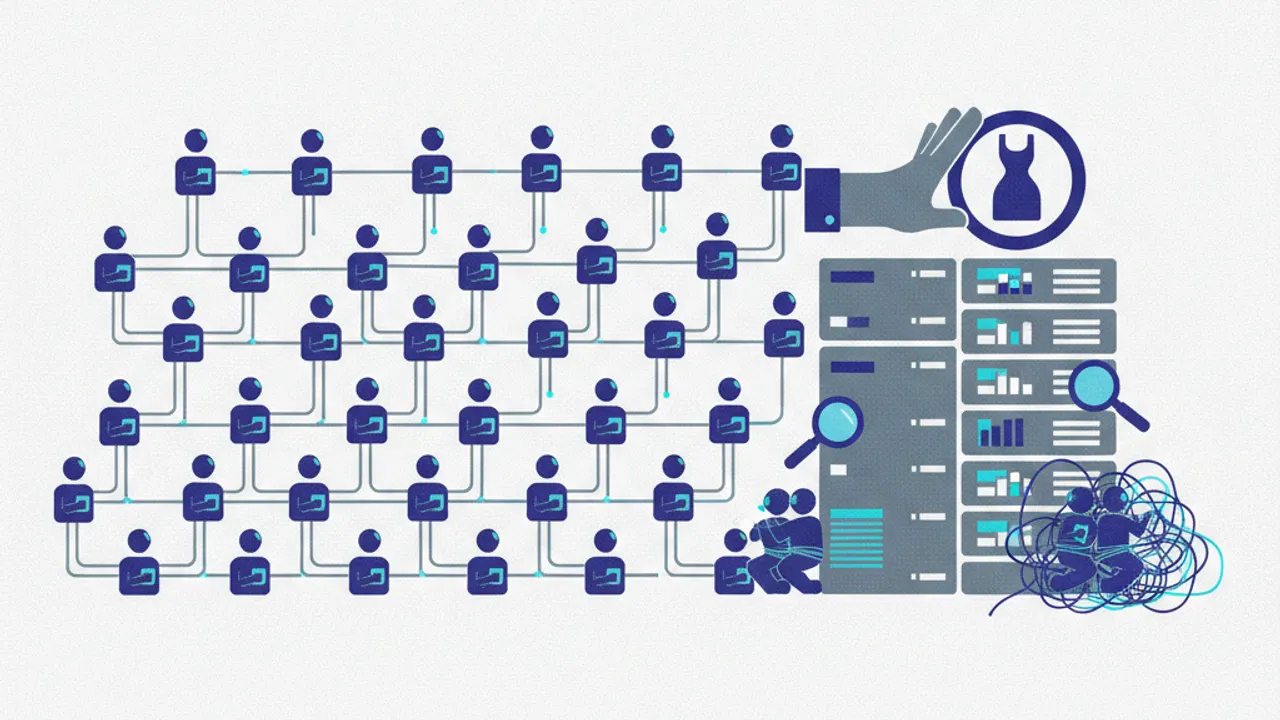
Enterprises are moving beyond experimental generative models and integrating autonomous agents directly into production environments. According to a recent survey of more than 1,600 executives conducted by Box, 83 percent of organizations now actively deploy AI agents across operational workflows. Four out of five surveyed companies report moderate to significant return on investment from these initiatives. Furthermore, approximately half of all respondents demonstrate tangible business improvements and productivity gains within six months of project sign-off.
Commercial success appears closely tied to deliberate organizational governance and structured data preparation. Frontrunners distinguish themselves by designating dedicated personnel responsible for monitoring autonomous agent actions. In addition, high-performing organizations systematically curate unstructured corporate data repositories to feed these agentic environments. The initial vision of fully unsupervised systems is thus giving way to disciplined governance structures that balance human oversight with algorithmic execution speed.
However, the operational rollout of these workloads is increasingly hitting physical hardware constraints. In its global survey, Digital Realty found that 40 percent of IT decision-makers now consider deficient specialized infrastructure the single largest obstacle to scaling artificial intelligence. This represents a dramatic surge from 2024, when only 9 percent of leaders cited infrastructure as their primary bottleneck. Concurrently, only 3 percent of executives report seeing no measurable return, with the vast majority projecting financial payback within six months to two years.
These computational bottlenecks are prompting organizations to rethink their foundational enterprise architectures. Approximately 86 percent of businesses are actively evaluating or deploying private and sovereign AI systems to insulate themselves from unpredictable third-party token consumption costs and to fulfill regulatory compliance demands. Furthermore, 88 percent are embracing distributed data strategies to keep compute close to end users and edge deployments. Consequently, 48 percent of surveyed companies plan to decommission legacy internal data centers altogether.
The sheer scale of infrastructure required to sustain this demand is detailed in a long-term projection by PricewaterhouseCoopers. In its global outlook, the advisory firm models cumulative worldwide investments of 31.6 trillion US dollars into AI-focused data centers and hardware equipment through 2050. Annual capital expenditures are projected to more than double, expanding from approximately 800 billion US dollars in 2026 to 1.8 trillion US dollars annually by mid-century.
Unlike historical infrastructure cycles, PwC expects no prolonged capex decline once the initial construction peak concludes. Due to rapid turnover in specialized semiconductor accelerators and optical networking, financial resources will perpetually funnel into hardware refresh cycles. The share of IT and communications technology within total capital outlay is projected to rise from roughly 70 percent today to 93 percent by 2050. Geographically, North America remains the dominant focal point, capturing 48 percent of aggregate global spending, or roughly 15.1 trillion US dollars, within the United States.