
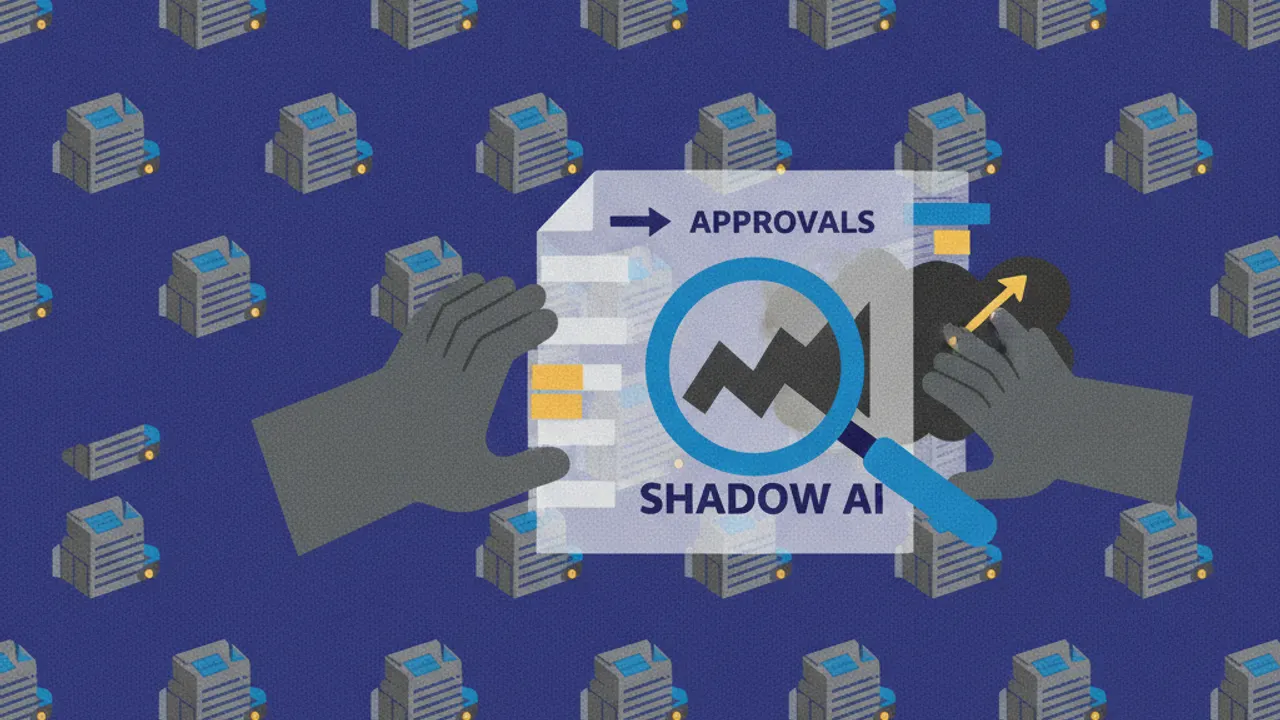
On September 19, 2026, the German Economic Institute (IW Cologne) published its report IW-Kurzbericht Nr. 63/2026 examining the integration of artificial intelligence in corporate environments. Authors Barbara Engels and Andrea Hammermann based their findings on a representative survey of nearly 5,000 employees. The results highlight a growing disconnect between the practical ambitions of workers and the formal infrastructure provided by their employers. Rather than waiting for complex corporate clearance processes, a rising number of staff members independently adopt digital tools for daily tasks.
The primary finding from the Cologne researchers is the widespread prevalence of unauthorized shadow AI across departments. Exactly 29.1 percent of employees who utilize AI systems for their work rely on tools or user accounts that have neither been provided nor approved by their company. Workers frequently turn to private accounts on commercial chatbot platforms to draft communications or conduct operational research. While this approach tangibly increases personal working speed, IW Cologne warns of substantial consequences. Unvetted tool usage poses severe hazards to data protection regulations, internal IT security, and the preservation of corporate trade secrets.
The authors observed a particularly striking pattern labeled the deployment paradox. Informal shadow AI usage is highest in organizations that actively invest in employee training and formal AI skill development. When newly acquired technical capabilities encounter rigid approval hierarchies and slow IT provisioning, operational friction inevitably follows. Because formal IT departments fail to keep pace with the workforce's fostered willingness to apply AI, trained personnel consistently resort to private workarounds.
This systemic organizational bottleneck is mirrored across large-scale enterprise deployments. On September 5, 2026, research firm IntuitionLabs published a meta-synthesis titled Enterprise AI Deployment Failures and Outcomes in 2026. Evaluating empirical data from organizations including MIT, RAND, S&P Global, and Gartner, the paper details pervasive pilot-to-production failures. The analysis demonstrates that between 30 percent and more than 80 percent of enterprise-wide AI initiatives completely miss their targeted revenue gains or operational cost reductions.
Crucially, IntuitionLabs found that modern algorithms are rarely the primary root cause of these project failures. Approximately 95 percent of abandoned or unprofitable deployments flounder due to institutional friction rather than model deficiencies. The predominant obstacles include inflexible legacy workflows, absent data governance frameworks, and disconnected tool silos that lack integration with core IT systems. Taken together, both studies establish that enterprise AI maturity depends far less on raw model capability than on responsive operational structures and timely tool access.