
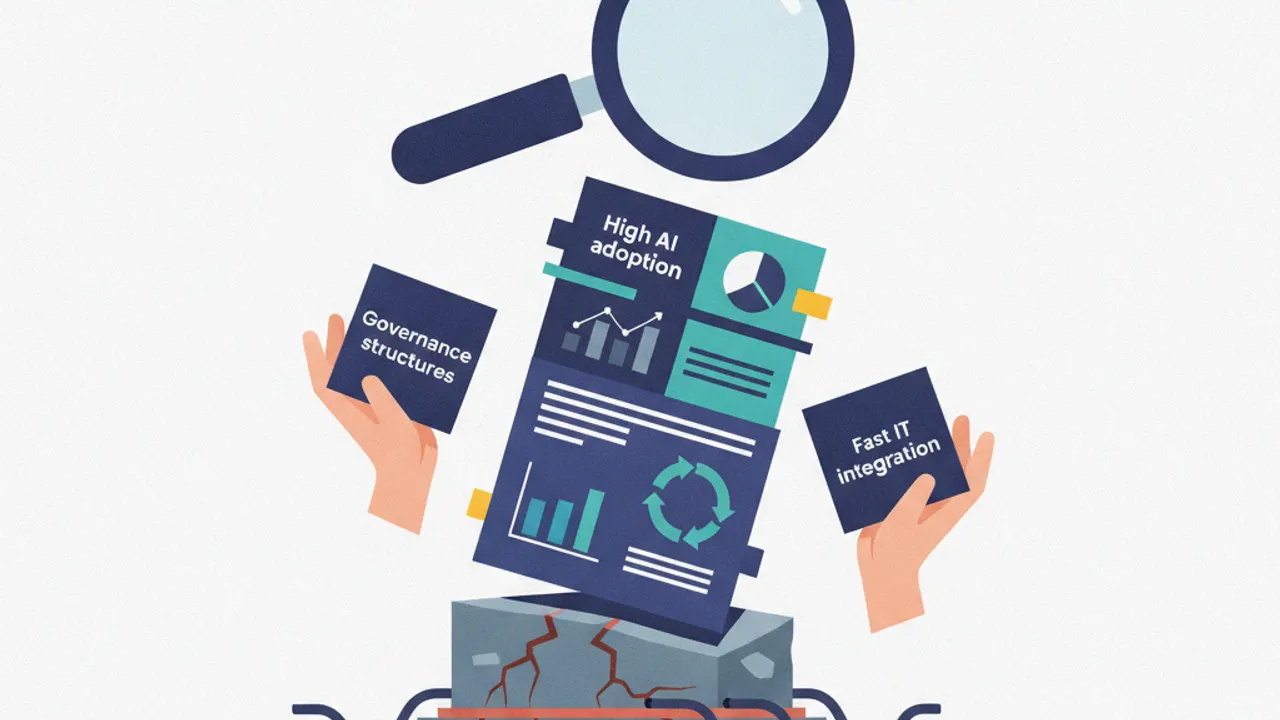
European enterprises are accelerating the deployment of artificial intelligence across internal operations, but organizational governance and technical integration are struggling to keep up. Two comprehensive reports published in late October 2026 by observability platform Datadog and payment provider Mastercard expose a growing rift between operational rollout and foundational control. While German enterprises in particular have taken a leading role in production IT environments, many organizations lack effective management mechanisms and modernized IT infrastructures.
The study 'The State of Operational AI in Europe 2026', conducted by Censuswide on behalf of Datadog, surveyed 756 IT decision-makers across Germany, the United Kingdom, and France. The data identifies Germany as a distinct operational frontrunner: 52 percent of German large enterprises using AI run the technology productively in everyday IT operations. By contrast, the adoption rate in both the United Kingdom and France stands at only 29 percent. However, this aggressive expansion across German IT infrastructure has outpaced corporate control frameworks.
The Datadog findings highlight a substantial steering deficit among German enterprises. Fifty-four percent of domestic IT leaders acknowledge that the velocity of AI implementation outpaces their organization's ability to govern it technically and regulatory, compared to a three-country average of 43 percent. Only 6 percent of respondents feel their governance framework is ahead of deployment. This dynamic produces a maturity paradox: 65 percent of self-described innovators report lagging oversight structures, whereas almost one third of low-maturity companies falsely believe their existing controls are entirely sufficient.
These structural challenges are corroborated by Mastercard's 'Industry Voices 2026' report, which surveyed 7,200 executives across 16 international markets. The research establishes that basic adoption across Europe is virtually ubiquitous, with 99 percent of large enterprises using AI in some form and 97 percent of surveyed professionals accessing tools regularly. Yet only 24 percent of organizations have systematically embedded AI into strategic core processes across the entire enterprise. Consequently, everyday usage remains largely confined to tactical tasks rather than fundamental business transformation.
Outdated IT architectures represent the primary bottleneck behind this operational friction. According to Mastercard, 69 percent of enterprises struggle to integrate new AI models into existing technological ecosystems. Fifty-two percent of organizations operate predominantly on heterogeneous legacy systems, significantly retarding projected productivity gains. Furthermore, 83 percent of European corporate decision-makers report a stark mismatch between their strategic AI ambitions and the operational resources available on the ground.
Taken together, both studies underscore that rapid tool adoption cannot compensate for architectural debt and missing governance guardrails. High usage metrics obscure the reality that without consolidated data pipelines and modernized integration layers, organizations risk building unmanageable operational vulnerabilities. For European enterprise leadership, real competitiveness will not be determined by the raw volume of installed AI models, but by their capacity to adapt legacy infrastructure and regulatory controls to the speed of algorithmic execution.