
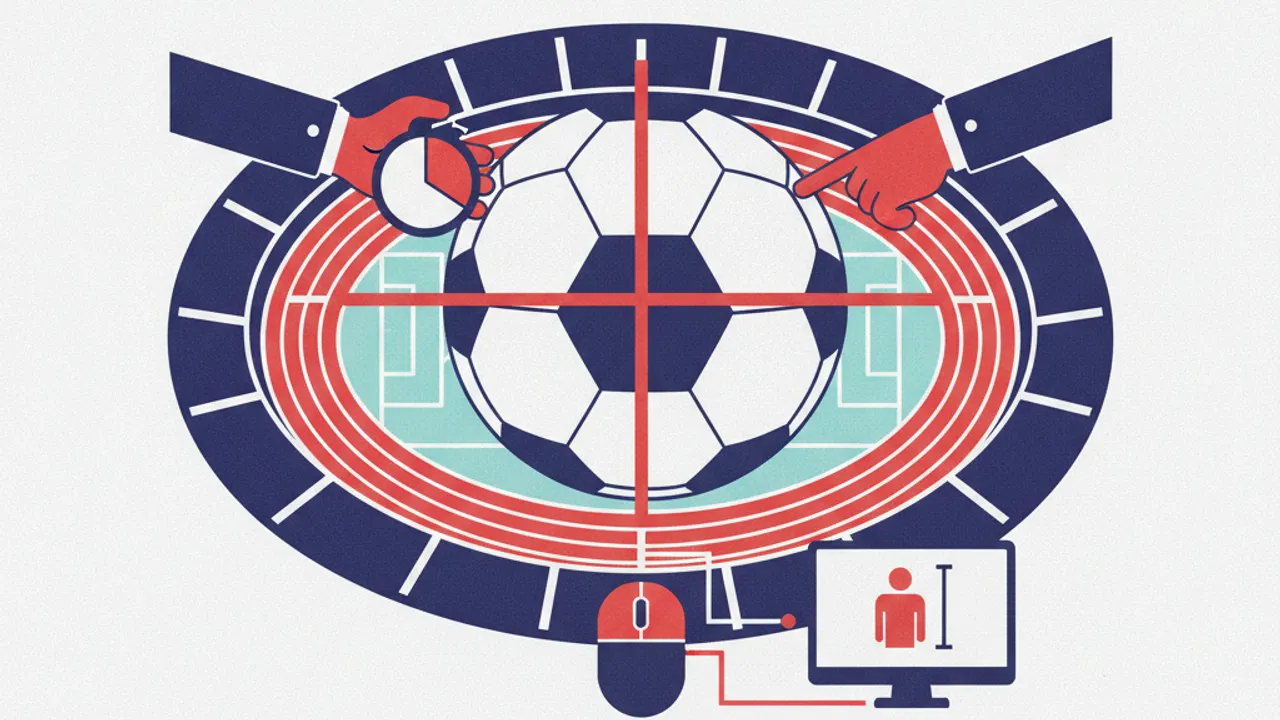
The English Premier League and the Professional Game Match Officials Limited, known as PGMOL, have finalized the operational parameters for their semi-automated offside technology. Following early-season fixtures and assessments by the Key Match Incidents panel, authorities presented the concrete guidelines for regular optical system deployment. The initiative directly addresses long-running disputes regarding drawn-out video reviews that have interrupted match flow across English football. By turning to computer-vision tools, the league seeks to accelerate review timelines while maintaining officiating integrity.
At the center of the technical setup is an optical camera network powered by computer vision from Genius Sports and Dragon. This tracking infrastructure captures thousands of distinct data points per player alongside continuous monitoring of the match ball. Using high-frame-rate tracking, the software builds a spatial representation of player positions at the exact instance a ball is passed. This automated spatial modeling replaces the manual process where video assistant referees drew lines across two-dimensional broadcast footage.
A notable operational decision by the Premier League concerns the visual display of margins. Despite the computational precision offered by the underlying artificial intelligence, the league has mandated that thicker tolerance lines will continue to be digitally rendered. Officials justified the retention of these broader lines to avoid stifling attacking football over millimeter-scale margins. Attackers will therefore not be penalized for negligible positional advantages that provide no practical advantage on the pitch.
Beyond technical accuracy, the primary objective of the semi-automated system is the reduction of match delays for players and supporters. The league estimates that the automated offside technology will shorten video assistant referee reviews by an average of more than 30 seconds per incident. Prolonged reviews in previous seasons frequently drew criticism from managers and fans for disrupting the tempo of the sport. Delivering rapid spatial coordinates to match officials is intended to curb these extended stoppages.
The rollout parameters were shaped by comprehensive evaluations conducted by the Key Match Incidents panel. This independent panel reviews critical match situations throughout the season to assess refereeing consistency and performance benchmarks. Evidence collected from opening matchdays provided the foundation for calibrating how optical tracking feeds into the match officials' decision workflow. The implementation reflects a calculated compromise between automated tracking precision and the traditional spirit of football.