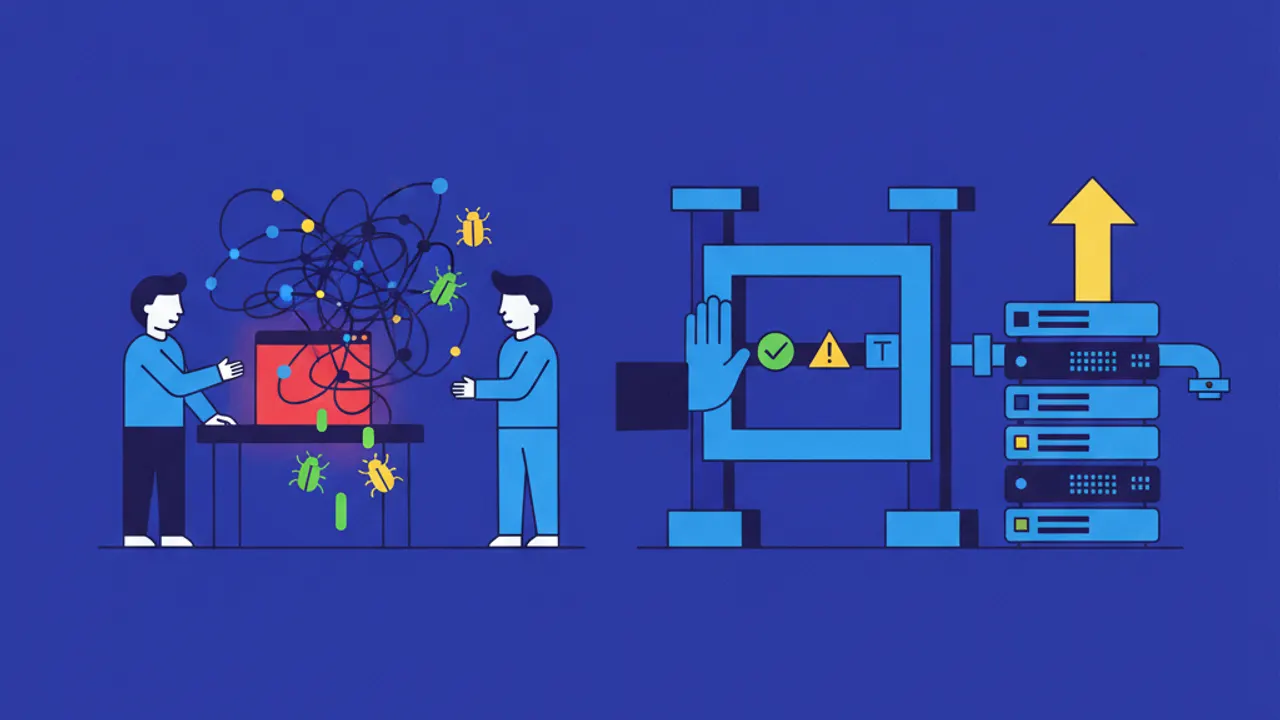
Software engineering workflows are undergoing a fundamental transformation. According to an analysis published by Simon Willison on August 22, 2026, traditional line-by-line code reviews suffer cognitive collapse under the rapid execution speed of autonomous coding agents. Human developers can no longer manually inspect the vast volume of automatically generated diffs without compromising review quality. Consequently, the primary skill in agentic engineering is shifting from visual diff reading to automated verification.
Data from the State of Code 2026 report highlights a growing oversight gap across engineering teams. While 96 percent of developers functionally distrust AI-generated code, only 48 percent systematically verify it before merging. This stark divide underscores why deterministic testing frameworks, strict invariant checks, and golden master files have become essential safeguards against silent failures in agent-produced code.
Alongside the verification debate, Drew Breunig of CMPND has raised concerns regarding the internal architecture of generative software systems. Breunig, co-author of the Context Engineering Handbook, warns against accumulating technical debt through overgrown system prompts, termed prompt debt. In many production setups, monolithic system prompts now account for up to 70 percent of total input tokens, rendering repositories difficult to maintain and driving up inference costs.
To mitigate this structural issue, Breunig recommends treating prompts as perishable goods and decomposing complex workflows into smaller, modular components. Instead of maintaining sprawling prompt strings, teams should implement structured evaluation pipelines and adopt programmatic optimization frameworks such as DSPy. This approach enables dynamic optimization and automated testing rather than reliance on brittle, manually tuned instructions.
This shift signals the end of uncritical generative AI adoption in enterprise software environments. Engineering organizations must restructure their delivery pipelines to capture the productivity gains of coding agents without degrading system stability. Going forward, the engineering focus shifts away from writing individual code lines or massive prompt texts toward designing rigorous specifications and automated verification environments.