
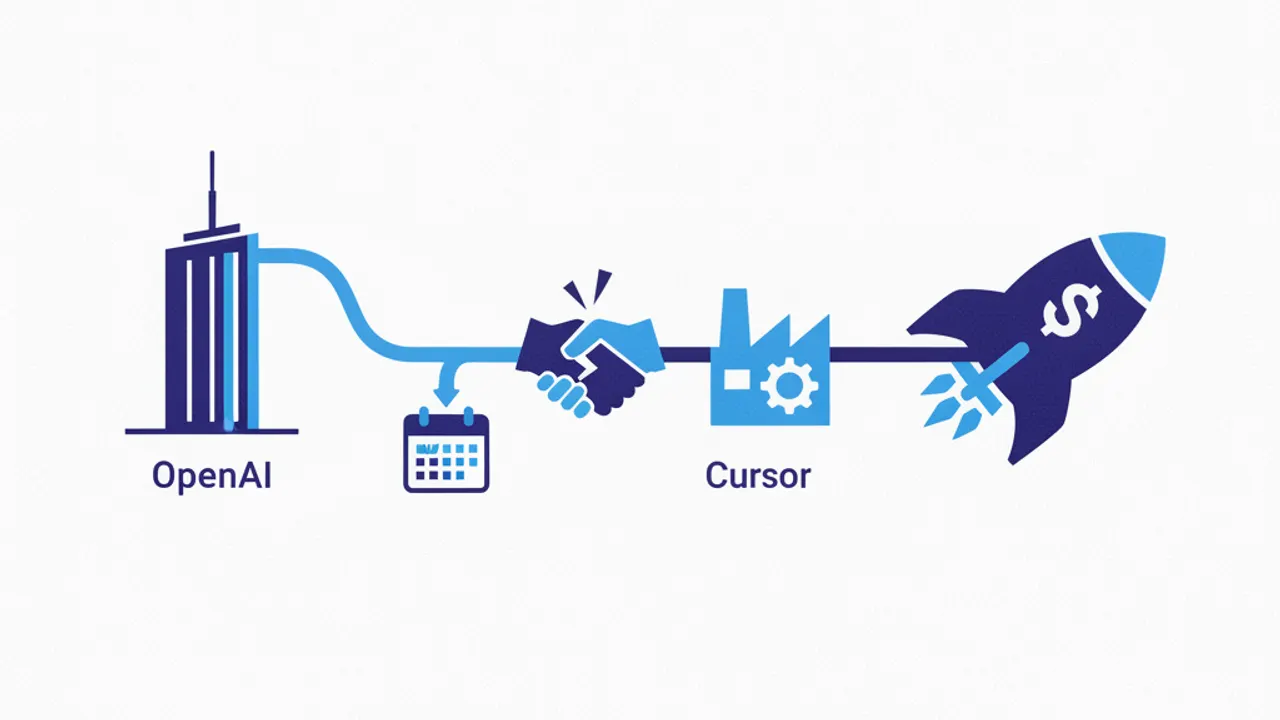
A major fracture has emerged in the developer ecosystem: OpenAI has announced it will not renew its partnership contract with AI coding assistant Cursor. The commercial agreement with Cursor's parent company, Anysphere, is scheduled to end on November 12, 2026. The decision comes directly after the acquisition of Cursor by SpaceX in a deal valued at 60 billion US dollars.
OpenAI cited a lack of confidence in compliance with its terms of service by companies associated with Elon Musk as the main rationale. In public statements, the company highlighted ongoing disputes and allegations surrounding the unauthorized distillation of proprietary data for training xAI's Grok models. With the expiration of the agreement, Cursor loses direct access to OpenAI's core model offerings.
The fallout for Cursor's feature pipeline is significant. Upcoming model architectures, including OpenAI's next-generation system Astra, will be entirely withheld from the platform. Engineering teams that rely on Cursor for code completion and automated refactoring will no longer be able to natively deploy OpenAI's most advanced models starting in mid-November.
Rival AI lab Anthropic moved swiftly to capitalize on the rift. Anthropic announced that it is provisioning additional computing capacity for its Claude model suite specifically targeted at Cursor users, seeking to fill the operational void left by OpenAI. This move signals a realignment of alliances across the developer tooling market.
For enterprise engineering organizations and software teams, the cutoff necessitates an immediate review of their developer toolchains. Many companies integrated Cursor as a standard development environment over the past year. These teams now face the task of adapting their multi-model configurations and evaluating transitions toward Anthropic or xAI infrastructure.
The confrontation underscores how corporate acquisitions and platform rivalries introduce systemic risks into modern software development. When API access is terminated due to high-stakes industry disputes, downstream customers are forced to navigate disruptions caused by power struggles between leading artificial intelligence providers.