
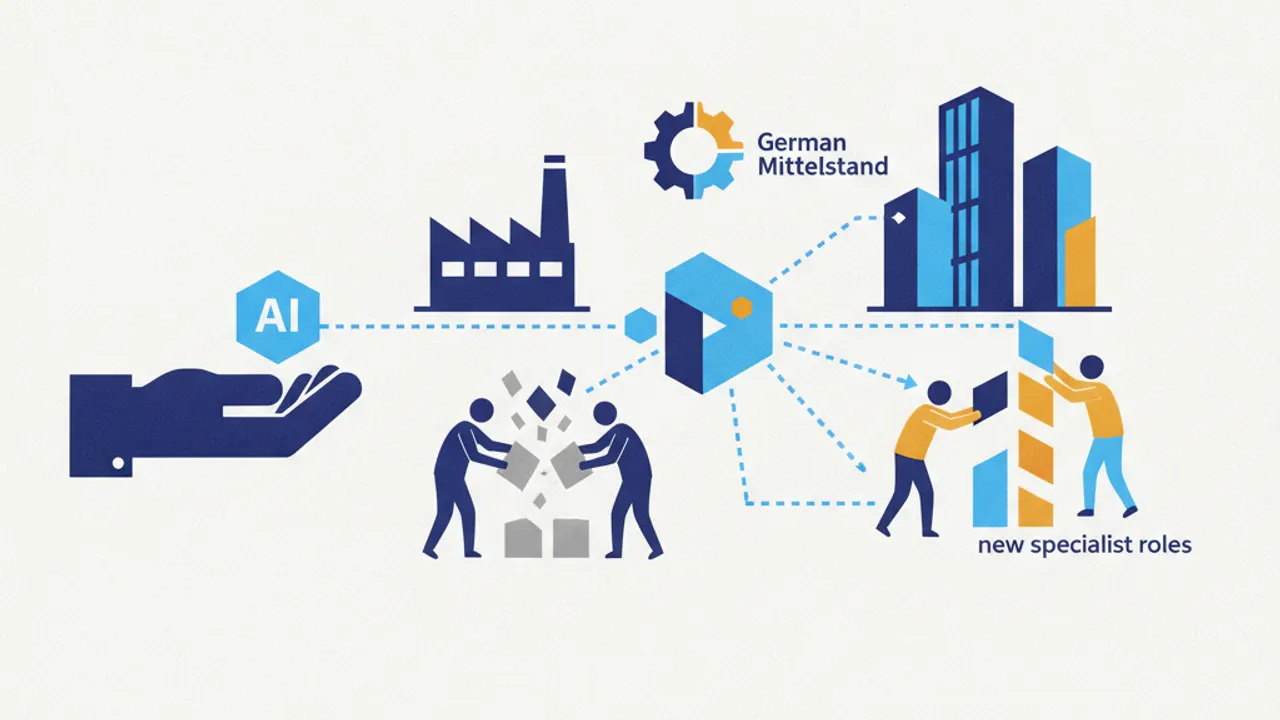
At the Digital Summit, the German Federal Ministry of Labor and Social Affairs presented new empirical findings on the state of the domestic labor market alongside leading economic research institutes. During the panel entitled Work, Growth, Transformation, experts conducted an initial data-driven assessment of how artificial intelligence is being adopted across industrial enterprises. Contrary to widespread concerns about massive job displacement, the findings paint a nuanced picture of day-to-day operations. Rather than triggering sweeping layoffs, German companies are currently undergoing a profound reallocation of job roles and workforce competencies.
The research conducted by the Institute for Employment Research under Professor Enzo Weber and the ZEW under Professor Irene Bertschek details this structural shift. Mid-sized companies that introduce algorithmic tools are gradually phasing out standardized routine tasks in administration and operational processes. Simultaneously, however, these same businesses are actively recruiting specialized talent to guide and supervise the systems. Demand is rising sharply for experts in data management, prompt engineering, and operational governance frameworks.
A complementary study by the German Economic Institute provides the macroeconomic context for this development. Researchers at IW Cologne emphasize that artificial intelligence currently acts primarily as a complement to human labor rather than a replacement. Faced with demographic aging and a shrinking domestic labor supply, the German economy is contending with an acute shortage of available workers. Productivity gains achieved through technological assistance are therefore regarded as the decisive prerequisite for preserving economic output and prosperity in the coming years.
Federal Labor Minister Alexander Schweitzer emphasized during the summit that the primary lever for productivity growth is anchored within small and medium-sized enterprises. To translate technological potential into tangible efficiency gains, organizations must couple technical investments with targeted continuing education initiatives for existing staff. Schweitzer also called on corporate leadership to embrace co-determination as a core success factor. Involving works councils early in the deployment process helps alleviate workplace anxieties and establishes transparent ground rules for daily operations.
This discussion marks a clear shift away from purely technology-centric narratives toward holistic organizational design. Companies across the German-speaking region increasingly recognize that purchasing software licenses does not yield a competitive advantage on its own. True productivity improvements only materialize when internal workflows are restructured, technical interfaces are standardized, and employees are empowered to use tools autonomously. The ongoing labor market transformation is consequently defined not by widespread redundancies, but by a sophisticated rebalancing of qualifications within existing teams.
For labor market policymakers, these empirical findings outline a clear mandate to support the Mittelstand through targeted initiatives. While large corporations possess the capital to establish dedicated training academies and governance frameworks, smaller enterprises frequently struggle with practical implementation hurdles. The Federal Ministry of Labor intends to support this transition through focused funding schemes and collaborative dialogue platforms. If mid-market businesses succeed in engaging their workforce early while establishing clear governance standards, the economy can effectively offset demographic constraints through intelligent automation.