
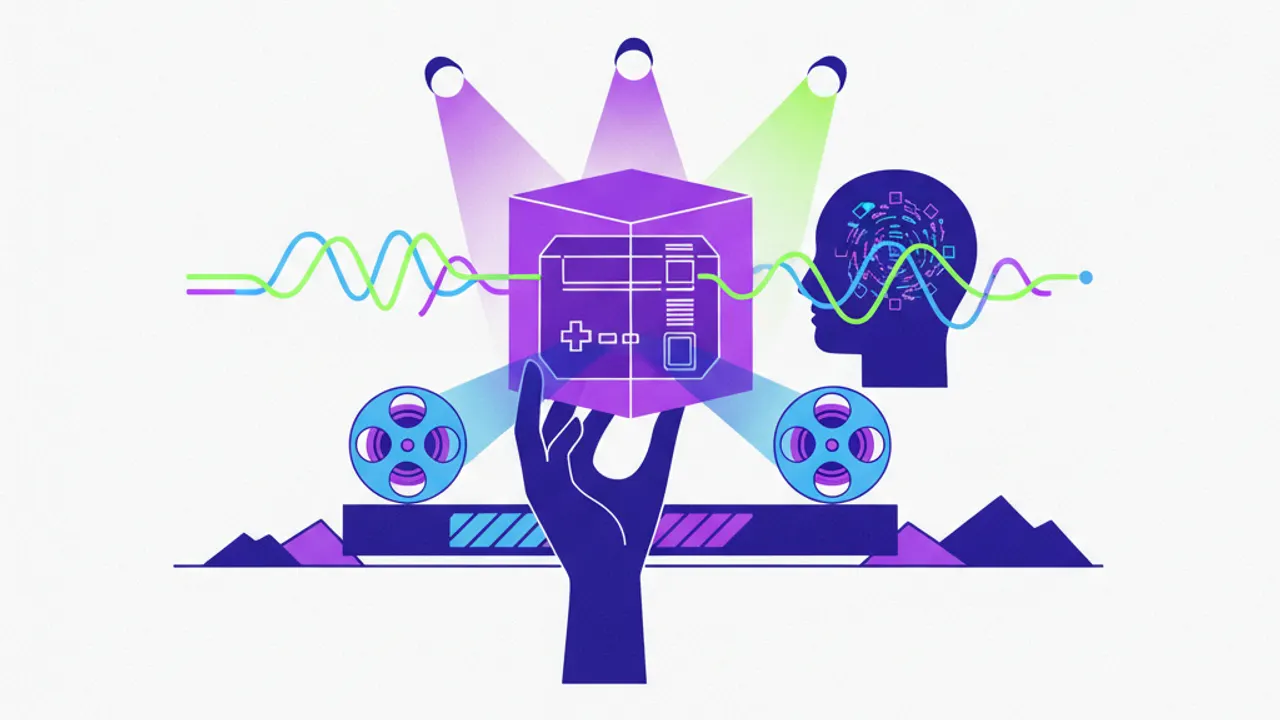
On October 30, 2026, developer Drew Breunig unveiled nesformer, an open source experiment that challenges conventional understandings of computing emulation. The release quickly garnered attention across the engineering community and was highlighted by prominent software curator Simon Willison. Rather than executing an emulator through traditional software on top of a host operating system, nesformer shifts the hardware logic of a vintage console directly into the weights of an artificial neural network. The project offers a striking demonstration of how large language models can reproduce strictly deterministic hardware systems.
The foundation of the project builds directly upon Qwenputer, a prior experimental architecture developed by researcher Divyansh Agrawal. Breunig adapted this approach to encode the complete instruction set and mathematical operators of the Ricoh 6502 processor. This historic 8-bit chip originally powered the Nintendo Entertainment System throughout the 1980s. Instead of using a traditional compiler to translate vintage instructions into modern x86 or ARM machine code, Breunig compiled the entire CPU execution logic directly into the parameter weights of the open source model Qwen3.5-4B.
A primary challenge in emulating physical computing hardware within a neural network involves managing dynamic memory states. Breunig addressed this barrier by utilizing the internal hidden state of the Gated DeltaNet architecture to serve as virtual random-access memory. As the game runs, the language model predicts each subsequent CPU cycle sequentially as its next token generation. A lightweight external rasterizer is then employed to read these internal state predictions and convert them into graphical output on the screen.
To prove the validity of the architecture, Breunig ran unmodified original ROMs, including the iconic arcade title Super Mario Bros. The neural network processes the binary game data correctly, advancing the gameplay state through matrix multiplications rather than conventional instruction pipelines. However, this architectural feat comes at a massive computational cost. Current benchmarks reveal that nesformer runs roughly 150 to 290 times slower than the original physical hardware. Generating a single visual frame requires between one and six seconds of compute time.
While the sluggish frame rate makes real-time gameplay impossible for now, the conceptual achievement remains substantial. The experiment demonstrates that transformer-adjacent models are capable of acting as universal compute engines, executing complex logic without relying on native emulator code. The deterministic behavior of the 6502 microprocessor exists entirely within the numerical weights of the neural network. This provides compelling evidence that large models can move beyond linguistic approximation to represent rigorous, verifiable computational machinery.
The implications for software preservation and the long-term future of interactive entertainment are considerable. As inference acceleration and specialized AI silicon continue to advance, hybrid models could eventually unify game engines, physical simulation and generative content creation into a single computational fabric. Future virtual environments might run without fixed logic engines, resolving rules and graphics simultaneously through learned weights. With nesformer, Breunig has provided an early but foundational proof of concept for this paradigm shift.