
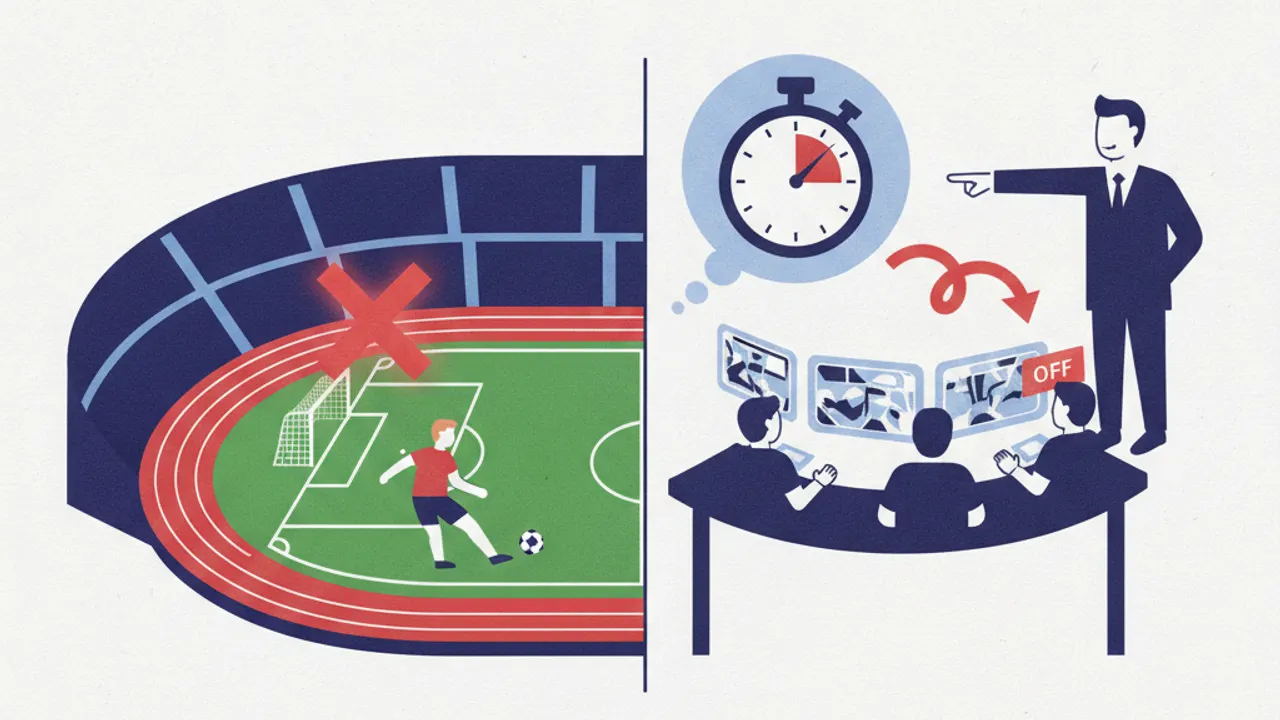
Following the Manchester derby, English refereeing body PGMOL faces a profound debate concerning the role of artificial intelligence in elite football. Referees chief Howard Webb confirmed an official error in the awarding of Erling Haaland's winning goal during the high-profile fixture. In the immediate aftermath, the organization took decisive action by standing down the responsible video assistant referee team from upcoming fixtures. The controversy has exposed unexpected vulnerabilities in how human match officials interact with high-speed automated decision tools.
At the heart of the disputed incident was the Semi-Automated Offside Technology, known as SAOT, which relies on tracking data and advanced computer vision. Within seconds of the play unfolding, the system accurately calculated that Haaland was not offside by a margin of three centimetres. Sensor feeds and camera tracking immediately provided the video room with a clear, millimeter-accurate confirmation of the striker's legal positioning. From a purely metric standpoint, the underlying tracking software executed its specialized technical calculation without any flaw.
The breakdown occurred entirely at the psychological interface between machine output and human judgment. Howard Webb explained that the instant confirmation from the AI triggered an acute cognitive tunnel vision, recognized in behavioral science as automation bias. Because the machine delivered an authoritative line clearance so rapidly, the video officials instinctively assumed that the entire attacking phase had been validated. This overwhelming confidence in the algorithm's output led the referees to abandon their standard procedural skepticism.
As a direct consequence of this automation bias, the video assistant referees failed to conduct a standard manual review of the broader phase of play. Crucially, another player standing in an offside position had committed an active interference with an opponent during the move. The tracking software had solely evaluated Haaland's personal position, leaving the contextual question of interference to human discretion. By relying uncritically on the green light provided by the software, the officials allowed an unlawful goal to stand.
The error has ignited an intense discussion among international refereeing committees regarding the operational boundaries of artificial intelligence. Analysts and administrators emphasize that while algorithms excel at resolving binary metric questions such as offside lines and ball contacts, they cannot interpret subjective rules. When automated systems appear infallible, humans operating as the final check risk becoming passive rubber stamps. Refereeing bodies are now confronting the urgent necessity to redesign training modules to preserve human scrutiny in high-pressure sporting environments.
This derby incident highlights the delicate friction inherent to human-in-the-loop governance across competitive industries. Technological precision can paradoxically undermine overall decision quality if operators surrender contextual responsibility to automated workflows. In response, PGMOL is reviewing operational communication protocols to ensure that subjective infractions are comprehensively assessed before any technological signal is accepted. The challenge of harmonizing algorithmic efficiency with nuanced sports governance has entered a critical new phase.