
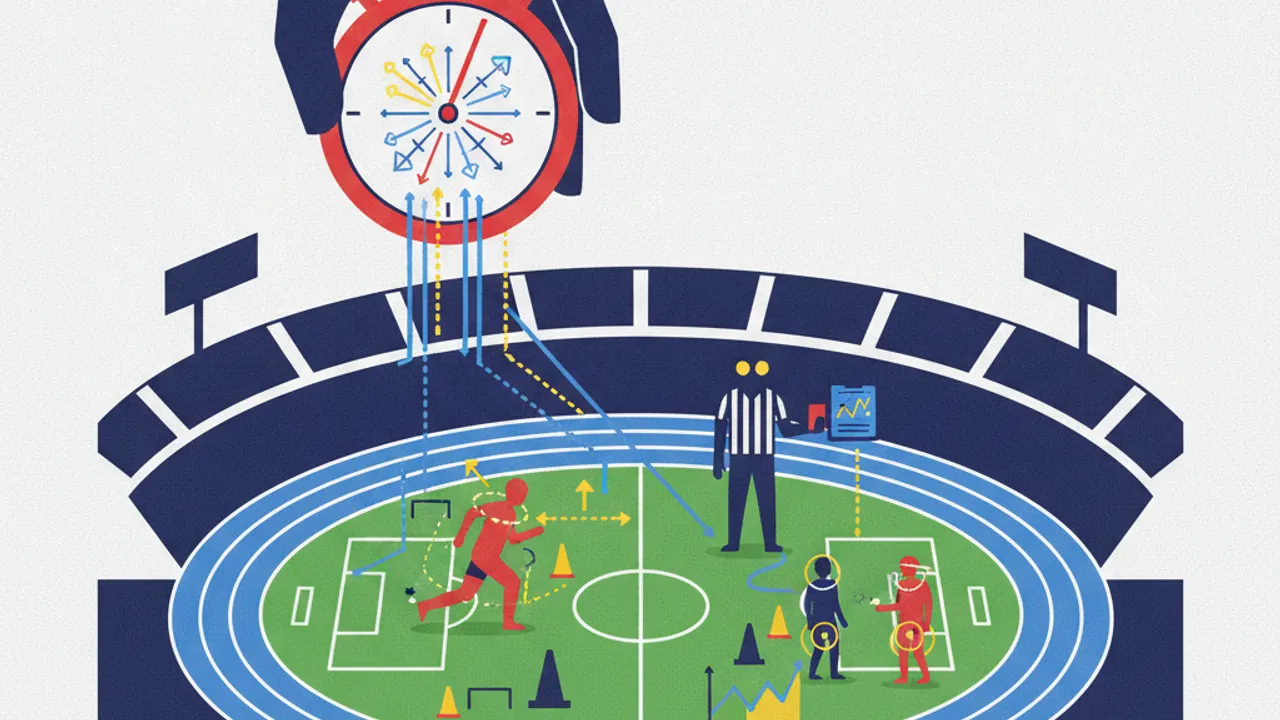
The deployment of machine learning in elite athletics is shifting rapidly from isolated experiments to deeply embedded core systems. On September 26, 2026, an international research team led by Yichen Xu and Qin Jin published an extensive overview of this transition titled 'A Survey of Large Models in Sports'. The paper highlights a fundamental engineering pivot from separate statistical tracking software toward multimodal vision and language architectures. In benchmarking scenarios, current Large Multimodal Models already achieve recognition accuracy rates exceeding 75 percent when identifying intricate tactical plays and formations. Furthermore, generative frameworks now enable coaching staffs to convert synchronized tracking coordinates and video footage into structured scouting reports within seconds.
Beyond post-match analysis, computer vision is entering routine training facilities. Norwegian sports tech firm SportAI is expanding the rollout of its markerless technique coaching system across the international venue network of MATCHi. The platform relies on conventional 2D video feeds captured on site, reconstructing joint angles, acceleration rates, and swing mechanics in real time without requiring on-body sensors. These biometric movement profiles are programmatically benchmarked against elite athlete databases to deliver automated feedback loops that help optimize strokes and prevent overuse injuries.
However, heavy reliance on automated performance guidance carries distinct psychological trade-offs for competitors. A study published on September 30, 2026, in the journal 'Frontiers in Psychology' investigated the mental consequences of algorithm-driven training regimens. The authors observed that uncritical reliance on automated workout metrics can lead to a gradual decline in an athlete's intuitive self-regulation. While adaptive scheduling significantly mitigates physical overtraining, an overdependence on algorithmic pacing recommendations demonstrably blunts an athlete's capacity to adjust independently during unpredictable competitive moments.
Officiating is undergoing a comparable conceptual transition. A comparative study published in the 'Journal of Sport for All and Recreation' evaluated deep learning pipelines incorporating YOLO and hybrid CNN-LSTM architectures against physical tracking sensors. The researchers concluded that vision models capture dynamic physical contact and foul plays with greater fidelity because they interpret entire spatial contexts coherently. The authors suggest that this capability will shift refereeing away from slow post-hoc video reviews toward predictive, real-time alert systems designed to minimize delays during matches.
At the commercial broadcast level, these computational capabilities are turning into live quantitative metrics for audiences and coaching staffs. The National Football League and Amazon Web Services have integrated the 'Tackle Probability' model from Next Gen Stats directly into live broadcast feeds and sideline workflows. Operating on five years of historical game logs, the system calculates success probabilities every tenth of a second by tracking roughly 20 variables, including pursuit angles and closing speeds. Simultaneously, Genius Sports is deploying its GeniusIQ-driven Moments Engine to maintain 3D digital twins that generate context-specific statistical overlays and tailored graphics as plays unfold.