
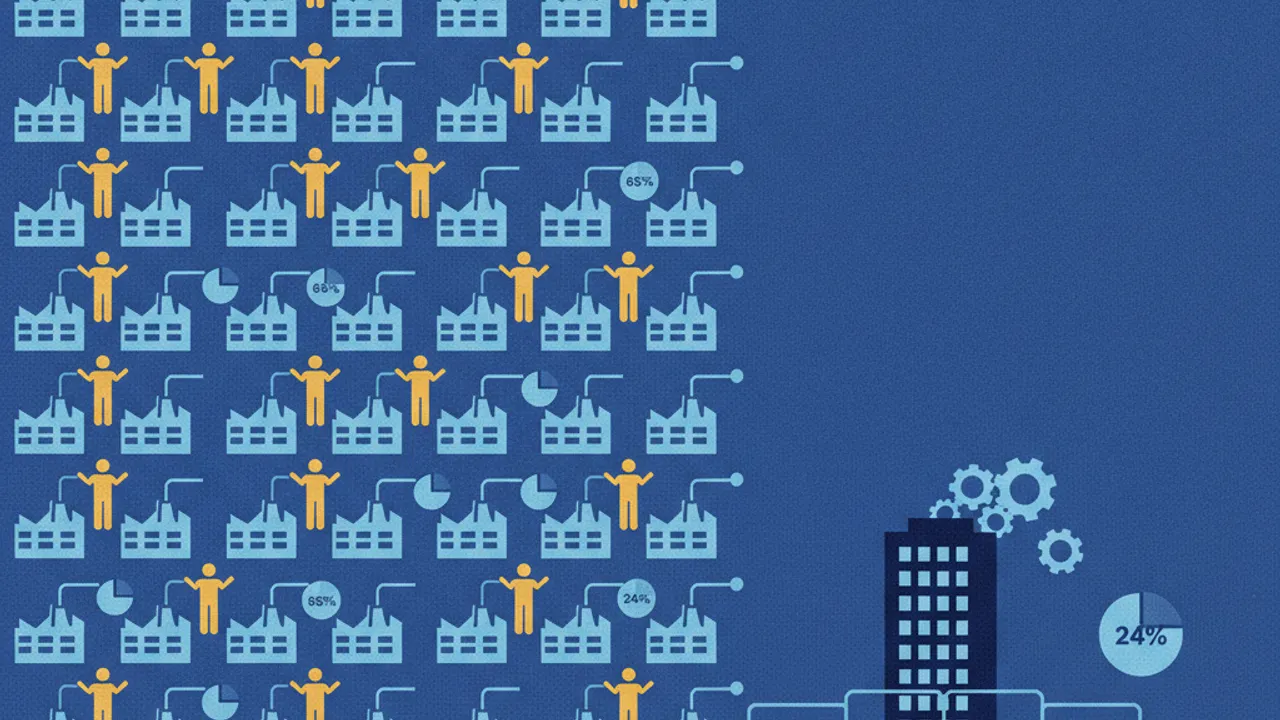
On 24 September 2026, a representative survey conducted by YouGov on behalf of Alibaba.com and the German E-Commerce and Distance Selling Trade Association (bevh) revealed a pronounced split in how German small and medium enterprises adopt artificial intelligence. While basic generative AI tools have reached broad adoption, autonomous AI agents capable of handling complex multi-step processes remain the exception across smaller firms. Only 24 percent of medium-sized enterprises currently deploy autonomous AI agents. The findings highlight that despite widespread experimentation with chatbots, true operational autonomy is still far from standard practice in Germany's corporate backbone.
The discrepancy becomes particularly apparent when comparing simple generative assistants with autonomous agent systems. Around 65 percent, nearly two thirds of surveyed SMEs, state that they use basic generative AI tools at least occasionally in their day-to-day operations. However, once company size increases, the willingness to deploy autonomous agents jumps significantly. Among SMEs with more than 10 employees, adoption rises to 45 percent. In these larger mid-sized operations, decision-makers are far more inclined to delegate end-to-end task flows to software agents.
A key driving force behind this selective adoption is the acute shortage of qualified personnel. According to the YouGov and bevh data, 52 percent of enterprises with at least 10 workers plan to introduce AI agents primarily to resolve operational bottlenecks in order processing and general administration. Companies hope to relieve staff from repetitive administrative duties and accelerate fulfillment pipelines without having to hire additional back-office staff. The technology is therefore treated less as an experimental innovation and more as an urgent pragmatic response to structural labor constraints.
This hesitation among smaller enterprises coincides with an otherwise powerful macroeconomic tailwind generated by artificial intelligence. On the very same day, the Joint Economic Forecast (Gemeinschaftsdiagnose Herbst 2026), compiled by leading economic institutes including ifo, IWH, IfW Kiel and RWI, sharply revised its German gross domestic product growth forecast for 2026 upward from 0.6 percent to 1.3 percent. The research institutes highlighted the worldwide expansion of AI infrastructure as a decisive growth driver. German manufacturers of data center equipment, semiconductor suppliers and ICT service providers are experiencing substantial influxes of orders from both the United States and Asia.
The simultaneous publication of both reports exposes a striking duality in the German economy. On one side, export-oriented industrial suppliers are capitalizing directly on global capital expenditure cycles for compute infrastructure. On the other side, domestic small businesses below ten employees risk lagging behind in leveraging the software productivity gains that this infrastructure is designed to enable. Observers point out that closing this gap will determine whether productivity gains remain confined to industrial hardware specialists or truly revitalize the broader SME economy.
For enterprise software developers and sector associations like bevh, the study signals a clear demand for lower integration hurdles. Autonomous workflows must become as accessible as conversational chat interfaces if the 76 percent of non-adopting SMEs are to be brought on board. As the German economic rebound gains traction through infrastructure investments, the next phase of competitiveness will hinge on whether smaller firms can successfully integrate autonomous agents into their everyday administrative workflows.