
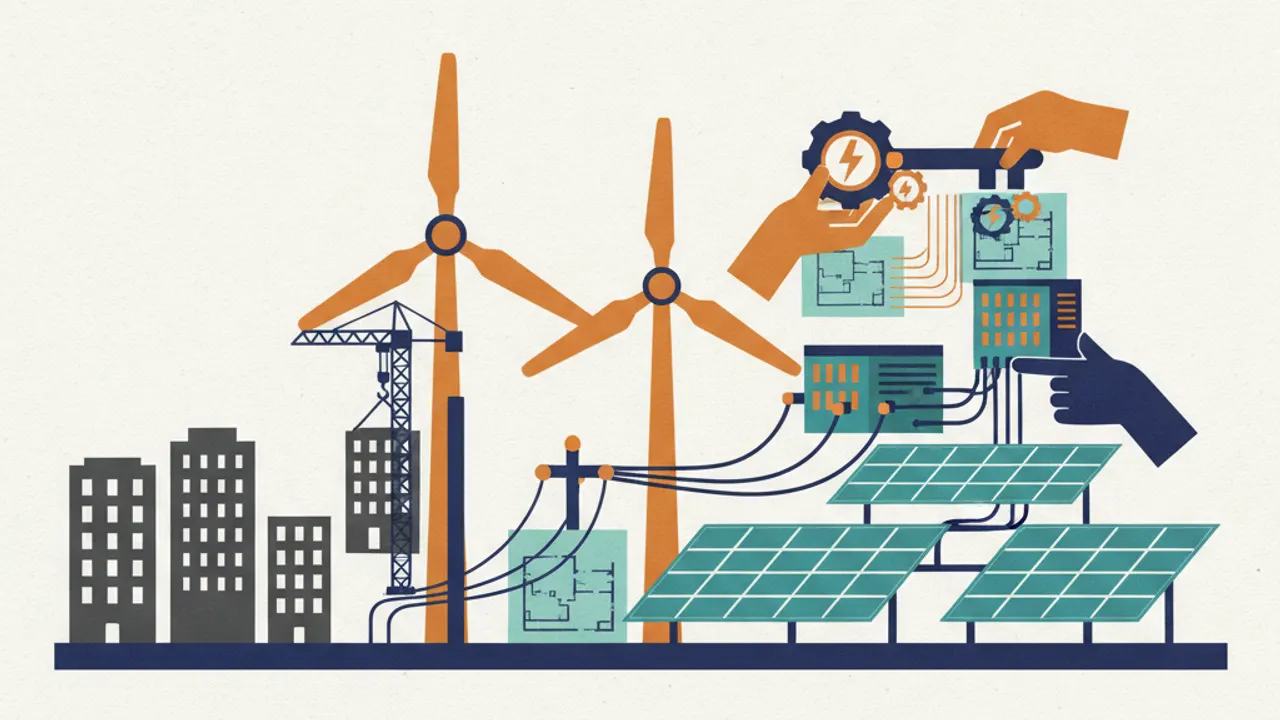
The foundational principles of commercial real estate valuation are experiencing a structural shift in mid-October 2026. A research report published on October 16 by the Urban Land Institute and investment manager Heitman places energy infrastructure at the center of future property pricing. Titled "Investment Strategies in the AI Era: Power Is the New Location", the publication examines how the escalating technical demands of digital infrastructure are transforming the sector. Traditional macro- and micro-location factors are increasingly losing their role as the sole determinants of commercial property value.
This transformation is driven primarily by the massive electricity consumption of data centers and modern artificial intelligence infrastructure. According to the analysis by ULI and Heitman, secured grid capacity, fiber connections, and redundant power supplies have become decisive factors in land and property assessments. For real estate funds and commercial developers, assets lacking guaranteed access to sufficient electrical power face growing competitive disadvantages. Location criteria are being redefined as technical utility metrics take precedence over proximity to conventional central business districts.
Simultaneously, the computational methodologies used for real estate underwriting are undergoing an architectural evolution. European deep-tech startup Kausable announced a significant funding round on October 15, 2026, for its AI-powered valuation platform. The company utilizes adaptive architectures capable of assimilating new data assets without requiring continuous, computationally intensive model retraining. This design allows the software to adjust to market changes far faster than traditional statistical platforms.
Kausable targets automated property appraisal and the environmental, social, and governance management of existing real estate portfolios. Through integrated analysis tools, the platform continuously tracks asset conditions and sustainability benchmarks across commercial properties. By pairing automated underwriting directly with ESG management, the system helps institutional owners meet evolving compliance mandates and identify depreciation risks early.
Industry assessments released alongside Kausable's capital raise also emphasize regional innovation hubs across the German-speaking market. The greater Vienna area is singled out as a leading PropTech center in the DACH region. The Austrian capital now hosts approximately 25 technology startups dedicated to artificial intelligence applications in real estate. This concentration of specialized firms provides the region with a pioneering position in testing machine-learning workflows for real estate transactions and asset operations.
The confluence of physical grid constraints and adaptive algorithmic underwriting is permanently altering institutional investment practices. Market participants must now incorporate direct power availability and dynamic data models into their due-diligence routines. As demonstrated by the findings from ULI, Heitman, and Kausable, standardized location metrics without consideration of electrical capacity and automated data streams are no longer sufficient to project property values.