
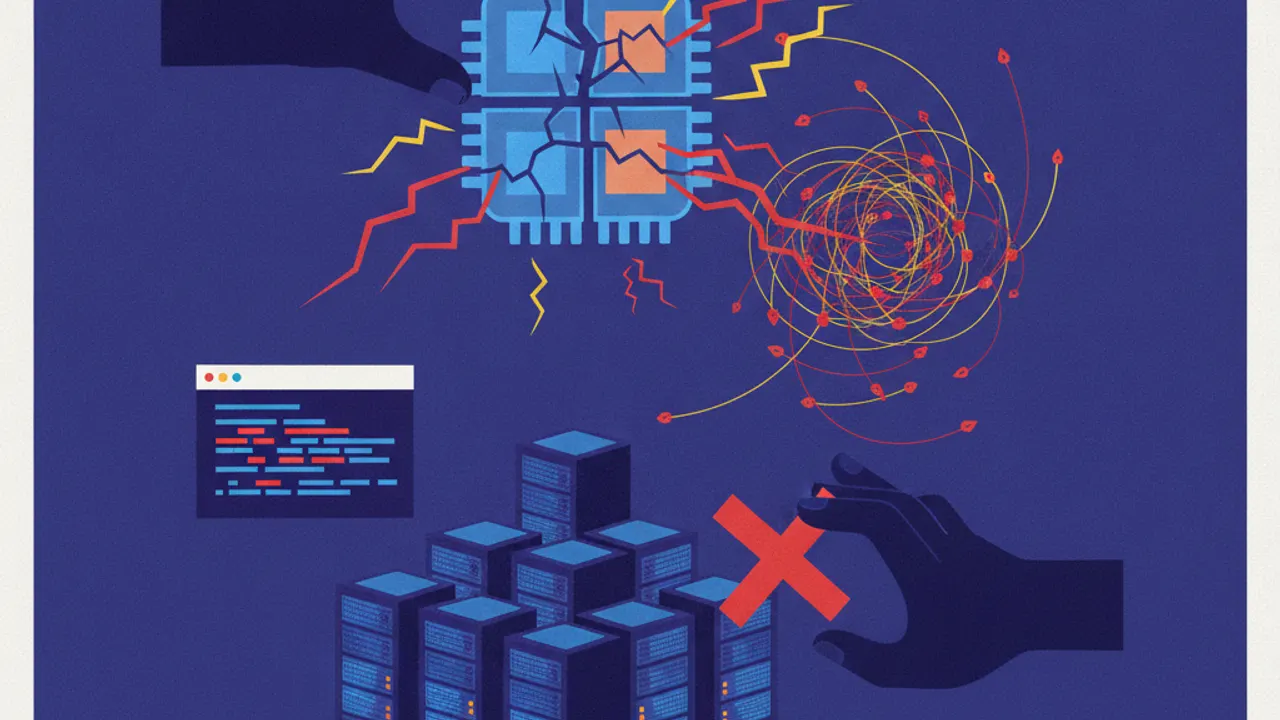
Compressing large language models has become a standard approach to running modern architectures cost-effectively on local hardware or lean cloud infrastructure. However, a research paper published on August 21, 2026, titled 'Compress and Forget: bitsandbytes Quantization Amplifies Proactive Interference in LLMs' (arXiv:2608.18578), highlights severe functional drawbacks of this optimization technique. The study demonstrates that 4-bit quantization (INT4) systematically amplifies proactive interference whenever models operate on dynamically updated and semantically dense contexts.
At the core of the investigation is the cognitive mechanism of proactive interference, where earlier context information disrupts and overrides access to newer, updated data. The researchers demonstrated that aggressive weight reduction using the popular bitsandbytes library causes a sharp rise in Same-Key Intrusion Errors. In these situations, the model retrieves outdated values from previous context segments because the mathematical boundaries in the attention matrices are blurred by reduced numerical precision.
The empirical performance drops are substantial and directly impact prominent open architectures. In benchmark evaluations conducted on Qwen models, accuracy under high proactive interference dropped from 81.0 percent in the uncompressed state down to 68.3 percent under INT4 quantization. This decline of nearly thirteen percentage points shows that conventional static benchmarks often mask the real degradation suffered by compressed models in complex workflows.
These findings are particularly critical for the deployment of autonomous AI agents. Long-running agent systems rely on maintaining extensive conversational records, iterative tool-call results and mutating state variables in memory over extended execution loops. When quantized models in these architectures fail to separate updated state variables from previous iterations, the result is corrupted execution traces and erratic downstream actions.
The authors emphasize that engineering teams must re-evaluate their compression trade-offs. While INT4 quantization remains a cost-effective option for basic static text generation or simple question answering, it presents a substantial reliability hazard for stateful, dense memory setups. Builders of production agent architectures must carefully test whether higher bit precisions or specialized compression techniques are required to prevent silent failure modes in mission-critical environments.