
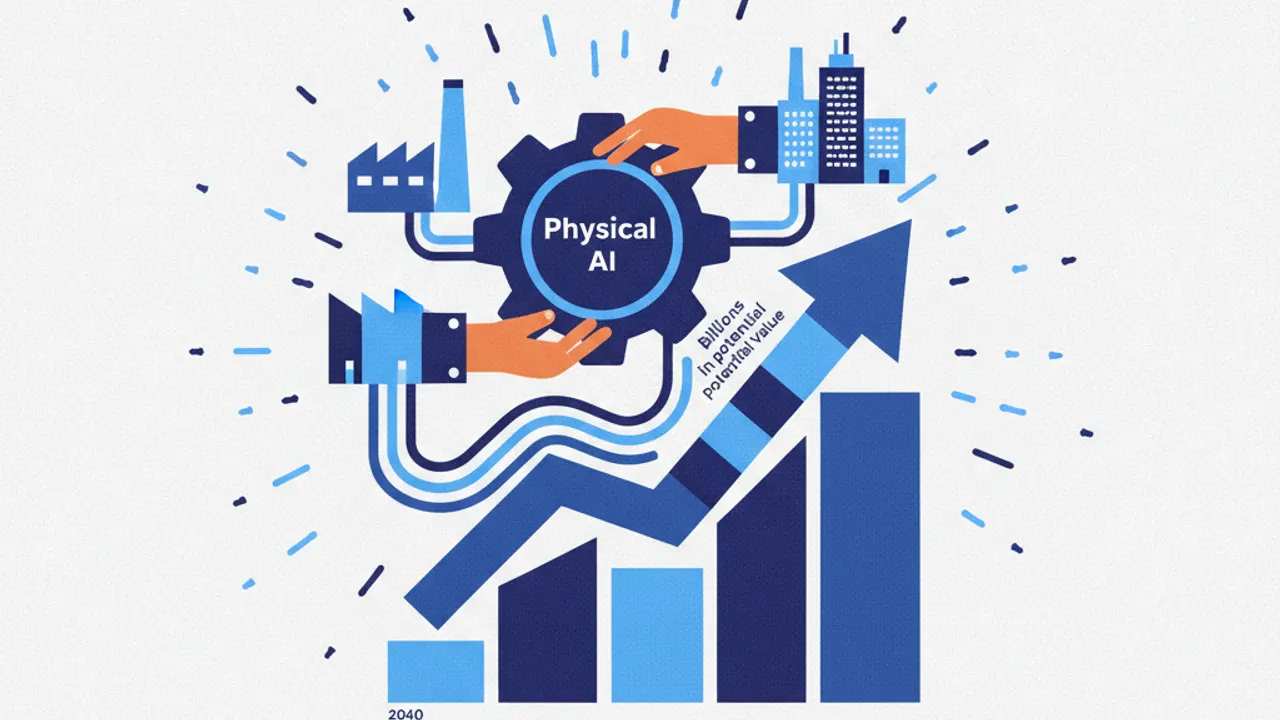
The debate surrounding artificial intelligence across the German economy is undergoing a fundamental shift in direction. While language models and text generation dominated public perception over the past two years, economists and industry analysts increasingly identify Germany's true economic leverage in physical applications. According to a joint study published on November 26, 2026, by PwC Germany, Strategy&, and the Handelsblatt Research Institute, the greatest value creation opportunity for the country lies not in purely generative language AI, but in the domain of physical AI.
The paradigm of physical AI involves linking advanced foundation models directly with robotics, industrial sensor systems, and networked automation hardware. Economic modeling in the report projects that, starting in 2040, this sector could generate an annual additional gross value added of 75 billion euros in Germany alone. In parallel, the researchers estimate that approximately 500,000 new jobs will be created across industrial manufacturing and robotics. Achieving these gains, however, requires companies to successfully transition current pilot initiatives into scalable, full-scale industrial operations.
Analysts emphasize that Germany possesses exceptional baseline conditions to capture this transformation. The country's dense concentration of specialized industrial manufacturers, its mechanical engineering legacy, and vast proprietary datasets from factory floors provide structural advantages that pure software economies struggle to replicate. Nevertheless, the study issues a clear warning regarding the pace of deployment, urging businesses to move beyond cautious trial phases. Without rapid operational integration across shop floors and assembly lines, the traditional leadership role of German manufacturing risks being eroded by foreign competitors.
The broader macroeconomic leverage of digital transformation and machine intelligence is supported by recent findings from the German Economic Institute (IW Cologne). In its study titled Potential Spaces in Germany, published on November 24, 2026, the institute calculates long-term growth potential of up to 1.9 trillion euros in additional gross domestic product through consistent AI adoption. This substantial gain depends entirely on widespread implementation across both core industrial branches and supporting enterprise services.
That this productivity leap is far from guaranteed is underscored by the institute's accompanying Autumn STEM Report 2026. Economists from IW Cologne identify an acute shortage of qualified specialists in essential domains, particularly data architecture and applied machine learning. Without targeted training and educational initiatives in technical fields, small and medium-sized enterprises risk stalling at practical implementation hurdles. Consequently, the gap between theoretical algorithmic capability and shop-floor execution threatens to widen.
Together, the findings from PwC and IW Cologne highlight a decisive moment for German industrial policy. The economic potential of physical AI aligns precisely with Germany's manufacturing strengths, offering substantial growth and employment prospects. The primary bottleneck is no longer access to industrial hardware, but rather internal methodological skills and organizational inertia when scaling beyond pilot environments. For German enterprises, long-term competitiveness will depend on workforce upskilling and the disciplined deployment of autonomous systems into regular production.