
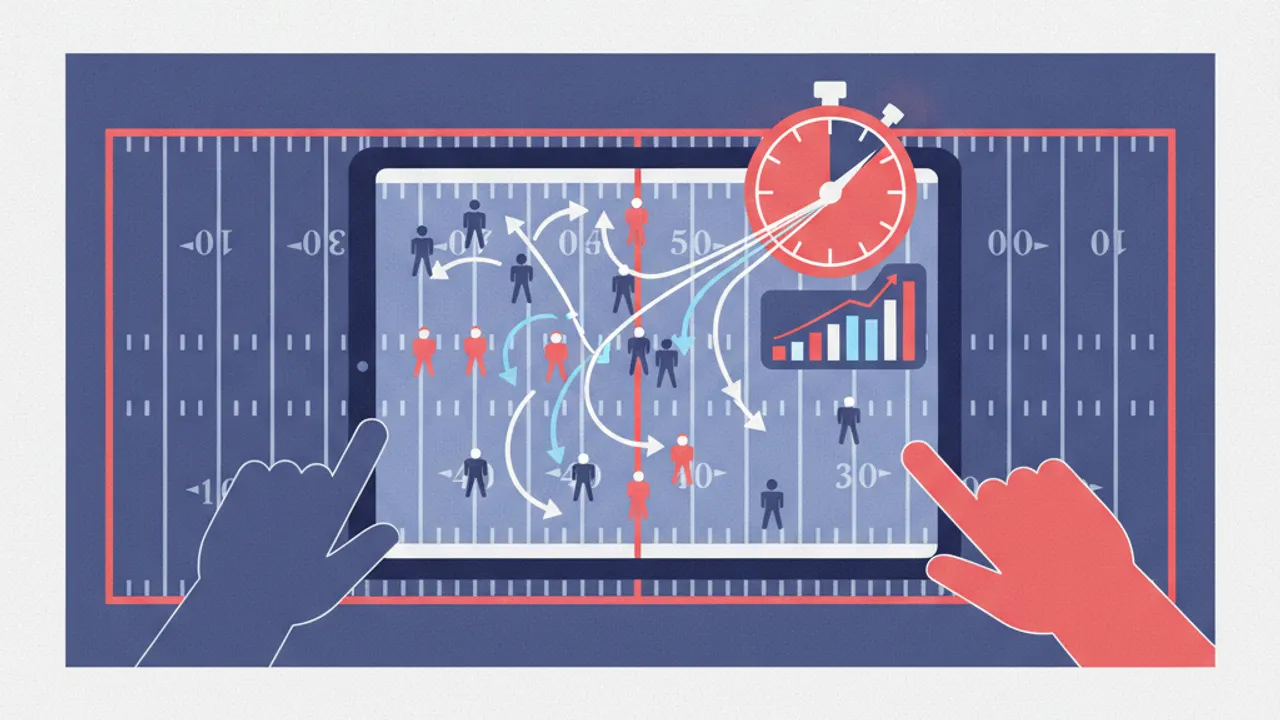
The National Football League and Microsoft have shared insights into the expanded deployment of artificial intelligence directly on the sidelines as the second half of the season gets underway. At the heart of this joint effort is the evolution of the established Sideline Viewing System, which coaches and players rely on during live games. By progressively integrating machine learning and generative analytical capabilities, the league's digital infrastructure is undergoing a significant transformation. What initially served as a digital repository for snapshot sequences is evolving into an active analytical platform for in-game tactical decisions.
The hardware backbone along the field continues to consist of the league's official Microsoft Surface devices, which are a standard fixture in NFL stadiums. Through the Sideline Viewing System, commonly abbreviated as SVS, coaching staffs previously reviewed static photographic sequences and brief clips to provide immediate visual feedback. With the newly integrated machine learning algorithms, the software now processes these data streams in depth immediately after each snap. This upgrade allows teams to access automated evaluations that clearly outline tactical patterns without requiring coordinators to manually sift through dozens of still images.
A primary focus of the technological upgrade is the instant recognition and classification of opposing defensive schemes. Immediately following a change of possession, coaches and quarterbacks can have defensive alignments automatically classified by the algorithms. The software detects recurring coverage patterns and defensive alignments before players even step back onto the field for their next offensive drive. By removing manual pattern-hunting under tight play-clock constraints, this automated processing enables coordinators to adjust playbooks rapidly based on clear defensive tendencies.
Several franchises are already embedding these enhanced capabilities into their operational game-day routines. Teams including the Tampa Bay Buccaneers and the Minnesota Vikings are utilizing connected Copilot architectures developed with Microsoft. These implementations help coaching staffs prepare specific game-day scenarios and navigate critical in-game operational choices. By tying tactical contingency plans directly to live operational data, the platforms provide coaching staffs with tools to refine their strategies under acute time pressure.
This push highlights how generative AI and machine learning are bridging the divide between week-long preparation and real-time game management. While computationally heavy analytics were historically confined to post-game reviews and weekday meeting rooms, these processing capabilities are now positioned directly along the sidelines. For the NFL and Microsoft, the deepened partnership serves as a high-stakes proving ground for enterprise software functioning under high-pressure competitive conditions. Feedback gathered from coaching staffs across the league is expected to guide subsequent refinements of the SVS platform and its underlying models.