
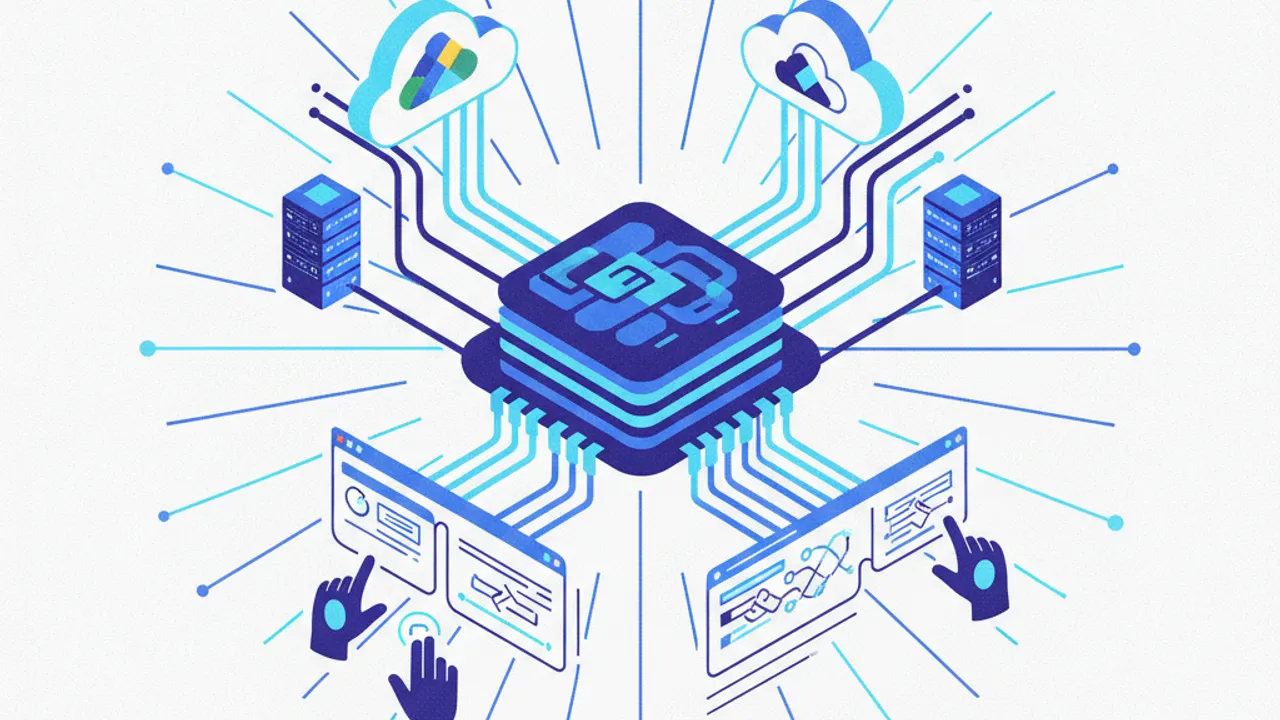
Anthropic has introduced a functional upgrade for developers building autonomous software agents. With the official rollout of the `interleaved-thinking` API header on October 21 and 22, 2026, the company's reasoning models can now alternate flexibly between internal thought chains and external tool calls. In parallel, the AI company announced the availability of Claude on the Google Cloud Marketplace. This integration enables enterprise customers to deploy the models directly within their existing cloud environments and procurement frameworks.
Previously, structured tool use with reasoning models faced a notable architectural bottleneck. Developers had to accommodate systems that were required to complete their entire internal chain of thought before triggering an external function or API call. This strict separation between the reasoning phase and the execution phase prevented models from evaluating intermediate outputs dynamically. If an invoked tool returned invalid parameters, empty datasets, or unexpected errors, the model could not adjust its ongoing reasoning strategy during execution.
The launch of the `interleaved-thinking` header changes this workflow fundamentally. Developers can now instruct Claude to formulate an initial reasoning step, invoke an external tool, and immediately analyze the returned output within a subsequent thought block. This adaptive loop allows the AI to parse results at runtime, verify intermediate progress, and tailor subsequent operations with high precision. Consequently, agents can navigate multi-step tasks by shifting repeatedly between reasoning and action without losing context.
Alongside the API update, Anthropic expanded its enterprise distribution by introducing Claude Models on Google Cloud. Organizations can now provision Claude directly through the Google Cloud Marketplace while operating under established enterprise governance. The underlying infrastructure remains fully managed and operated by Anthropic. However, authentication and permissions are integrated into Google Cloud Identity and Access Management (IAM), and usage is billed directly through existing Google Cloud contracts.
The transition toward more autonomous tool execution aligns with ongoing safety investigations by the vendor. On October 12, 2026, the Anthropic Safety team published a research report assessing the risks of autonomous model replication outside central operator datacenters. Using ECI capability scores, the researchers empirically evaluated the threshold levels at which models could autonomously copy and execute themselves across decentralized hardware or independent cloud instances. The findings emphasize why robust safeguards are essential as tool-use capabilities grow increasingly independent.
For engineering teams and platform architects, these announcements bring concrete operational simplifications. The introduction of interleaved thinking reduces the need for complex custom middleware that previously fed tool outputs back into fresh prompts. Furthermore, pairing adaptive reasoning with streamlined procurement through the Google Cloud Marketplace marks a clear step forward for agentic infrastructure. Developers now have more resilient primitives to deploy multi-step analytical and coding agents in production environments.