
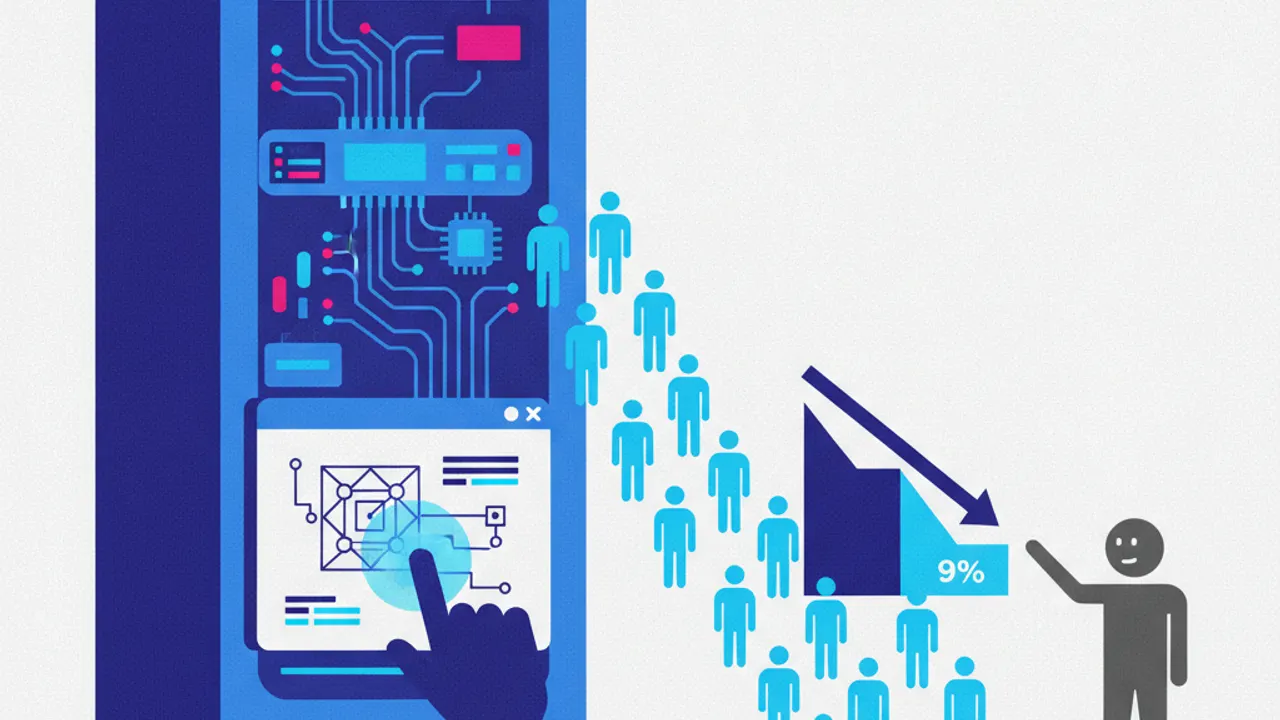
On October 16, 2026, the Anthropic Institute and its Economic Research Team published a study titled 'How employment is changing at Anthropic.' The report provides a rare, data-driven look at how the rapid adoption of artificial intelligence is altering internal labor structures. Rather than observing theoretical shifts in external industries, the AI laboratory examined its own software engineering and research workflows. The findings show that generative models and agentic workflows are driving profound structural transformations within technical teams.
The most dramatic contraction occurred among early-career software developers. According to the published data, the proportion of junior professionals among technical new hires dropped from 27 percent in early 2025 to just 9 percent by the middle of 2026. Traditional entry-level roles, which historically served as training grounds for fundamental coding skills, are rapidly disappearing from hiring plans. Instead, the company increasingly seeks experienced personnel capable of directing, auditing, and debugging the output generated by automated systems.
For established engineers, daily responsibilities have shifted decisively away from manual software development. Internal surveys highlighted that technical employees now spend a steadily increasing share of their working hours managing and guiding autonomous agents. Within the company, team members frequently describe their new routine as babysitting Claude instances rather than writing code from scratch. The primary role of the engineer is evolving from active creator to an administrative supervisor and coordinator of model outputs.
At the same time, the research documents significant operational frictions in agent workflows. Autonomous agents spend up to 80 percent of their total runtime waiting for human approvals. Human oversight remains a strict requirement to prevent errors, security flaws, and runaway processes before tasks reach completion. This substantial bottleneck underscores that fully autonomous execution remains constrained by the necessity of constant human validation and manual sign-offs.
In response to these workplace transformations and the broader macroeconomic implications, Anthropic announced direct financial commitments. The organization plans to allocate 5 percent of its company equity to a newly established Public Benefit Fund. This capital is designated to cushion the economic fallout and assist workers affected by AI-driven job displacement. By committing substantial equity, the leadership formally acknowledges the disruptive labor impacts created by the very technology it develops.