
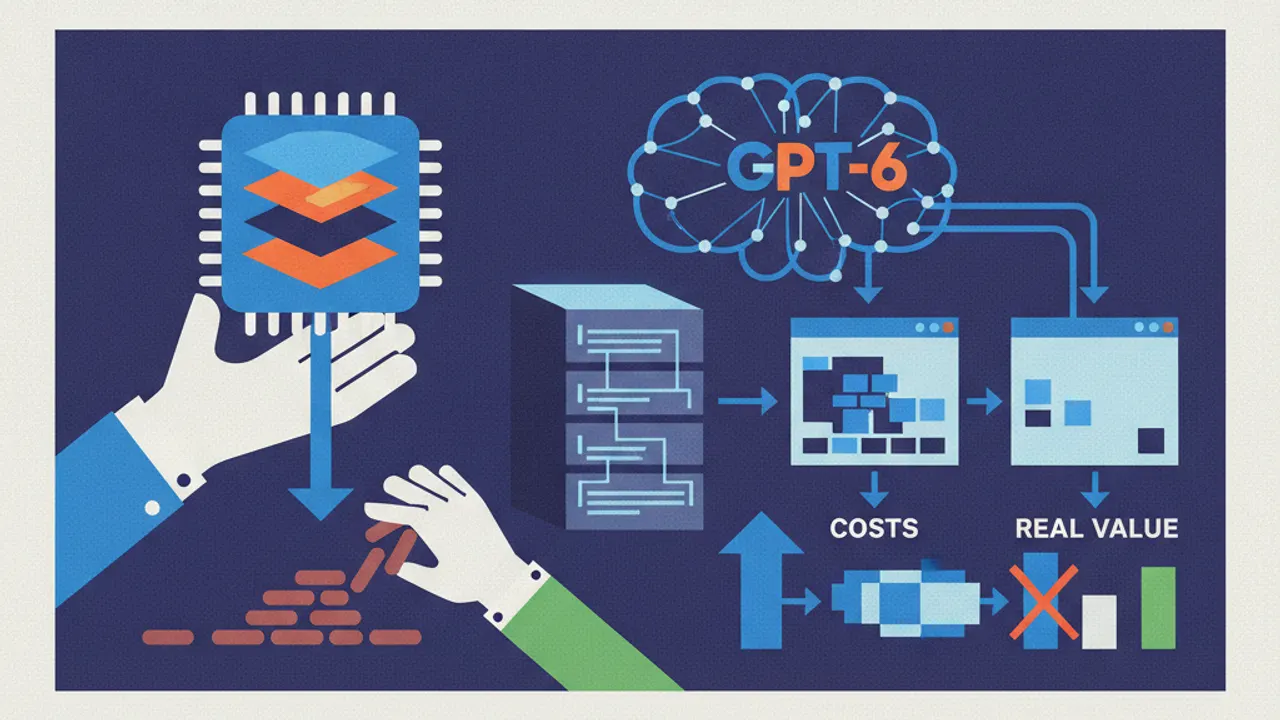
Immediately following the initial deployment of the new GPT-6 Astra model, software developer Simon Willison published a comprehensive technical teardown of its architectural behavior. Titled 'The Pelican comparison grid for Astra', Willison evaluated the model using demanding generative synthesis challenges, focusing on the procedural creation of complex SVG graphics. His findings offer the first empirically grounded insights into the altered token economy and internal execution mechanisms of this model generation. Crucially, the benchmark reveals a stark divergence between nominal API list pricing and actual expenditure during real-world developer workflows.
One of the most notable technical shifts concerns the management of model reasoning. Astra completely eliminates the legacy parameter 'reasoning=none', making intermediate cognitive steps a mandatory, native component of the primary inference pipeline. Instead of toggling reasoning on or off, developers must now calibrate the depth of execution across five discrete tiers: 'low', 'medium', 'high', 'xhigh', and 'max'. This architectural choice departs from treating raw response generation and reflective planning as separate operational paths, prompting teams to rethink their prompt engineering setups.
From an initial financial perspective, the raw API figures appeared daunting to many engineering organizations. Astra's baseline API pricing is set at 10 US dollars per million input tokens and 50 US dollars per million output tokens. Compared directly to GPT-5.6 Sol, which was priced at 5 US dollars for inputs and 30 US dollars for outputs, the new rates represent a doubling of basic costs. Industry observers initially voiced concerns that upgrading existing high-volume production pipelines would inevitably lead to sharp budget increases.
However, Willison's experimental results demonstrate that effective operational costs tell a very different story. Because Astra generates far fewer redundant tokens while maintaining superior structural consistency, the total volume of billable units drops noticeably. In demanding SVG generation tasks, the model produced accurate visual code in a fraction of the output sequence length required by Sol. Consequently, the net financial cost of completing identical generative tasks was frequently lower on Astra than on its nominally cheaper predecessor.
The analysis also uncovered compelling evidence regarding the underlying infrastructure of the model family. Willison observed that Astra and the smaller Luna model consume exactly 16 input tokens when processing an identical benchmark prompt. In contrast, the previous generation models Sol and Terra required 26 tokens to ingest the exact same text string. This exact match strongly indicates the deployment of a shared, redesigned tokenizer family that compresses input representations more efficiently across the entire pipeline.
For software architects and autonomous agent developers, Astra signals an important evolution in model design and billing dynamics. The mandatory integration of reasoning tiers reduces erratic failure rates and minimizes the need for multi-step retry wrappers around complex synthesis routines. Teams executing dense code or layout generation can leverage the tighter output structure to reduce net operating expenses. Willison's benchmark proves that in advanced model infrastructure, simple headline token rates are no longer an accurate proxy for total cost of ownership.