
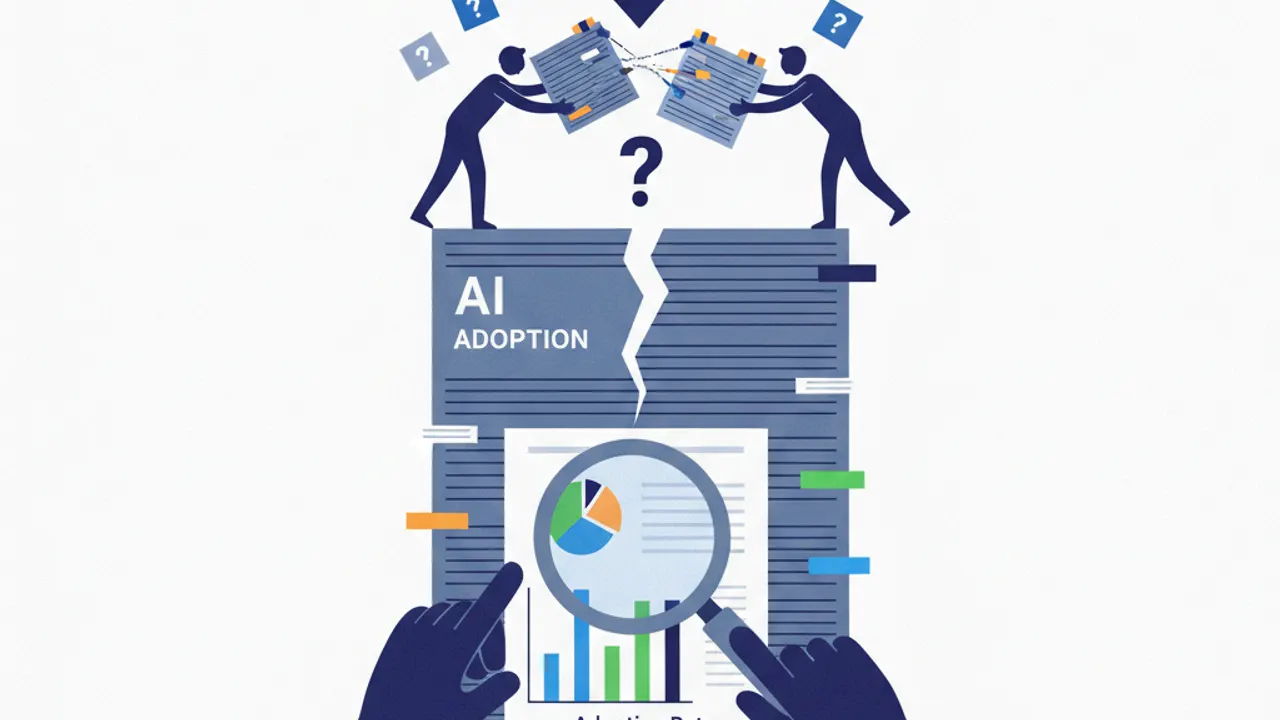
The initial pressure to adopt artificial intelligence in the corporate world is giving way to a sober assessment. Recent studies by KPMG, WRITER, and Nomura demonstrate that while algorithms and language models have entered almost all business functions, organizations face substantial hurdles in governance and ROI measurement. As corporate leaders demand clear strategic alignment, the operational focus is shifting from simple deployment to deep process integration and management control.
In Germany, a survey of 480 executives conducted by KPMG reveals that 98 percent of companies now classify artificial intelligence as relevant to their business. This marks a steady rise from 56 percent in 2024 and 91 percent in 2025. Although 98 percent of surveyed firms now possess a formal AI strategy, the report highlights a significant governance gap. Only 39 percent of responding companies actively manage AI implementation directly through top management.
This lack of executive oversight is also reflected in corporate budget allocations for the coming fiscal periods. For 2026, 67 percent of German companies plan to spend less than ten percent of their total investment budget on AI projects. Nevertheless, 71 percent of respondents state that previous AI investments met or exceeded their expectations. Success is primarily evaluated through productivity gains of 65 percent rather than direct revenue growth at 48 percent.
Beyond governance issues, a distinct value gap between employees and executive leadership complicates organizational value realization. A study by WRITER and Workplace Intelligence involving 2,400 participants indicates that 97 percent of workers personally benefit from AI tools. However, only 23 percent of surveyed companies report a significant return on investment at the enterprise level. This divergence frequently creates internal tensions and authority disputes during software integration.
The WRITER survey further underscores a hardening attitude among enterprise managers toward workplace resistance. Overall, 56 percent of executives report internal conflicts, while 54 percent observe organizational friction within their workforces. Furthermore, 60 percent of surveyed business leaders plan to dismiss or replace employees who persistently refuse to adopt AI tools. Consequently, tool usage is rapidly shifting from a voluntary choice to a mandatory job requirement.
Despite these internal tensions, global labor market data refutes fears of an immediate automation-driven layoff wave. An analysis by Nomura Holdings across Asian markets recorded 130,700 AI-related new hires compared to approximately 60,700 job cuts. In India alone, 83,100 new roles were created while 31,921 positions were eliminated. Over 90 percent of these new positions emerged within the IT sector to support productivity deployment.