
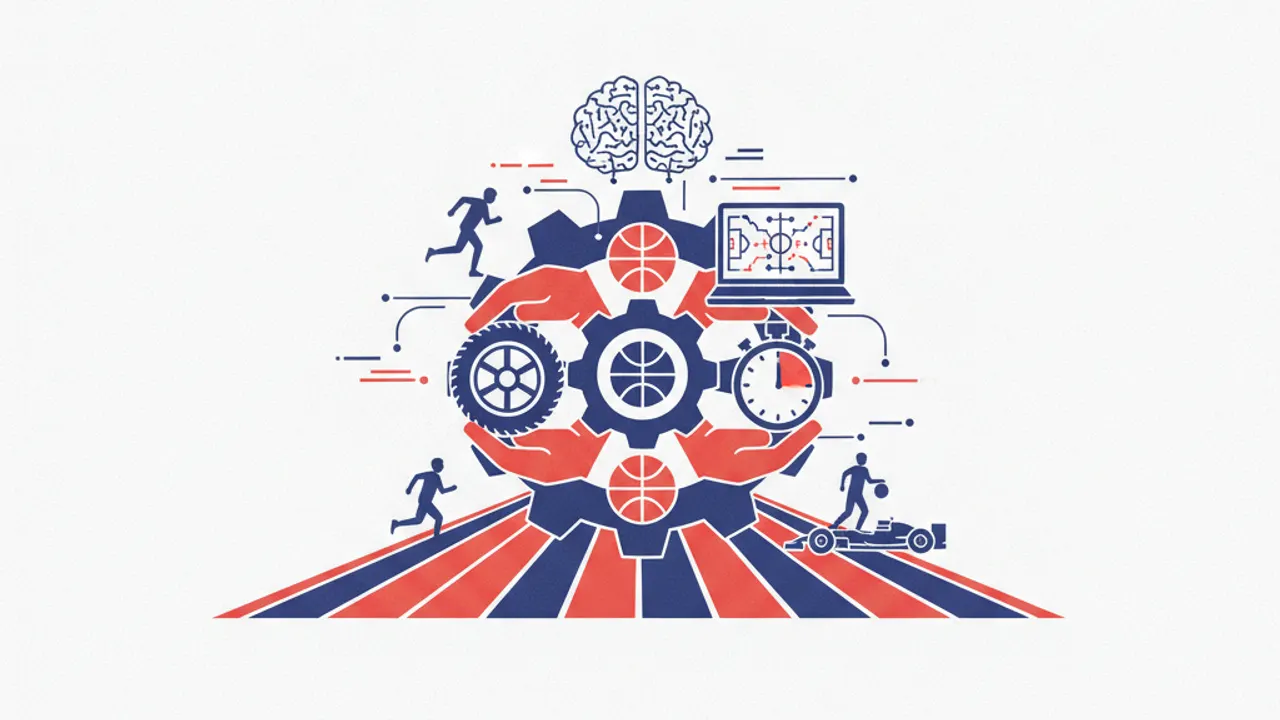
The professional sports industry is steadily integrating artificial intelligence into business-critical operations. Rather than relying on superficial marketing experiments, established sports organizations, prominent investors, and specialized software providers are forming long-term alliances. Recent deployments span high-speed telemetry processing in motorsport, dynamic logistics for newly launched competition formats, and language-model-based scouting in elite basketball.
In motorsport, Formula 1 team Williams Racing announced an official technology partnership with Zoox, the autonomous mobility and AI subsidiary of Amazon. During any given Grand Prix weekend, a single racing car produces hundreds of gigabytes of sensitive telemetry data. The primary goal of the collaboration is cross-industry technology transfer: Zoox's algorithms, designed for real-time object detection and prediction in urban traffic, are being adapted to optimize vehicle setup, aerodynamic simulations, and the evaluation of high-speed sensor feeds at the track.
Simultaneously, generative AI is entering player analysis and scouting departments. Cerebro Sports, a sports technology venture backed by US billionaire Mark Cuban, launched a dedicated analytics platform in collaboration with Google Cloud. The system links Cerebro's global player performance database with Large Language Models hosted on Google Cloud infrastructure. Coaches, scouts, and front-office executives can submit intricate tactical inquiries using natural language instead of compiling manual database queries.
The interface evaluates specialized performance parameters, such as shot pattern efficiency under defensive pressure, composite defensive ratings, and granular comparisons between collegiate prospects and seasoned professional athletes. A primary objective is the standardization of talent identification metrics. By expanding sophisticated analytics beyond proprietary NBA franchise systems, the platform makes advanced performance metrics available to youth academies and semi-professional leagues.
Algorithmic optimization is also taking hold in league administration. TMRW Sports, the sports technology venture founded by golf icons Tiger Woods and Rory McIlroy behind the indoor-based TGL golf league, announced a strategic partnership and investment in Fastbreak.ai. The indoor format introduces complex operational constraints that require tight coordination across broadcast schedules, venue operations, and athlete travel.
Fastbreak.ai applies machine learning algorithms to solve these operational demands mathematically. The software calculates pairings and tee times in real time to balance three competing objectives: maximizing premium television broadcast windows, mitigating athlete travel fatigue, and smoothing spectator flow within the stadium. Across multiple sports, these developments show that predictive and generative models are rapidly becoming the operational backbone of modern athletic enterprises.