
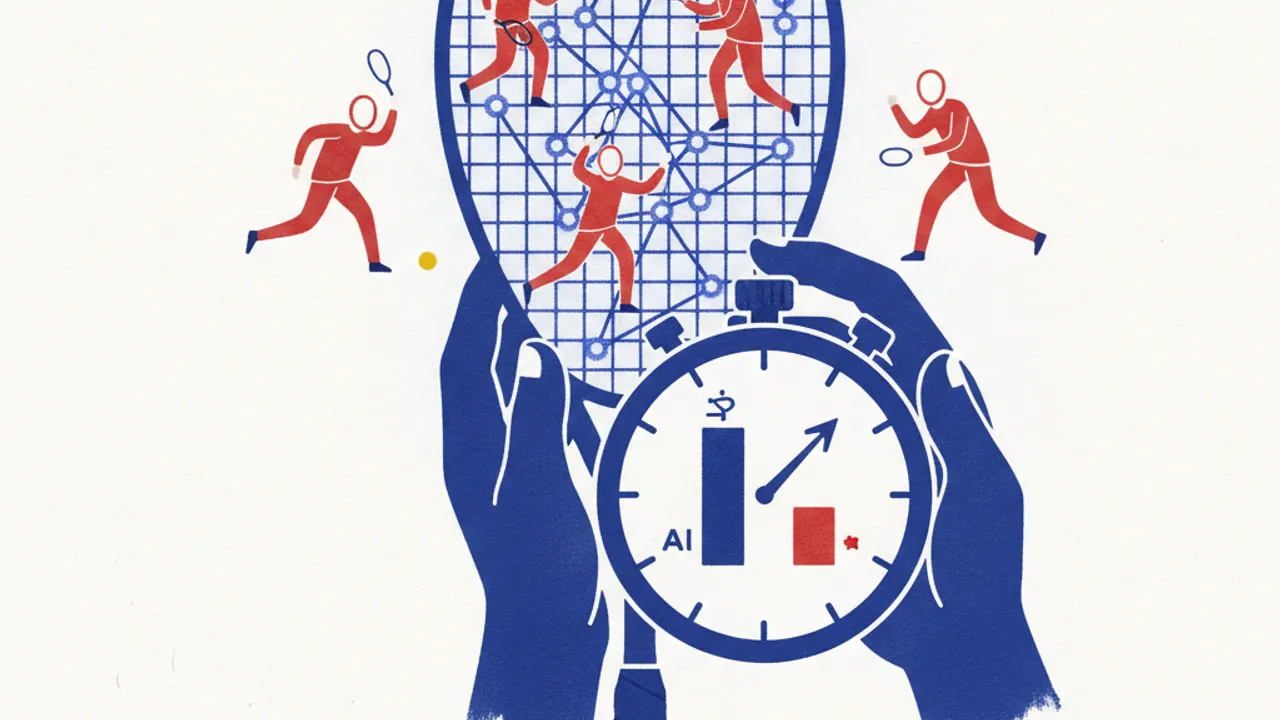
Artificial intelligence in sports officiating is undergoing a fundamental shift beyond automated line calls and simple offside tracking. While platforms such as Hawk-Eye traditionally focused on geometric and binary outcomes, newer deep learning models are moving into the contextual interpretation of player movements and physical interference. An evaluation project presented in late September 2026 by Duke University and Pioneer Academics in collaboration with the PSA Squash Tour highlights this technical leap.
The project evaluated the IntelliReferee assistance system, which utilizes neural networks trained on competition video to assess contested interference incidents. During validation tests, the models attained an agreement rate of approximately 86 percent with elite referees on controversial let and stroke situations. These specific calls require judging whether a competitor obstructed an opponent's swing path or direct access to the ball, representing a historically subjective domain in racket sports.
This progress is supported by a systematic meta-analysis published on September 30, 2026, in the Journal of Sport for All and Recreation. The paper compared the accuracy of multiple referee assistance setups across various sporting contexts. The findings show that computer vision pipelines built on current YOLO and hybrid CNN/LSTM architectures significantly outperform purely sensor-based tracking devices when classifying physical challenges and fouls.
The meta-analysis also identifies an ongoing shift in how sports governance implements automated decision support. Rather than relying entirely on post-hoc reviews typical of standard video assistant referee (VAR) systems, emerging architectures focus on predictive alerts delivered in real time. This operational format aims to reduce cognitive fatigue among on-court officials and prevent avoidable officiating delays before disputes escalate.
Moving from rigid tracking to situational spatial judgment signals a major maturation phase for officiating software. Tournament organizers and governing bodies now face the operational task of gradually integrating platforms like IntelliReferee into competitive tours without disrupting match flow. The latest empirical benchmarks provide a clear framework for deploying automated assistance across fast-paced sports defined by tight physical proximity.