
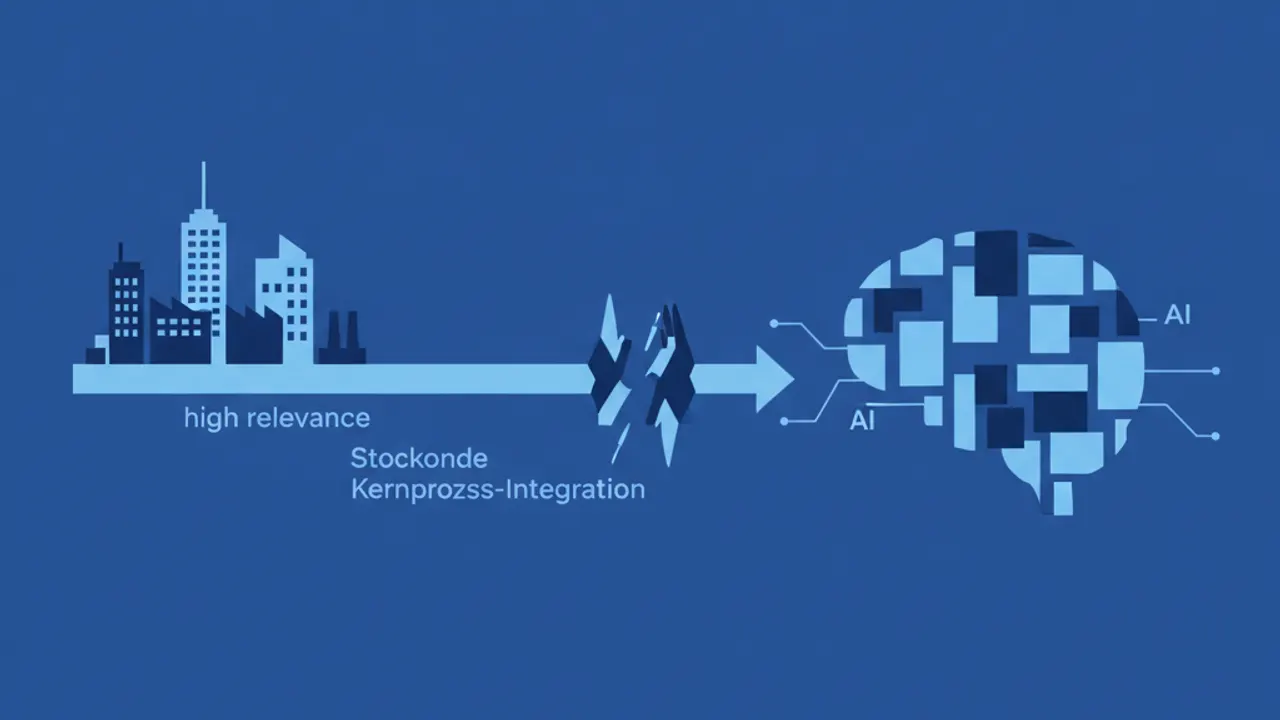
The German business sector widely acknowledges the strategic importance of generative artificial intelligence. According to surveys conducted by KPMG and various industry associations, 97 percent of companies now classify AI as relevant to their business models. Furthermore, nearly 80 percent of surveyed firms anticipate profound transformations across their respective industries. These figures demonstrate that theoretical awareness of AI's transformative power has firmly arrived in executive boardrooms across the Mittelstand.
However, a substantial gap remains between strategic ambition and daily operational execution. A comprehensive, end-to-end integration across all operational core processes has so far been accomplished by fewer than one percent of companies. The initial phase of merely testing individual software tools is increasingly giving way to a more pragmatic evaluation. The operational focus has consequently shifted from experimental pilots toward establishing robust data architectures, ensuring regulatory compliance, and executing deeper workflow integration.
In addition to internal structural hurdles, notable regional disparities characterize AI adoption across Germany. Analyses from the ifo Institute Dresden highlight a distinct gap between western and eastern federal states among small and medium-sized enterprises. While more than half of companies nationwide actively utilize AI systems, the adoption rate in eastern Germany remains just below 40 percent. The primary obstacles cited by enterprises include unresolved liability issues, complex data protection requirements, and measurable employee qualification deficits.
Meanwhile, the labor market is experiencing a profound skill evolution rather than widespread workforce reductions. The PwC AI Jobs Barometer reports a new peak in job postings mentioning AI capabilities, which now constitute 1.3 percent of all job advertisements nationwide. In leading sectors such as technology and media, this figure climbs above 6 percent. Skill diffusion is the dominant trend, as AI proficiencies are increasingly embedded into standard job profiles rather than relegated to specialized niche roles.
Against the backdrop of demographic shifts, the pragmatic deployment of AI is becoming indispensable for business continuity. Analyses by the German Economic Institute emphasize that SMEs primarily leverage AI to cushion the worsening shortage of skilled labor. Practical use cases concentrate heavily on routine task automation, including document processing and the pre-structuring of sales proposals. Furthermore, firms increasingly implement AI-driven knowledge management solutions to preserve crucial institutional knowledge amid generational workforce transitions.