
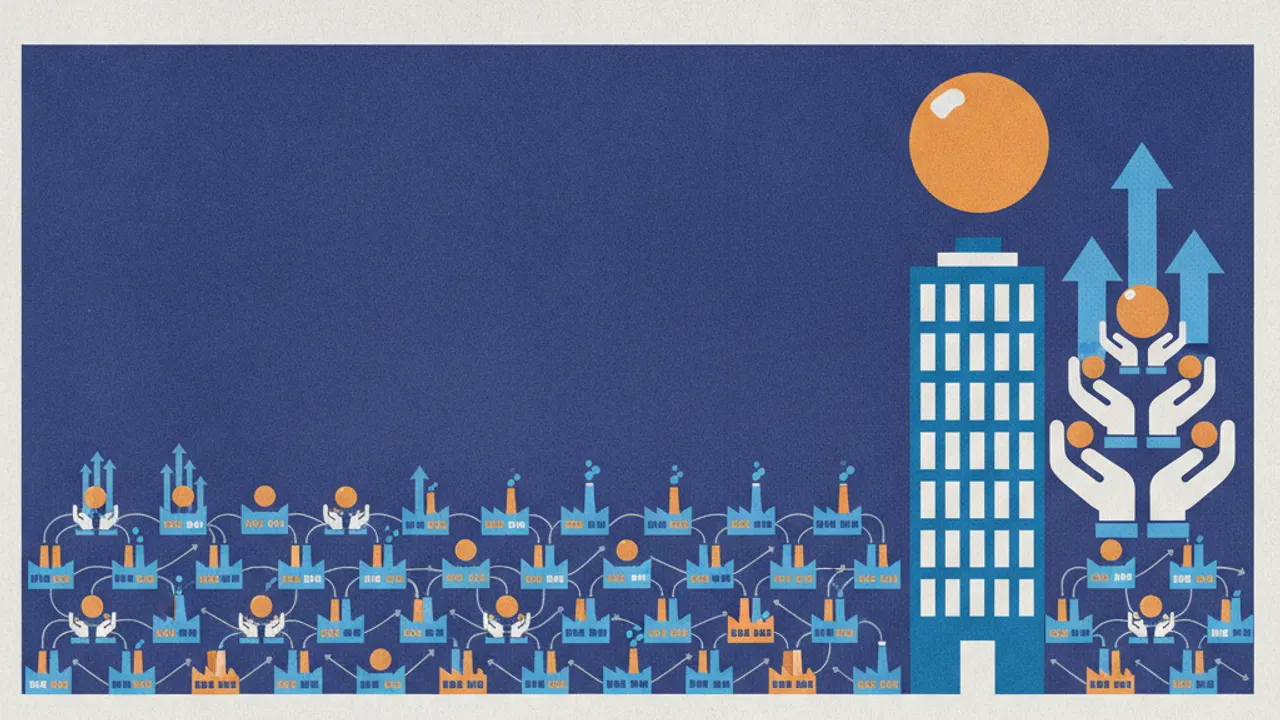
The deployment of artificial intelligence across the German economy has entered a critical stage of maturity. While large enterprises are rapidly overhauling their operational workflows, smaller businesses struggle to keep pace. Recent evaluations by the German Economic Institute (IW) alongside the Federal Statistical Office highlight an expanding divide in adoption: while 57 percent of large corporations actively deploy AI tools in day-to-day operations, that figure drops to 36 percent among mid-sized companies and falls to just 23 percent for small businesses.
Where modern systems have successfully integrated into daily business procedures, the financial and operational benefits are unmistakable. Companies that anchor generative and agentic architectures deep within their core processes report measurable efficiency surges. According to IW figures, 82 percent of these active adopters achieve an average annual productivity increase of 13 percent, proving that thorough implementations deliver concrete corporate value beyond early experimentation.
This performance leap is propelled by a broader transition in tool selection. Findings from the SME AI Index 2026, compiled by Salesforce and the German Association of Small and Medium-sized Businesses (DMB), indicate that 51.2 percent of surveyed mid-sized firms now test or deploy AI solutions. Most notably, companies are shifting away from standalone conversational assistants toward autonomous workflows. More than 16 percent of small and mid-sized enterprises already run multi-step agents that resolve customer inquiries, process invoices, or direct supplier orders without requiring manual intervention.
Despite these successes, data protection standards remain paramount in corporate procurement decisions. The IW Future Panel reports that two-thirds of German firms establish European data sovereignty as an uncompromising criterion. Maintaining data storage strictly within the European Economic Area, securing portability, and avoiding proprietary vendor lock-in are non-negotiable terms during vendor talks. Consequently, businesses remain cautious about platforms relying exclusively on non-transparent cloud providers located outside Europe.
At the same time, internal workplace behavior poses an escalating operational risk that undermines official company governance. Complementary research by the IW shows that 29 percent of AI-using employees rely on unauthorized software tools on the job. This shadow AI habit exposes internal business figures, proprietary operational data, and customer records to third-party cloud environments. For management, this practice creates both regulatory compliance vulnerabilities and commercial liability risks.
Mid-sized enterprises face a dual strategic mandate. To prevent large corporations from pulling away permanently, smaller operations must overcome hesitation regarding multi-step agents. Simultaneously, curbing shadow AI requires clear organizational policies and compliant European cloud tooling for staff, ensuring that the 13 percent productivity leap does not come at the expense of dangerous data leaks.