
Skip to content
AI ConnectPowered by VELENTIS
AI-generated2 min

Kākāpō Party: How Claude Opus 5.5 Created a Keynote Animation from Pure Code

At the WeAreDevelopers World Congress, Simon Willison demonstrated a self-contained canvas animation built from bird photos by Claude Opus 5.5 and executed by local agents.

This article was AI-generated and published automatically. Context, labelling and all sources at the end of the article.

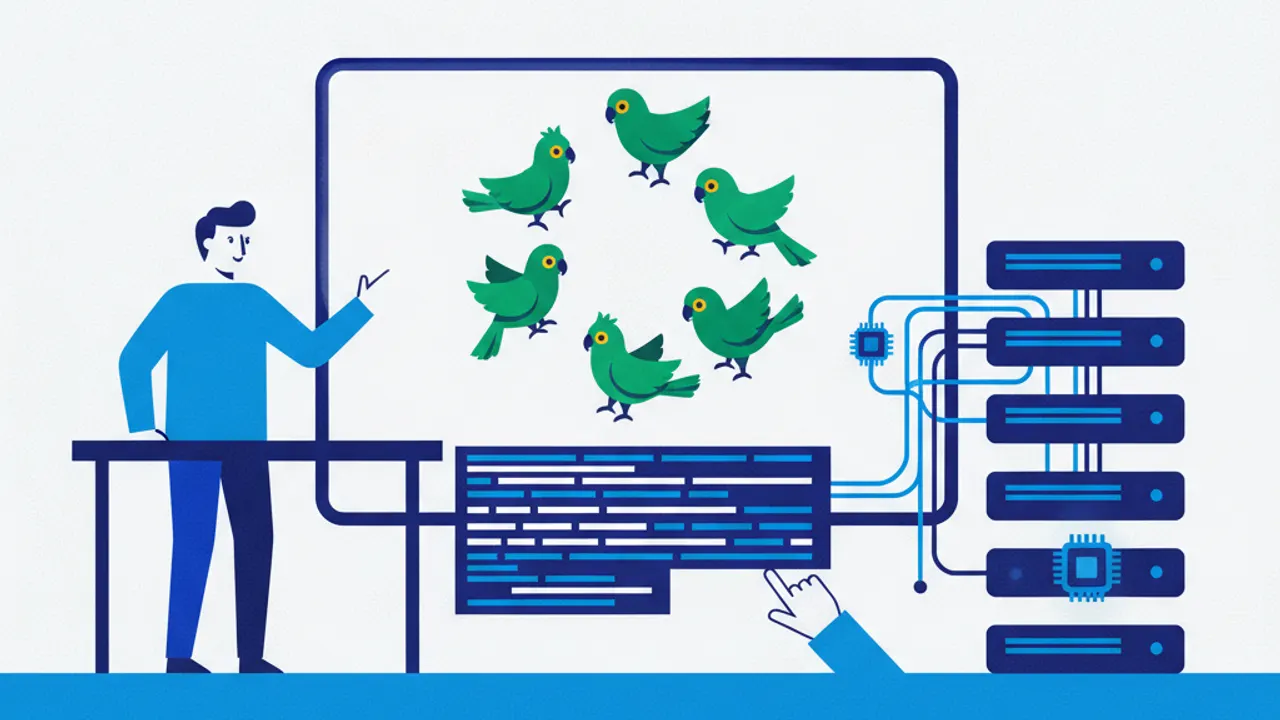
(KI-generiertes Symbolbild: Gemini / AI Connect)

On September 25, 2026, developer Simon Willison concluded his keynote at the WeAreDevelopers World Congress with a striking demonstration. His project, named Kākāpō Party, highlighted the rapidly advancing capabilities of state of the art artificial intelligence in creative programming. The technical backbone of the experiment was Anthropic's flagship model, Claude Opus 5.5, which had been released only three days earlier. The showcase offered a vivid example of how multimodal models can translate visual inputs directly into functional, complex computer code.

The technical workflow relied on merely three photographs of the endangered New Zealand parrot species. From these reference images, Claude Opus 5.5 generated a completely self-contained HTML5 canvas file with an exact file size of 45,880 bytes. Crucially, the code operated without any external dependencies, web fonts, or downloaded graphical assets. Every single visual element and movement was calculated and rendered purely mathematically through instructions executed directly on the canvas.

The resulting animation featured 22 pixel art Kākāpō parrots moving in precise synchronization at a tempo of 124 beats per minute. To prepare the demonstration for the conference stage, Willison combined modern agentic software tools. Using Claude Code alongside the browser automation framework Playwright, he orchestrated an automated browser session. This setup rendered the dynamic canvas animation and exported it directly into a clean 15-second video clip without requiring any manual editing steps.

Across the global developer community, the experiment was received as a milestone in agent-driven software development. It demonstrates how frontier models bridge the gap between image comprehension, geometric code generation, and automated delivery. Instead of manually writing boilerplate code or drawing sprite sheets in design tools, engineers can now use local coding agents to manage entire asset pipelines from initial prompt to rendered output.

Anthropic officially launched Claude Opus 5.5 on September 22, 2026. The new top-tier model matches the performance benchmarks of the experimental Fable-5.1 series while reducing execution costs by roughly 40 percent compared to its predecessor, Opus 5. Pricing was set at 4.00 US dollars per million input tokens and 20.00 US dollars per million output tokens. Prompt caching read costs dropped to 0.20 US dollars per million tokens, significantly lowering the barrier for recursive agent workflows.

Anthropic also introduced a structural protection feature known as Preserved Thinking. This persistent reasoning trace cannot be disabled via the API, preventing competing developers from distilling the model's inner cognitive steps. Following its debut, Claude Opus 5.5 secured the top position on the Artificial Analysis Intelligence Index with an overall score of 58. Willison's parrot animation served as an immediate practical validation of the model's technical credentials.

What this means for you

For developers, Willison's demonstration proves that modern AI systems are shifting from simple code completion to autonomous asset generation. The ability to turn static reference images into lightweight, mathematically rendered graphics without external dependencies opens up new avenues for rapid web prototyping. Furthermore, lower token costs and agentic orchestration tools make such end-to-end automation viable for day to day engineering tasks.

Perspectives

Coverage: 1× EU · 1× Other

One story, several angles: how each source frames the topic, each with a verbatim quote.

  • orcarouter.aiOther

    Orca Router examines the project with analytical scrutiny, emphasizing the technical artifact of a self-contained HTML file without external resources while framing the demo as a verifiable practical experiment rather than a formal benchmark.

    Original quote

    „one HTML file of 45,880 bytes containing no pictures, no video, and no network calls.“

    orcarouter.ai
  • news.lavx.huEU

    LavX News frames the project as an application-focused demonstration of how language models can create interactive visual content, while underscoring the necessity of human direction and additional tooling.

    Original quote

    „The episode demonstrates that LLMs can create interactive visual content in addition to text.“

    news.lavx.hu

Source classification is maintained editorially (political spectrum only where consensus is broad; vendor communication is PR, not journalism). Unlabelled sources are unclassified: we do not guess.

Evidence

Solidly sourced
59/100
  • Simon Willison presented the Kākāpō Party demonstration powered by Claude Opus 5.5 at the WeAreDevelopers World Congress on September 25, 2026.

    verified
  • The model generated a self-contained 45,880-byte HTML5 canvas file animating 22 Kākāpō parrots at 124 BPM from three reference photos.

    single source
  • Released on September 22, 2026, Claude Opus 5.5 is priced at 4.00 US dollars per million input tokens and 20.00 US dollars per million output tokens.

    single source
  • Claude Opus 5.5 reached the top position on the Artificial Analysis Intelligence Index with a score of 58.

    single source

The evidence score is computed, not hand-set: from confidence, the number of sources and the share of verified statements.

Source & transparency

As of: September 27, 2026

AI-generatedAI-generated: produced automatically from vetted sources with technical quality checks (source, quote and figure verification); no human sign-off of each item before publication

Sources
2
Verified statements
1 / 4
Evidence score
59Solidly sourced

Want to put this into practice?

We connect you with suitable AI providers from the DACH region, free of charge and without obligation.

What's next?