
Skip to content
AI ConnectPowered by VELENTIS
AI-generated2 min

Inception Labs Unveils Mercury 3: Diffusion LLM Reportedly Hits Over 1,000 Tokens per Second

Inception Labs has launched Mercury 3, a diffusion-based language model offering up to 1,068 tokens per second and a context window of one million tokens.

This article was AI-generated and published automatically. Context, labelling and all sources at the end of the article.

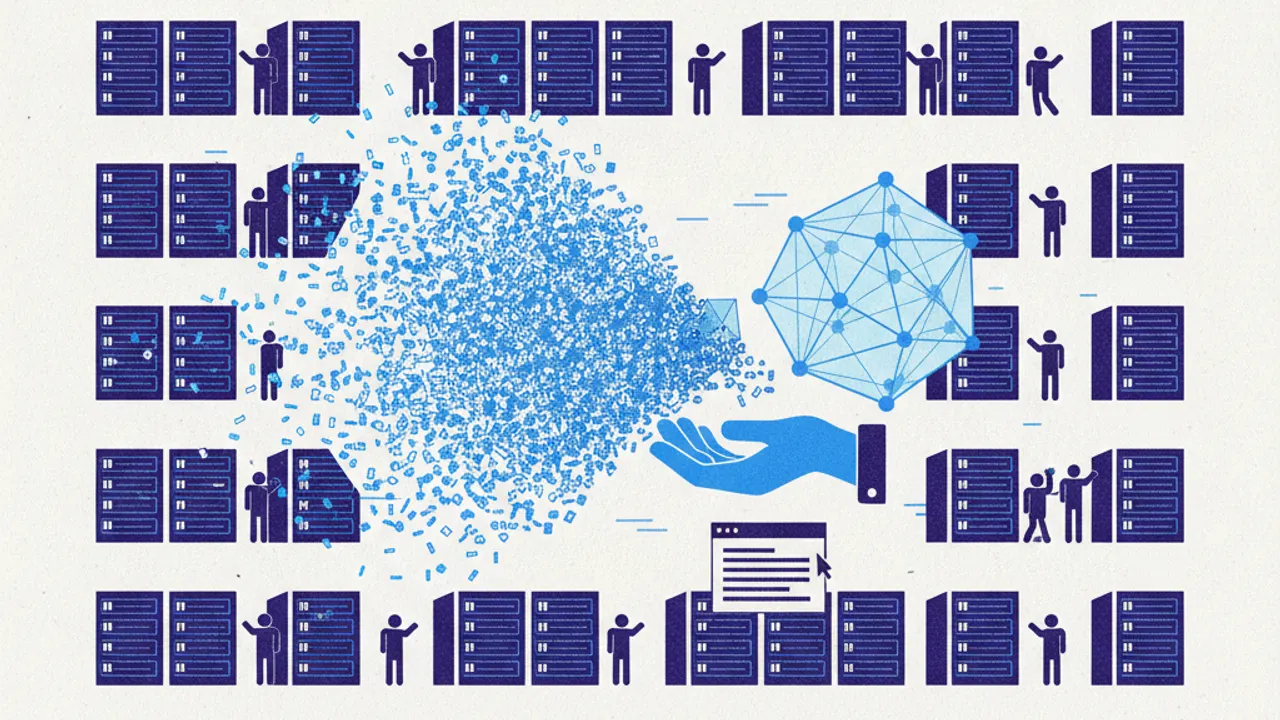
(KI-generiertes Symbolbild: Gemini / AI Connect)

On October 19, 2026, AI developer Inception Labs announced Mercury 3, describing it as the largest and most capable diffusion-based language model (Diffusion LLM) built to date. The model departs from the standard autoregressive paradigm that dominates modern natural language processing, aiming to prove that diffusion methods can scale effectively for text generation. Compared to its first-generation predecessor, Mercury 1, the new system expands model scale by more than fortyfold.

Throughput and context capacity form the core of the announcement. Running on Nvidia graphics hardware, Mercury 3 achieves generation speeds of up to 1,068 tokens per second while supporting a context window of one million tokens, up from 260,000 tokens in version 2.5. According to company benchmarks, the architecture operates between four and eight times faster in latency and raw throughput than autoregressive counterparts such as Claude Haiku 5.5 and GPT-6 Luna.

Inception Labs is making Mercury 3 available via an application programming interface priced at 0.10 US dollars per million input tokens and 0.35 US dollars per million output tokens. Alongside the flagship model, the company introduced two dedicated variants: Mercury Decide, an engine optimized for fast decision-making workflows with a reported latency of 160 milliseconds, and Mercury Voice, tailored for voice interactions.

The launch aligns with a broader industry push toward high-throughput inference across expansive context windows. On the same day, Chinese AI lab MiniMax introduced MiniMax M3.1 Flash, a mixture-of-experts model featuring 428 billion total parameters with approximately 23 billion active parameters. Leveraging sparse attention techniques, that model also processes up to one million context tokens, underscoring how engineering focus across the sector is shifting from sheer parameter growth toward operational efficiency.

For teams developing autonomous software agents and retrieval pipelines, raw inference speed directly dictates viability. Multi-step agent workflows require models to ingest and evaluate extensive background documentation rapidly. Higher token generation rates substantially reduce cycle times, making complex background reasoning far more practical in production environments.

What this means for you

Inception Labs demonstrates that diffusion architectures can challenge autoregressive dominance in text processing. For engineering teams, token throughput exceeding 1,000 tokens per second at low API rates makes multi-step agentic pipelines significantly faster and more cost-effective to run in high-volume production setups.

Perspectives

Coverage: 3× Other

One story, several angles: how each source frames the topic, each with a verbatim quote.

  • daily.devOther

    The source reports with skepticism on the model, emphasizing community doubts about whether the claimed performance and speed metrics hold up in real-world use.

    Original quote

    „Mercury 3 says diffusion LLMs can scale, now prove it“

    daily.dev
  • inceptionlabs.aiOther

    Inception Labs presents the release as proof that diffusion language models can scale and outperform leading competitive models at high speed.

    Original quote

    „Today we’re introducing Mercury 3, the most capable diffusion-based LLM released to date.“

    inceptionlabs.ai
  • baseten.coOther

    The platform factually highlights the model's technical specifications and its suitability for latency-sensitive production workloads.

    Original quote

    „It generates more than 1,000 tokens per second and supports a 1M-token context window.“

    baseten.co

Source classification is maintained editorially (political spectrum only where consensus is broad; vendor communication is PR, not journalism). Unlabelled sources are unclassified: we do not guess.

Evidence

Well sourced
76/100
  • Mercury 3 achieves a throughput of 1,068 tokens per second on Nvidia GPUs with a context window of 1 million tokens.

    single source
  • Inception Labs priced Mercury 3 API access at $0.10 per 1 million input tokens and $0.35 per 1 million output tokens.

    verified
  • Mercury 3 increases the model scale by more than 40 times compared to Mercury 1.

    verified

The evidence score is computed, not hand-set: from confidence, the number of sources and the share of verified statements.

Source & transparency

As of: October 20, 2026

AI-generatedAI-generated: produced automatically from vetted sources with technical quality checks (source, quote and figure verification); no human sign-off of each item before publication

Sources
3
Verified statements
2 / 3
Evidence score
76Well sourced

Want to put this into practice?

We connect you with suitable AI providers from the DACH region, free of charge and without obligation.

What's next?