
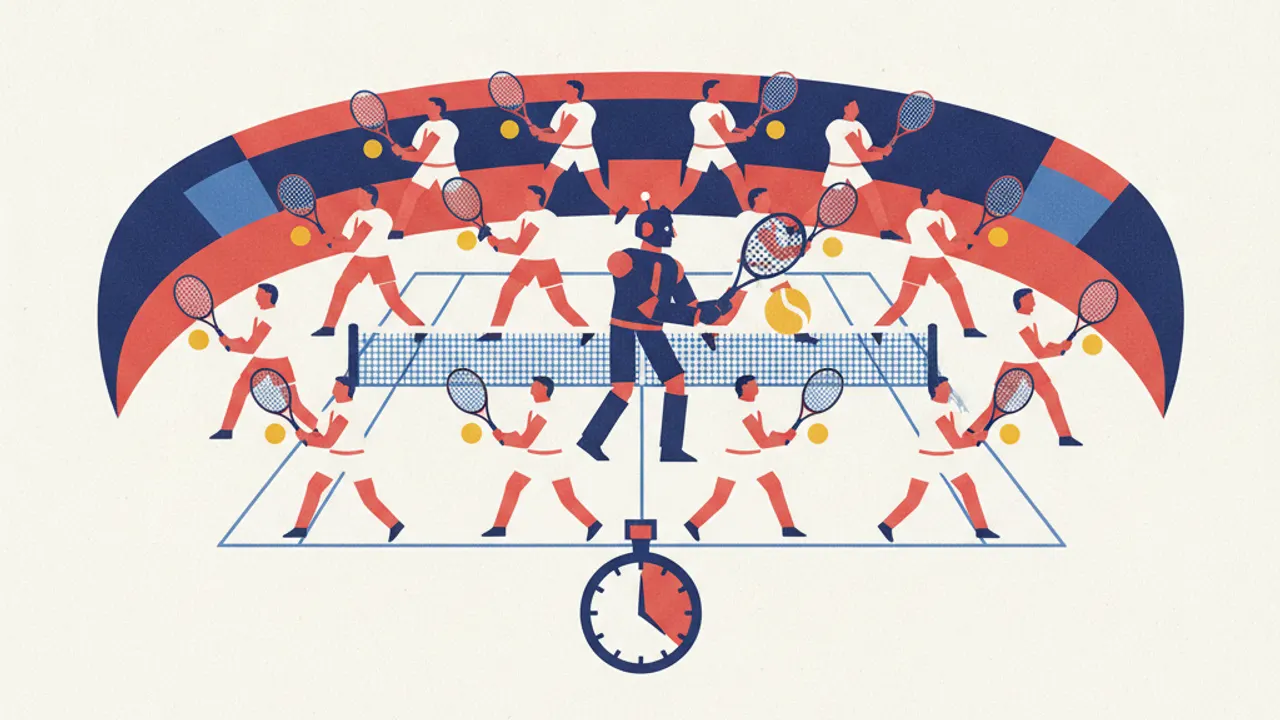
At the opening of the 2nd World Humanoid Robot Games held at the National Speed Skating Oval in Beijing, robotics company Galaxy General Robotics showcased its humanoid robot Galbot ET 1. The machine faced human athletes directly on a regulation tennis court. With this live demonstration, the manufacturer highlighted how deeply the integration of computer vision and physical robotics has progressed in highly dynamic athletic scenarios.
A game of tennis imposes extreme physical and computational challenges on humanoid hardware, demanding split-second trajectory anticipation and precise swing execution. Galbot ET 1 relies on specialized visual processing to calculate incoming ball trajectories within milliseconds. Simultaneously, adaptive reinforcement learning models adjust motor controls and balance in real time, enabling the machine to step rapidly toward the ball.
The underlying software architecture goes beyond basic reactionary movement by making autonomous tactical decisions on the court. The system constantly monitors the opponent's position and calculates optimal stroke angles and shot velocity based on the projected flight path. According to the development team, the framework is designed to handle both singles play and cooperative doubles setups, requiring sophisticated multi-agent spatial coordination.
This exhibition represents a meaningful milestone for embodied artificial intelligence. Earlier humanoid demonstrations have largely focused on structured industrial environments, logistics tasks, or scripted locomotion routines. Navigating a fast-paced racket sport requires relentless, millisecond-level error correction to account for ball spin, unpredictable bounces, and rapid shifts in momentum.
Industry observers anticipate that such platforms will eventually transform elite athletic coaching and sports technology. Advanced humanoid training partners could soon replicate specific shot types with unmatched repeatability, preparing professional athletes for nuanced tactical scenarios. Concurrently, the sensory data generated during high-speed sports rallies provides critical engineering insights for general-purpose robotic navigation and balance control.