
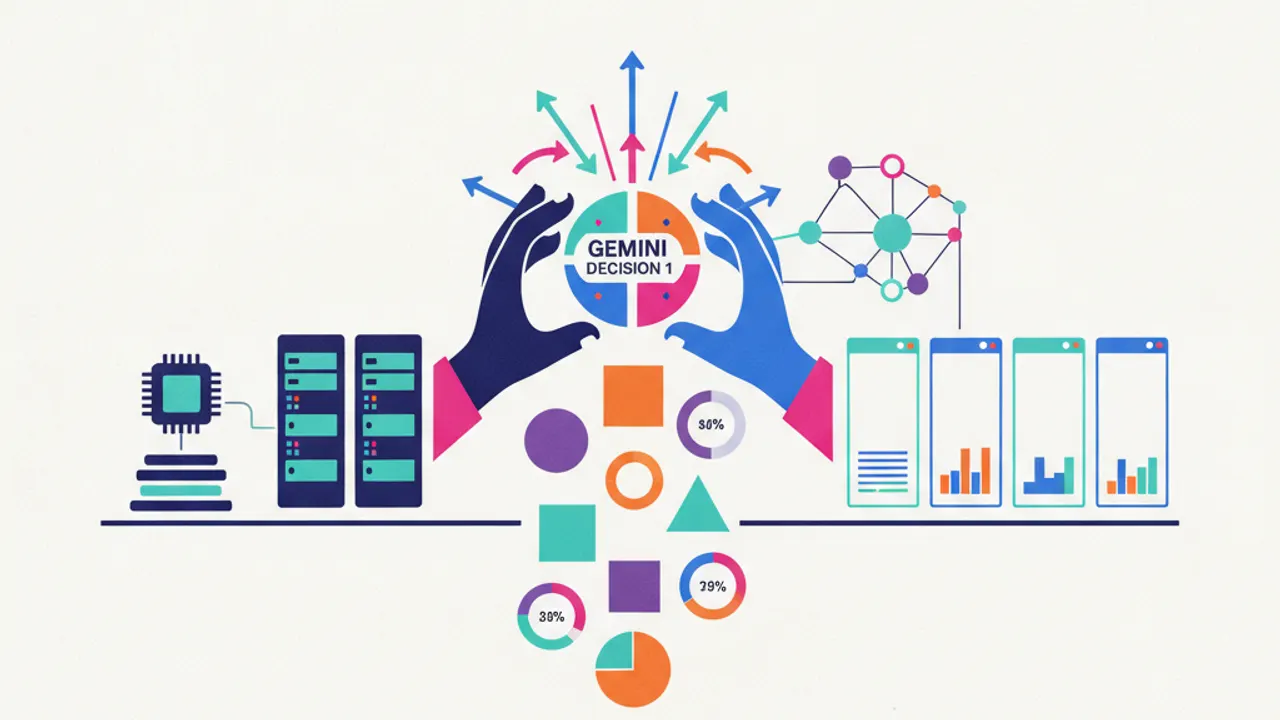
On November 11, 2026, Google DeepMind officially launched the Gemini Decisions API alongside its dedicated model, Gemini Decision 1. The release marks a distinct departure from standard conversational interfaces by intentionally omitting free-form text generation entirely. The model focuses exclusively on delivering calibrated probabilities for structured evaluations and deterministic classifications.
Operationally, the system is designed to generate zero output tokens. Instead of parsing descriptive responses, developers can submit up to 1,000 closed queries within a single API request. The engine supports yes-or-no assessments, so-called noul queries, multiple-choice questions with up to 255 predefined options, and weighted rubric scoring systems.
Despite returning pure probability distributions, Gemini Decision 1 functions as a fully multimodal classifier. It accepts inputs that combine raw text, high-resolution images, video streams, audio files, and complete PDF documents. To accommodate deep enterprise document audits, the architecture maintains an expansive context window of 262,144 tokens, or 256k tokens.
Performance benchmarks emphasize rapid turnaround times alongside aggressive pricing. Decision latency runs between 150 and 250 milliseconds per batch request. Google has set pricing at 0.10 US dollars per million input tokens, while entirely waiving fees for the returned decision payloads.
The launch places DeepMind in direct competition with specialized classification engines across the artificial intelligence sector. Key alternatives in this market segment include TypeSafe's Jev framework and OpenAI's GPT-6 Luna Decision API. Google aims to capture developers who require reliable gating mechanisms without the latency and cost penalties of standard large language models.
For agentic engineering workflows, the architectural shift removes the fragility associated with prompt engineering for output schemas. By eliminating the need to parse markdown blocks or validate loosely formatted JSON strings, the API minimizes hallucination risks during automated routing, moderation, and data classification tasks.