
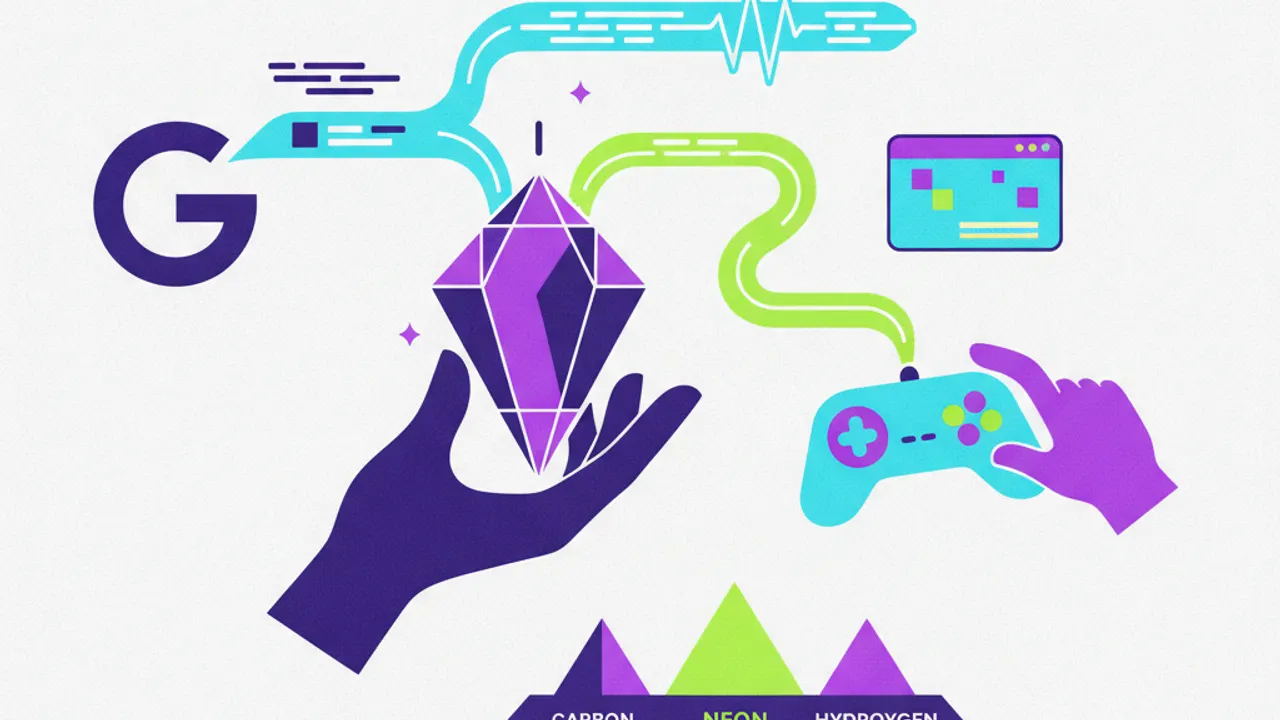
Google DeepMind officially introduced Gemini 4 Neon on November 18, 2026, unveiling a specialized artificial intelligence model focused on agentic coding and autonomous tool execution. The launch addresses an accelerating demand for capable development assistants across software companies and game studios. DeepMind positioned Neon strategically within its model hierarchy, placing it directly between the Carbon variant, designed for maximum performance, and the Hydrogen variant, engineered for high efficiency. Neon aims to strike a practical balance, allowing developers to execute complex programming tasks without incurring the computational overhead associated with Google's flagship model.
Architecturally, Gemini 4 Neon emphasizes the dependable orchestration of external programming tools and developer interfaces. DeepMind specifically trained the model to plan multi-step workflows, execute function calls with minimal error rates, and monitor intermediate runtime outputs. This explicit focus sets Neon apart from conventional large language models that primarily handle code completion. For software engineering teams, this design provides greater reliability during long-running tasks where an agent must continuously coordinate compilers, application programming interfaces, and database queries.
DeepMind highlighted the model's operational capabilities through a live demonstration on its Google Antigravity developer platform. Utilizing the platform's `/swarm` command, Gemini 4 Neon generated and deployed fully functional, interactive two-player games directly inside a standard web browser. The system not only authored the complete underlying code and graphical interface in real time, but also assumed the role of an autonomous second player within the live session. This dual capability demonstrates how modern agent architectures can merge immediate software authoring with real-time interactive gameplay.
The developer community swiftly acknowledged the release, integrating the new model into existing toolchains within hours of its public debut. Software curator Simon Willison promptly delivered version `llm-gemini 0.38` for his open-source plugin ecosystem. This rapid update enabled programmers to interact with Gemini 4 Neon directly via command-line utilities and standardized scripting environments. Such immediate open-source adoption illustrates the velocity with which specialized developer models are now evaluated and integrated into everyday workflows.
Neon's debut arrives amid intense competition surrounding specialized agentic models and browser-based computing. Just one day earlier, on November 17, 2026, competitor OpenAI released GPT-6.2 Sol, pricing the model at two dollars per million input tokens and ten dollars per million output tokens. OpenAI framed Sol primarily as a cost-effective sub-agent manager capable of handling complex web environments, including Three.js 3D generation. DeepMind's Gemini 4 Neon directly joins this competitive landscape, emphasizing collaborative agent swarms and interactive browser runtime environments.
The convergence of Gemini 4 Neon and Google Antigravity indicates a broader shift in how digital experiences and game prototypes are constructed. Rather than writing and debugging browser software through purely manual iterations, development teams can now generate functional test environments on the fly. Engineers gain the ability to explore novel gameplay concepts in direct collaboration with an artificial intelligence that functions simultaneously as a programmer and an interactive tester. This release signals that the next phase of agentic development will increasingly rely on responsive execution layers and coordinated multi-agent swarms.