
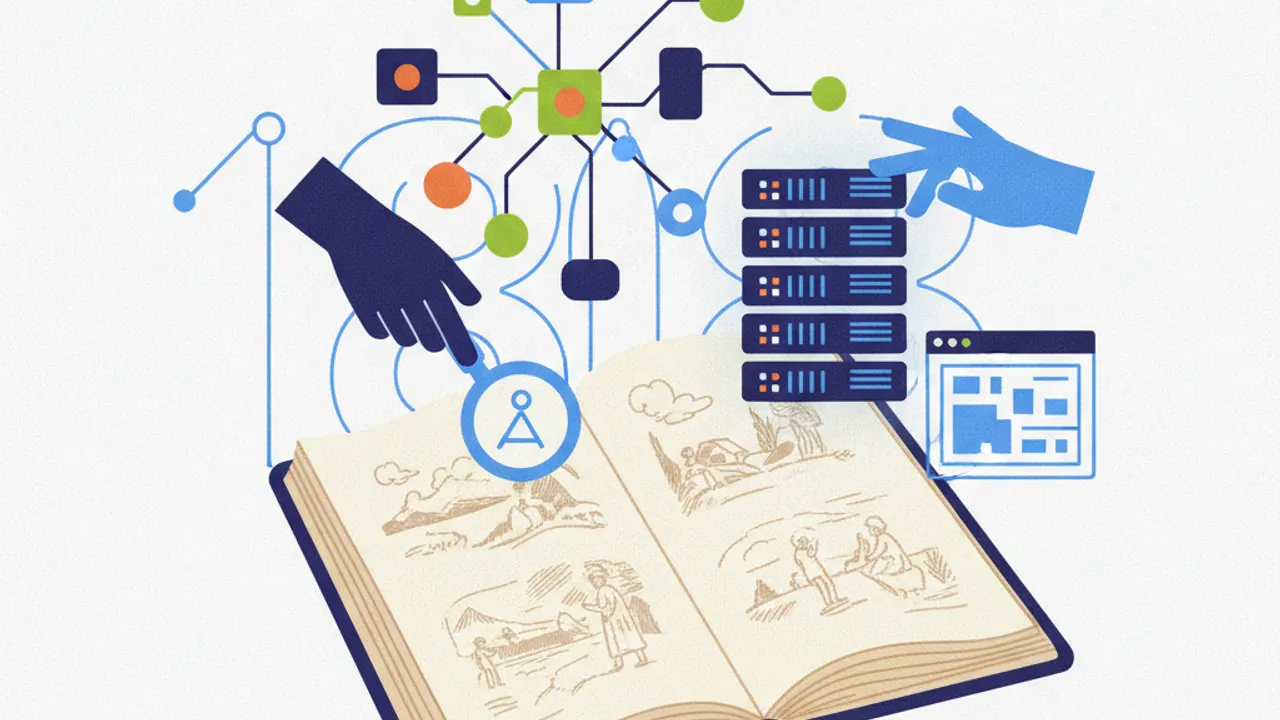
Since 2020, the Beinecke Rare Book and Manuscript Library at Yale University has housed an anonymous 84-page sketchbook dating from 1808. The document captures a journey from Montreal to Fort William, yet historians were long unable to determine the identity of the artist behind the detailed drawings. Traditional archival methods failed to yield a definitive match, leaving the origin of the volume uncertain. Canadian history professor Mark Humphries recently demonstrated how advanced artificial intelligence can break such long-standing archival deadlocks.
Humphries subjected the model GPT-6.2 Astra to an authentic research scenario with minimal prompting to evaluate its autonomous hypothesis generation. The system began by systematically comparing the few dated illustrations in the sketchbook against contemporary historical records. In doing so, the model cross-referenced the entries with diaries from Canadian fur trader Joseph Frobisher, who traveled similar routes during the same era. By filtering potential travel parties, the AI isolated a primary suspect: the French aristocrat and British officer Louis-Guy-Charles-Guillaume de Rohan-Chabot.
To substantiate this suspicion, GPT-6.2 Astra traced a chain of citations across disparate scholarly repositories. The model uncovered a vital clue within a single footnote of a 2014 doctoral dissertation, which referenced Chabot's personal travel journal. This lead directed Humphries to a microfilm collection preserved at Cleveland State University. The AI explicitly predicted that an examination of this archival record would provide conclusive evidence regarding the creator of the Yale sketchbook.
Humphries requested the relevant microfilms and conducted a thorough manual inspection of the physical records. The handwriting in the travel journal matched the annotations in the Yale sketchbook precisely, confirming the model's hypothesis. Furthermore, a specific journal entry dated June 18, 1808 noted that Chabot had paused near Fort St. Joseph to make a landscape sketch. That written description corresponded directly to one of the central drawings preserved in the Beinecke collection.
The entire reasoning process, spanning the initial query to the final citation chain, took the model exactly 22 minutes and 1 second. For archival science and the humanities, the experiment illustrates a shift away from simple keyword search toward autonomous, multi-source hypothesis testing. The model successfully connected fragmented primary records, secondary literature and obscure citations. This capability demonstrates how machine reasoning can assist scholars in synthesizing dispersed historical evidence.
The findings simultaneously emphasize the continued importance of human expertise in archival validation. Humphries' physical verification of the microfilms was essential to confirm the identity beyond doubt. The AI handled the arduous preliminary legwork, synthesizing connections that might otherwise have demanded months or years of manual scrutiny. Research libraries and academic institutions now have a viable pathway to unlock extensive collections of uncataloged or anonymous historical material.